

Families of missing people in Mexico challenge World Cup siege hours before the opening
A peaceful march brought together thousands of people in Mexico City to make visible the situation facing the country with more than 133,000 missing
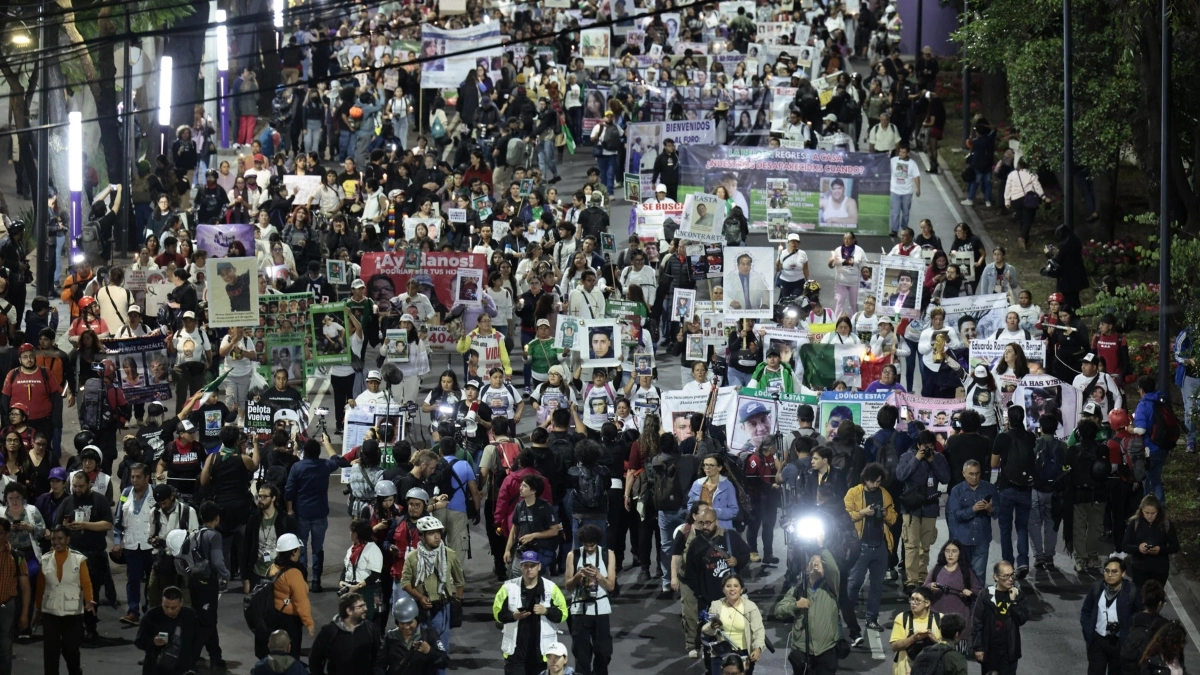

Thousands of protesters were contained this Wednesday night by a strong police operation when they tried to advance towards the Mexico City Stadium, where the opening of the 2026 World Cup will be held in a few hours, seeking to make visible the situation facing the country with more than 133,000 missing people.
The groups wanted to take the crisis of disappearances to the main stage of the tournament in Mexico, but the security device deployed in the surroundings prevented them from reaching the stadium and forced them to carry out an act of memory in front of the security fences that protect the arrival to the building.
Even so, their claims were heard loudly during a peaceful march that brought together thousands of people in the south of the capital.
“Mexico champion in disappearance” and “Because they took them alive, we want them alive,” could be heard among the slogans.
Coming from different states of the country, the families carried elements alluding to the World Cup, such as Mexican national team shirts with the faces of their missing loved ones or figures such as the FIFA trophy. Between the canvases, it read: “The ball is coming home…Our missing people when?”
“We want the world to know that we have many missing people and resources are invested in other things and the cases of our missing people are not resolved,” Ana Lucía Gasca, mother of Ricardo Arturo Lagunes Gasca, who has been missing since 2023, told EFE.
A few steps away, Tranquilina Hernández, mother of Mireya Montiel Hernández, missing since 2014, agreed on the lack of resources to attend to the searches, in contrast to what was invested in the World Cup party.
“You cannot cover the sun with a finger by bringing a World Cup when there is no budget for the search for our loved ones,” he reproached, prior to the march.
After advancing through several streets, the families met a group of officials, among them, the secretary of the government of Mexico City, Cesar Cravioto, who tried to talk with them to stop their advance towards the stadium.
“Today the State shows us that it does have the police to find the missing, but it decides to protect foreigners,” searcher mother Jaqueline Palmeros said into the megaphone.
A few steps ahead, the protesters ran into a strong police cordon with trucks and thousands of officers lined up to block access.
“I think we have every right to express all our frustration, so much pain and so much anguish that we have,” said Hernández.
Some relatives began to jump over the fence and go over the trucks, while shouting: “Repressive state,” among other demands.
But after a few minutes, they got off the trucks and held the evening they had before at the gates of the stadium, but now in front of the police force.
Currently, Mexico exceeds 133,000 missing people, according to data from the National Registry of Missing and Unlocated Persons (RNPDNO), which counts disappearances since the 1950s.
Given this, the UN Committee against Forced Disappearances (CED) seeks to bring the crisis of disappearances in Mexico to the General Assembly, considering them “crimes against humanity”, which has been repeatedly rejected by the government.