

Scandal at the World Cup! Argentina challenges FIFA after eliminating England and risks a very harsh sanction
The Argentine players, emboldened by the victory, challenged FIFA by finally displaying a banner of the Falklands conflict with the English.
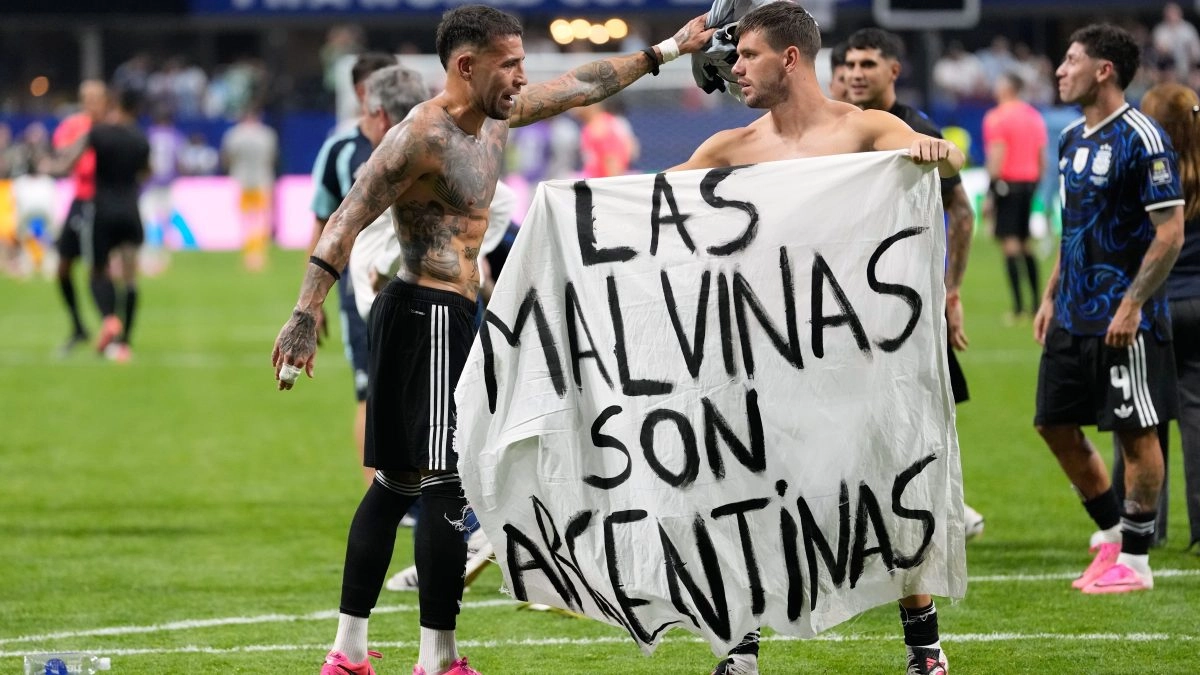

The Argentina team defied the strict provisions of FIFA. The highest football body had ordered both the Albiceleste and England to refrain from making public demonstrations about the conflict over the Malvinas Islands, reactivated in the narrative after more than four decades.
However, Argentine soccer players ignored the prohibition that bans messages of a political, religious or warlike nature before, during and after matches.
At the end of the match where Argentina beat England 2-1 to advance to the grand final of the 2026 World Cup, controversy broke out. The albicelestes players, led by Giovani Lo Celso and Nicolás Otamendi, displayed a banner with the legend: “The Malvinas are Argentine.” The gesture immediately generated countless global reactions.
The ghost of a historic sanction
As a matter of principle, the FIFA Disciplinary Committee could open an investigation ex officio. This process would result in a heavy financial fine for the Argentine Football Association (AFA), accompanied by a severe warning: repeating acts of this nature could lead to sporting punishments, such as loss of points or suspensions.
Both federations knew perfectly well that the issue was under scrutiny. This rivalry has marked the official and friendly duels since the 1982 World Cup in Spain, the year in which the war broke out in the archipelago, which lasted for 74 days and concluded with the Argentine surrender on June 14 of that year.
The tension in this 2026 edition was maximum. Just 24 hours before the opening whistle, security authorities warned that the entry of flags, t-shirts or banners alluding to the Malvinas was strictly prohibited into the stadium.
Maradona's antecedent in Mexico 1986
The emotional charge of this clash inevitably evokes the 1986 World Cup in Mexico. On that occasion, Diego Armando Maradona transformed the quarterfinal match against the English into a personal cause. His historic double (the 2-1 sealed with the mythical “Hand of God” and the Goal of the Century) was dedicated by the Argentine star to the soldiers who fell in combat against the British troops.
Due to the high risk of the match in 2026, FIFA and the United States authorities tightened control measures. Although it was analyzed to completely separate both fans from the sale of tickets, the logistics of the tickets prevented it.
For this reason, the authorities of the city of Atlanta, Georgia, implemented differentiated access: Argentine fans entered through door 4 and English fans through door 3, confiscating any clothing with political references in the filters. However, the strict fence failed on the field and came from the protagonists themselves.
The controversial precedents analyzed by FIFA
The international organization has already dealt with similar crises. At the 2018 World Cup in Russia, the Swiss Granit Xhaka and Xherdan Shaqiri celebrated their goals against Serbia by making the gesture of the double-headed eagle (symbol of the Albanian flag), in a clear reference to the Kosovo conflict. On that occasion, Serbia protested and FIFA resolved the case with a fine of 10,000 Swiss francs for the players, without suspending them.
The case of the Argentine banner is not the only one under investigation in this tournament. Hours earlier, Egypt's technical director, Hossam Hassan, celebrated Australia's elimination by entering the field with a Palestinian flag to dedicate the victory.
It is expected that in the next few hours FIFA will issue an official statement and determine the punishments for both the Argentine delegation and the Egyptian strategist.