

CAPTCHA: the truth behind the annoying “I'm not a robot” tests
CAPTCHAs don't just stop bots. Discover how they really work, why they appear on so many websites and what Google does with your answers
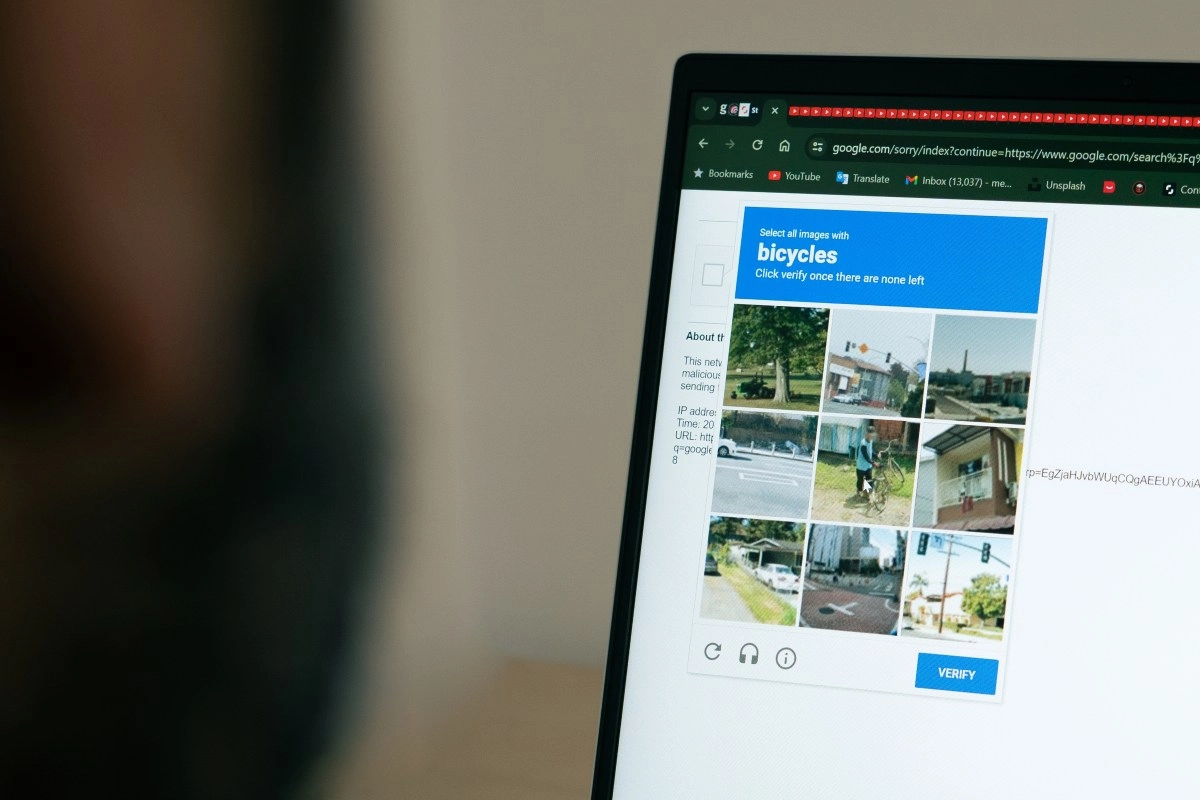

You've spent years solving blurry traffic lights, stairs, and buses to show the internet that you're a person. But here's something that probably no one told you: those annoying tests known as CAPTCHAs don't just protect websites from automated attacks. For more than a decade, they were also training artificial intelligence without asking your permission.
What is a CAPTCHA?
The term CAPTCHA is an acronym in English that roughly means “public, fully automated Turing test to distinguish between computers and humans.” It was born in the late 90s, when computer scientist Mark D. Lillibridge was looking for a solution to combat spam in online forums.
The logic is simple. With the massification of the Internet, programmers discovered that they could create bots to automatically browse sites, extract emails, send spam, or even launch DDoS attacks by flooding servers with fake requests. CAPTCHAs were the developers' response, putting up a barrier that humans could easily overcome but bots could not.
Early systems displayed distorted and blurred text that had to be transcribed. They worked fine until optical character recognition (OCR) technology improved so much that bots started solving them without a problem.
Why so many websites use them, beyond basic security
The underlying reason is economic and operational. Without some type of verification, any form, registration or comment box on a website is exposed to mass automation.
This translates into specific problems:
Simply put, CAPTCHAs are not a whim of web designers. They are a first line of defense against traffic that, according to cybersecurity industry data, can represent more than 40% of all requests a site receives. Google evolved its version, reCAPTCHA, into a variant that analyzes user behavior (cursor movement, time on page, clicks) to assign a suspicion score from 0.0 to 1.0 without interrupting your browsing.fortinet 1
The secret that Google did not publicize, you trained its AI without knowing it
Here comes what many do not know. When Google acquired reCAPTCHA, the system evolved from text to images. And those images had a dual purpose.
By asking you to identify traffic lights, cars or traffic signs, Google knew part of the answer but used your selections to label data and train its artificial intelligence models, including the vision systems of its self-driving company, Waymo. According to recent research, this occurred over approximately 15 years, directly contributing to Waymo's valuation of $45 billion.
It is not a technical scandal in the legal sense, but it is an ethical gray area. You were working for free as a data labeler without anyone explicitly telling you. Today, reCAPTCHA v3 no longer needs you to do that because it analyzes your behavior in real time and can detect bots invisibly.
Why does the CAPTCHA ask you to identify images of traffic lights or cars? These images are visual challenges that humans solve intuitively but that are difficult for bots. Additionally, in the case of Google's reCAPTCHA, those responses were used for years to train computer vision systems, including those for autonomous vehicles.
Are CAPTCHAs 100% effective against bots? No. They are a deterrent barrier, not a definitive solution. The key is not to create impossible tests, but to discourage most automated attacks that use basic programs. The most advanced bots, with AI support, can already solve many types of CAPTCHAs.
Is there already an alternative to traditional CAPTCHAs? Yes. Google's reCAPTCHA v3 analyzes user behavior without showing any visible challenges. There are also solutions like Cloudflare Turnstile, which check in the background using multiple device signals and browsing context.
The next time you see that “I'm not a robot” box, you know exactly what's behind it. And if you've ever identified a traffic light in a blurry image, well, technically you were already part of the development team for a self-driving car.