

From where did the idea that a small city in Colorado is the ground zero come from? of the Aragua Train in the US.
In August of last year, a video went viral in Aurora, showing six armed individuals forcibly entering an apartment
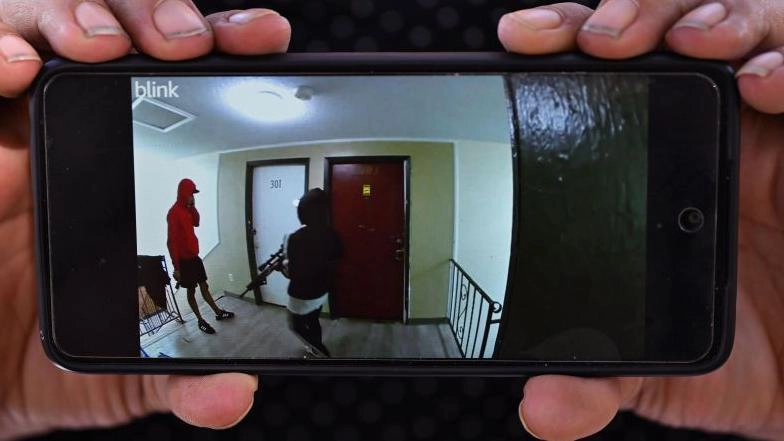

Cindy Romero has gradually increased the security measures in her home over the last year and a half.
She started by securing the door with several locks, installed cameras and armed herself.
“I was always lower class and I’ve lived in some pretty shady places, but nothing comparable to the blatant criminality in these apartments,” she tells BBC Mundo, referring to Edge at Lowry, six red brick blocks located in Aurora, an impoverished suburb of Denver, Colorado (USA).
She had been complaining to the police for months about the constant noise, broken glass and forced doors, garbage piling up in the yard, parties that lasted until dawn, drug sales in the back alley, the fights.
But what happened on August 18, 2024 reached another level, says this 52-year-old woman with gray hair.
Around 11:15 p.m., sitting with her husband in the living room, Romero was checking the images from one of the security cameras at her door on her phone when she saw some subjects.
Some were wielding assault rifles and pistols, others were talking on their cell phones, and, all with their faces uncovered, they broke into the apartment across the street, number 301, and shortly after disappeared downstairs.
A few minutes later they heard shouts in Spanish in the street” Shut up” followed by shots from weapons of six different calibers.
That would end with the death of his neighbor, Oswaldo Jose Dabion Araujo, a 25-year-old Venezuelan, although Romero was still unaware of this.
And much less that his city would earn the label of “ground zero” in the US for the Aragua Train, an organization born in a Venezuelan prison that expanded across the American continent.
But how did we come up with that idea? And what do the narrative and the intersecting interests that built it reveal about the real presence of the Venezuelan gang?
The last to arrive in a diverse city
“In Aurora, all the ingredients came together; it was a perfect breeding ground, a time bomb,” Venezuelan Jesús Meleán tells BBC Mundo. He has lived in the area for years and, as editor of the local outlet El Comercio de Colorado, has covered the issue in detail.
“All the conditions were in place for criminal elements to exploit a vulnerable population and for that to fuel a political agenda. A shame, really, in an open and historically diverse city like this one.”
With its 400,000 inhabitants, Aurora is a community where minorities are the majority.
According to the most recent municipal socioeconomic report (2022), in the last five years the population that identifies solely as white has decreased by 5%, while 30% identify as Latino, 17% as African American, and 7% of Asian ethnic origin.
One-fifth of the municipality's inhabitants were born in another country, a percentage that has been increasing in recent decades. The report identifies 58 nations of origin, with Mexico being the most common, although there are also residents born in Ethiopia, El Salvador, Vietnam, South Korea, or India.
Furthermore, 33% of residents speak a language other than English at home, Spanish in 20% of cases, and 14 languages ??coexist in the municipality's schools.
In the last two and a half years, some of the 43,000 residents from Venezuela established in the Denver metropolitan area have been added to this plurality.
The peak of this immigration was recorded in December 2023, with hundreds of Venezuelans arriving in the area every day.
Many did so directly from the border with Mexico, in buses chartered by the governor of Texas, Republican Greg Abbott, with the aim of pressuring this and other "sanctuary cities," those with regulations that protect their municipal authorities from collaborating with federal authorities on immigration matters.
The Denver mayor's office, in the hands of the Democrats, adapted a series of hotels and allocated resources to house them. When these became saturated, with public aid in between and some organizations as intermediaries, the migrants settled in apartments.
Many found a new home in Aurora, bordering Denver but with a lower average income and, therefore, cheaper housing options.
Thus, they ended up in the Edge at Lowry blocks,as Cindy Romero's neighbors, or just blocks away, in the Fitzsimons Place apartments or the Whispering Pines apartments, all operated by CBZ Management, a company with a history of negligence.
Negligence, Crime, and the Making of a Story
Since May 2023, Aurora city officials had been trying to force CBZ to fix the three dilapidated apartment complexes in the depressed East Colfax corridor, which connects Denver and Aurora.
Although inspection records dating back to 2020 — years before the arrival of Venezuelan migrants — already attest to rat infestations and deteriorating walls and ceilings in the homes.
In March 2024, some of the Tenants sent local media videos and photos of leaking walls, flooded rooms, pieces of the ceiling falling off, and trash piling up in the hallways.
“I’ve been reporting mold to management since the week I got here,” Alyssa Alva, who has a 10-month-old daughter, told Denver7.
In July, the landlord offered a new explanation for why he couldn’t repair the buildings: Venezuelan gang members had taken over, forcing managers to flee.
That month, a shooting at the Fitzsimons Place apartments left two people injured. Police arrested Jhonnarty Dejesus Pacheco-Chirinos, 24, and Jhonardy José Pacheco-Chirinos, 22, two Venezuelan brothers who, according to local press, “had the neighborhood terrorized.” Arrest affidavits obtained in the following weeks by The Denver Gazette would reveal that police suspected them of belonging to the Tren de Aragua, also known as TdA in the US. Aurora Mayor Mike Coffman, a Republican, and Councilwoman Dannielle Jurinsky repeated CBZ’s unverified claim in media interviews. “We have areas in our city that have unfortunately been taken over, and we need to take them back,” Coffman told a radio host.
Though the two later tried to tone things down with a joint statement — “the exaggerated claims fueled by social media and certain outlets are simply not true” — the damage had been done.
Emily Goodman of the East Colfax Community Collective, a group that offers housing advice and assistance, called the Aurora case “a textbook example” of scapegoating.
“I’m not saying there’s no crime in the area. There definitely is,But I don't think using newcomers as a scapegoat for buildings that have been in a deplorable state for years is an accurate representation of why things were happening the way they were," he emphasizes.
The apartments in question were condemned and their neighbors evicted. The Colorado attorney general's office then confirmed that it was investigating CBZ Management, citing regulation violations.
BBC Mundo tried unsuccessfully to contact the company, which reported on its social media that, with the litigation ongoing, it would not comment or offer interviews.
"In an attempt to discredit this event for political purposes and avoid government accountability, some have spread false information about our situation," reads a X thread in which CBZ explains his version of what happened.
A protest over the elections in Venezuela
Newly designated a “transnational criminal organization” by the Treasury Department under the Joe Biden administration —upon replacing him at the White House, Trump would double the bet, naming it a “transnational terrorist organization”—a series of incidents suggest that local and state authorities were already aware of the possible presence of the Tren de Aragua in the area before the shooting at the Aurora apartments.
The shooting, which occurred on July 28 and was not given excessive media coverage, nevertheless coincided with another event that, according to editor Jesús Meleán, marked a turning point inflection in this whole story.
Something that added fuel to the fire and helped reinforce the idea, which was already taking shape in the minds of certain politicians and residents, that with Venezuelan immigration, TdA members had arrived in the area.
On the occasion of the presidential elections in Venezuela in July 2024, members of the community began to gather in the parking lot of a shopping center, to celebrate what they anticipated would be a resounding defeat of Nicolás Maduro. They numbered between 3,000 and 4,000, according to authorities' estimates.
At the stroke of midnight, when Maduro declared himself the winner, they honked their horns in sign of protest, began to obstruct traffic and there were even reports of shots being fired in the air.
Dozens of messages echoing the event flooded social media, including one from Councilwoman Jurinsky warning that a crowd had "taken over" a part of the city.
"The November elections may be the most important of your lives, your children's lives, your grandchildren's lives. Again, everyone deserves the truth!" she wrote.
In the months remaining until the presidential elections in the United States,Aurora was increasingly gaining attention.
The viral video, Trump and the TdA's "command and control"
When asked if she knew the six armed men who were recorded by the security camera at her door, Cindy Romero doesn't hesitate.
"They were illegal immigrants who had arrived with the last wave," she exclaims, referring to Venezuelan immigration. “I knew they were involved in some kind of criminal activity, but not that they were part of a transnational gang,” she admits.
The latter, which police investigations to this day have not established, was reportedly told to her by Councilwoman Jurinsky, after having helped her move to another apartment dozens of kilometers away.
“Aurora has a huge gang problem,” Jurinsky would claim after Romero’s video went viral, after she sent it to a Fox 31 reporter. The city government and the city’s police department continue to deny that this is true to this day.
Trump, then in the midst of his race for the U.S. presidency, was quick to seize on the incident at the small Colorado city to reinforce his rhetoric of "more immigration, more crime."
The current candidate mentioned it when facing Democrat Kamala Harris in the September debate. "We are going to carry out the largest deportation in the history of our country," he said that same month at a press conference at his golf club in Los Angeles. "And we will start with Springfield — a town in Ohio where, according to the current president, migrants were eating the local population's dogs and cats — and Aurora."
In October, during a campaign event in the city, the Republican christened his campaign of mass expulsions Operation Aurora. He also described the town as a "war zone," while Mayor Coffman insisted that the incidents were "isolated" and the reports "exaggerated."
The reactions of local authorities and law enforcement representatives were joined by statements from politicians and activists of different stripes and from inside and outside the state, some stirring the immigration-crime cocktail, others denouncing a "disinformation campaign."
Trump would win the elections in November, and from his first day in the Oval Office would begin to promote his anti-immigration agenda.
In mid-March, he invoked the Alien Enemies Act of 1789 to expel Venezuelan migrants allegedly linked to the Railroad of Aragua.
Meanwhile, on a visit to Colorado, the then acting head of the Drug Enforcement Administration (DEA), Derek Maltz,He claimed that TdA's "command and control center" was located precisely in the state.
He called it "ground zero for some of the most violent criminals" in the country, something that experts consulted by BBC Mundo doubt.
A change in strategy
"I feel very hurt by the community here and by how everything has been handled," confesses Shannon Peterson when BBC Mundo visits the neighborhood where the Edge at Lowry complex is located almost a year after the video recorded there went viral.
She says this as we walk around the block from her house to the six buildings that, after being closed in February, look bleak today, with boarded-up windows and surrounded by a fence adorned with signs that warn in red: "No trespass.”
“The whole situation was handled horribly, and whose fault was it? Trump’s, who was simply behaving like Trump? Or those so desperate to oppose him that they defied reason and put others at risk?” this American, an English as a foreign language teacher married to a Mexican, asks rhetorically.
Tired of the insecurity and of the fact that representatives on both the city council and the state legislature ignored her calls,” she says, “she organized a neighborhood patrol to better understand the situation, raise awareness through talks, and put pressure on people.”
“I knew that I had to do something, and I also knew I couldn't do it alone," she admits.
It was door to door, and that's how she met Olga, who lives just a few meters from the infamous buildings.
At that time, this Guatemalan woman with US citizenship who has been in the country for three decades was trying to sell the house she shares with her husband and children.
"But the months went by and no one wanted it," she laments, while asking that her real name and details that could lead to her identification not be omitted, for fear of retaliation.
Both say they now feel more relieved, not only because of the closure of the complex, but also because of the change in how violent incidents are managed – and reported – since the Department of Aurora Police have a permanent figure at the helm. It's an opinion shared by most of those interviewed by BBC Mundo for this report.
Todd Chamberlain replaced Heather Morris, who had been serving on an interim basis, as police chief in September. He is the sixth person in the position in five years.
On June 9, when nine armed men were caught on security camera wreaking havoc at another residential complex in Aurora, Chamberlain responded with a press conference. "This may sound like déjà vu.We are addressing it actively, effectively, and immediately,” he assured the media.
The Aurora Police Department declined BBC Mundo’s interview request, as did the mayor’s office.
In a statement attributed to its spokesperson Jennifer Soules, the city government reiterated that “neither the TdA nor any other entity or criminal group has taken control of the entire city.”
“The Aurora Police Department, in partnership with local, state, and federal law enforcement agencies, confirmed that select individuals with connections to the Tren de Aragua appeared to be targeting other Venezuelan migrants at three apartment complexes within a two-mile radius,” the statement reads.
It also assures that crime was reduced by 20% in 2025 with compared to the previous year, continuing a trend that was already downward.
And he concludes: “The complete and accurate story of Aurora is one where public safety is a top priority and the city is making significant progress year after year in protecting its residents.”
But then, what is the real presence of the Tren de Aragua in Aurora and the Denver metro area?
Raids and arrests
In early February, dozens of federal agents, wearing tactical gear and carrying smoke grenades, raided several properties in the Denver metro area.
“We are here today looking for members of the Tren de Aragua, for gang members from Venezuela,” he explained in a video posted in X Caleb Vitello, the then acting director of US Immigration and Customs Enforcement (ICE).
BBC Mundo asked ICE about the number of arrests and how many of them are considered affiliated with TdA in that area of Colorado. The agency responded that it cannot provide broken down information and that the publicly available statistics have not been updated since January.
When asked the same question, the Department of Homeland Security (DHS) only referred, in general, to more than 273,000 arrests and the deportation of 239,000 "illegal aliens" as of June 30.
However, at a press conference in late June, Attorney General Pam Bondi announced that 2,711 TdA members had been arrested nationwide by that date.
“I think everyone in this room agrees that this is one of the most violent organizations in the world,” she said, boasting of “significant progress in the operation to dismantle it.”
However, not everyone is convinced.
Tim Macdonald,The legal director of the Colorado branch of the American Civil Liberties Union (ACLU) believes the mass raids in the state are in response to “Trump’s false narrative about a city taken over by the gang.”
The ACLU is legally representing some of those detained.
“And in the cases in which we’ve been involved, we know that the accusations are absolutely frivolous and weak, that the Trump administration and ICE officials have tormented them with accusations that they are members of Tren de Aragua based on something that would never hold up in court and that has no basis in fact,” says Macdonald.
Among his clients are some of the 252 Venezuelans whom the Trump administration deported to El Salvador and who were held for four months in the Cecot maximum security prison before being repatriated to their country on July 18, in an exchange agreed between Washington, Caracas and San Salvador.
But then, what truth is there in the assertion of the former head of the DEA that Aurora is —or was— the “ground zero” of TdA in the US?
The epicenter of TdA in the US?
"We have certainly seen elements of leadership on the ground in Colorado, and that is because the state has been one of the main destinations for Venezuelan migrants in the US," David Olesky, special agent in charge of the DEA's Rocky Mountain Field Division, tells BBC Mundo.
Although he warns of the difficulty of distinguishing whether These are original members of the band or associates. “Sometimes it represents a challenge, because it is not that the gang members have a credential that accredits them as part of one gang or another,” he explains.
“The important thing is to investigate what illegal conduct they are involved in and identify the networks, and that is our focus,” he adds.
The DEA is part of the joint task force made up of local, state and federal agencies to combat TdA in Aurora since August 2024.
The Federal Bureau of Investigation (FBI), which is also participating in the effort, declined BBC Mundo’s interview request.
Daniel Brunner, a retired FBI special agent and expert in criminal organizations who did agree to speak with this media, categorically denies that the epicenter of the criminal organization in the US is in this city of Colorado.
The now researcher and security consultant, who believes that the Aragua Train is present in at least twenty states in the country, doubts that it even has a "ground zero."
"The TdA entered the U.S. so quickly that they were unable to establish a clear command and control like, for example, the (Salvadoran gang) MS-13,that has a well-defined structure, with program leaders, cliques (cells), because it emerged in the 80s,” he explains.
The Tren de Aragua has only been in the North American country for three years, Brunner agrees with other specialists, and estimates that it would have between 500 and 700 “original members” there.
“Although they are recruiting young people and there are another 2,000 people who say they belong to the gang, when in reality they don’t,” he emphasizes.
To understand the dimension of the phenomenon and the level of threat it poses in United States territory, Brunner insists that it is necessary to carry out investigations within the framework of the Civil Racketeering, Influence and Corrupt Organizations Act.
This law, better known as RICO for Its acronym in English, allows organizations and their members to be prosecuted as organized crime and terrorism charges to be filed against their leaders.
"But that takes a long time, even years, and the Trump administration wants quick results," she concludes.
Cindy Romero saw her situation resolved, in part,. She says she lives much more peacefully in her new apartment on the other side of the city, although her family continues to live in Aurora.
When Trump arrived in the city for a political rally on October 11, he invited the woman on stage and applauded her courage.
"For Cindy, the radical left can no longer say it never happened," proclaimed the still-candidate.
“Sometimes people ask me if I don't feel like Trump used me,” Romero told BBC Mundo today.