

The desperate situation of a Palestinian photojournalist in the midst of the famine affecting Gaza
The Society of Journalists of the Agence France-Presse warned that if there is no
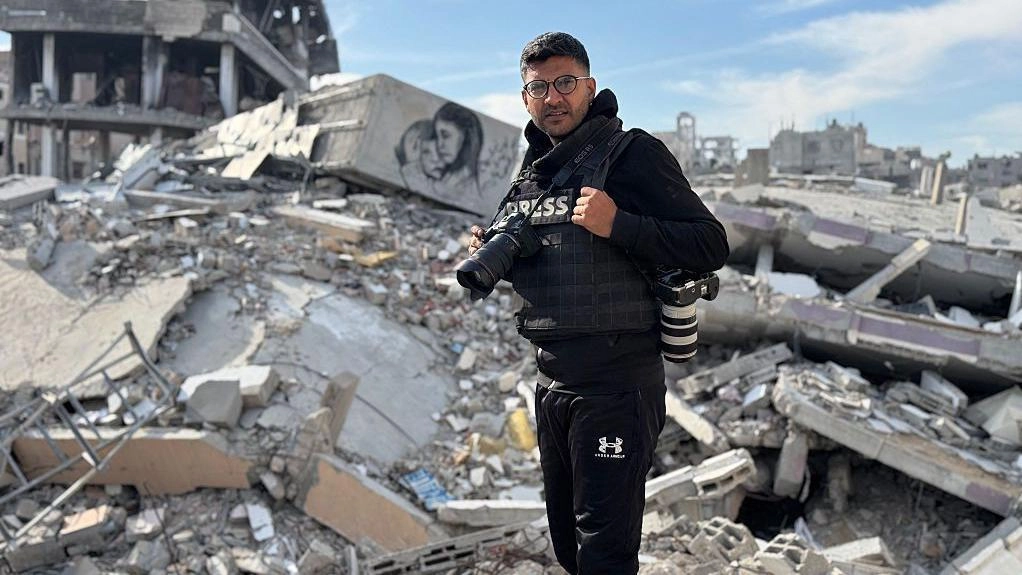

Bashar Taleb portrayed the impact of the Israeli offensive in the Gaza Strip until hunger took over. He reached it.
On Saturday, July 19, the Palestinian photojournalist posted a message on his Facebook account that read: "I no longer have the strength to work in the media. I am thin and I can no longer work."
Taleb, 30, has photographed victims of hunger and violence in Gaza for the international news agency France-Presse (AFP), whose journalists published a statement on Monday, July 21, warning that if there is no "immediate intervention, the last reporters in Gaza will die."
"Since AFP was founded in August 1944, we have lost journalists in conflicts, we have had wounded and prisoners in our ranks, but none of us remembers having seen a comrade die of hunger," the statement said. The Society of Journalists of the French news agency.
This call is part of a global alert. Two days later, on Wednesday, July 23, more than 100 humanitarian organizations, including Save the Children, Oxfam, and Doctors Without Borders, issued a statement denouncing a "massive famine" in Gaza. However, Israeli authorities argue that they are facilitating the entry of humanitarian aid and are acting in accordance with international law. A brother who died of hunger Taleb has been working for AFP since 2010. He has been a contributor, a freelance photographer, and, since 2024, a senior photographer. "He has lived in absolute poverty and works at enormous risk to his life," warns the statement from the journalists of the AFP.
“Hygiene is a major problem for him, with periods of severe intestinal illnesses.”
His colleagues reported that the Palestinian photographer “has been living since February in the ruins of his house in Gaza City with his mother, his four brothers and the family of one of them.”
“Their home is devoid of any comfort except for a few cushions. On Sunday morning, he reported that his older brother ‘had died of hunger.’”
“We refuse to watch them die”
The journalists explained that while Taleb and other contributors receive a monthly salary from AFP, “there is nothing to buy, or the prices are completely exorbitant.”
“The banking system has disappeared and those who exchange money between online bank accounts and cash charge a commission of almost 40%.”
“We refuse to watch them die,” the note adds regarding the contributors. “We risk learning of their deaths at any moment, and this is unbearable.”
The agency's employees specified that Taleb, along with a few other colleagues, are the only ones reporting on what is happening in the Gaza Strip.
“The international press has been banned from entering the territory for almost two years.”
On Sunday, July 20, Taleb wrote: “For the first time, I feel defeated.”
“I wish Mr. Macron could help me get out of this hell,” he said, referring to the French president.
“I don't know if I will come back alive.”
The statement from the AFP Society of Journalists also tells the story of Ahlam, another contributor who lives in the southern Gaza Strip.
“Every time I leave the tent to cover an event, conduct an interview, or report on a story, I don't know if I'll come back alive,” the statement warns.
Alham says the biggest problem is the lack of food and water.
“We see how their situation is worsening. They are young and their strength is failing them. Most of them no longer have the physical capacity to move around the enclave and do their work.”
“Their heartbreaking cries for help are now daily.”
“Will I eat today?”
Like the AFP journalists, the humanitarian aid organizations that raised the alarm about the famine in Gaza emphasized the consequences that the conflict is having on their workers.
“While Mass starvation is spreading across Gaza, the bodies of our colleagues and those we serve are wasting away,” the document states.
“Every morning, the same question echoes across Gaza: Will I eat today?” it adds.
“Children tell their parents they want to go to heaven, because at least in heaven there is food,” said one aid worker providing psychosocial support, speaking of the devastating impact on children.
“Palestinians are caught in a vicious cycle of hope and anguish, waiting for assistance and ceasefires,only to find that conditions are worsening,” the statement said.
“It is not just physical torment, but also psychological torment. They are presented with survival as a mirage.”
International Pressure
The UN said Israeli forces have killed more than 1,000 Palestinians trying to obtain food aid since the Gaza Humanitarian Fund, a controversial US- and Israeli-backed entity, began operations in late May, replacing a broader UN-coordinated humanitarian response.
Israel is facing mounting international pressure over the catastrophic humanitarian situation in the Palestinian territory.
More than two million people are suffering from severe shortages of food and other essential subsistence items after 21 months of the current Israeli offensive.
The organizations’ letter states that permitted aid distributions in Gaza “has an average of just 28 trucks a day.”
The UN has previously suggested that a minimum of 600 trucks a day is required to feed a population of two million.
The organizations claim that Israel has denied access to “tons” of crucial supplies and accuse it of false promises about its plans to increase aid “when there is no real change on the ground.”
On Tuesday, the Israeli military body responsible for coordinating aid deliveries, Cogat, insisted that Israel acts in accordance with international law, stating that it facilitates the entry of aid, while ensuring that it does not reach Hamas.
Israeli military spokesman, Lt. Col. Nadav Shoshani, posted on X that 950 trucks of aid “are currently waiting in Gaza for organizations international authorities to collect and distribute them to the Gazan civilian population.”
“This comes after Israel facilitated the entry of aid into Gaza,” he added.
The casualties
According to the UN, approximately 87.8% of the Gaza Strip is now under Israeli evacuation orders or is within Israeli militarized zones, leaving the 2.1 million inhabitants crammed into some 46 km² of territory.
Israel launched a military campaign in Gaza in response to Hamas’s cross-border attack on October 7, 2023, which killed some 1,200 people and 251 were taken hostage, according to Israeli authorities.
Since then, at least 59,029 people have been killed in Israeli attacks, including more than 17,000 children, and 142,000 others have been injured, according to the Hamas-controlled Gaza Health Ministry.
Click here to read more stories from BBC News Mundo.
Subscribe here to our new newsletter to receive a selection of our best content of the week every Friday.
You can also follow us on YouTube, Instagram, TikTok, X, Facebook and our new WhatsApp channel.
And remember that you can receive notifications in our app. Download the latest version and activate them.