

Who are the prisoners released in the exchange between the US and Venezuela
With the mediation of President Nayib Bukele, the US governments carried out an unprecedented exchange of prisoners
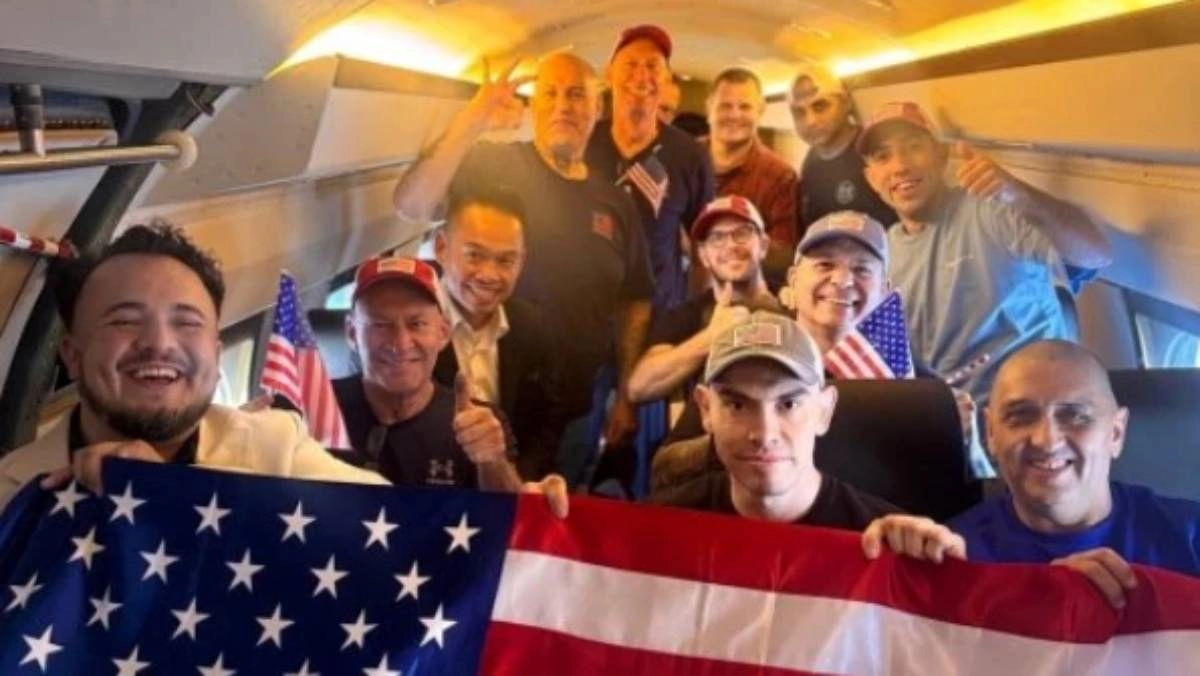

The US and Venezuelan governments carried out an unprecedented exchange of prisoners this Friday with the mediation of Salvadoran President Nayib Bukele.
A total of 252 Venezuelans who had been deported by ICE from the United States in March and held at the Terrorism Confinement Center (Cecot), a maximum-security prison in El Salvador, were sent to Venezuela.
In exchange, the government of Nicolás Maduro released 10 US citizens detained in Venezuela, as well as an unspecified number of Venezuelans whom Washington considers political prisoners, according to authorities from both countries.
The operation was the result of weeks of negotiations between the Venezuelan and US governments.
We analyze what is known about the prisoners released from both sides.
The Venezuelans who were in Cecot
The 252 Venezuelans repatriated this Friday had been held for four months in El Salvador's Cecot (National Commission for the Protection of Human Rights) under an agreement between Trump and Bukele.
Many of them were accused of belonging to criminal organizations such as the Aragua Train, although relatives, lawyers and activists denounced a lack of evidence and arbitrary proceedings.
Some of those released gave their testimonies, broadcast by the Venezuelan official network Telesur.
"We were four months without communication, kidnapped," one of them said from the plane that was taking them back, and another added: "We didn't know what day it was."
They claimed that they slept on metal plates and were beaten several times a day.
The mother of one of those released spoke to the BBC from Venezuela.
He assured that Óscar González Pineda, who was working as a tile and carpet installer when he was detained by immigration authorities in Dallas, Texas, had no connection to the Tren de Aragua gang and expressed excitement about his return.
The US president pushed for the deportations under the Alien Enemies Act of 1798, which gives him the power to detain and deport natives or citizens of "enemy" nations in times of war outside of due process.
Salvadoran President Nayib Bukele reiterated Friday that all of them were implicated in criminal activity, including murder, rape and robbery, although his government never presented concrete evidence.
Some of those deported were detained at their homes or jobs in the United States and flown to El Salvador on flights managed by the Trump administration.
According to court documents and testimony from family members, several of them were legally residing in the US, had no criminal records and were not allowed to challenge their expulsion.
Human rights organizations have repeatedly denounced the extreme conditions of the Salvadoran prison.
Some relatives claim that ties to criminal gangs were inferred solely because of tattoos or other elements considered suspicious.
Those released in Venezuela
In addition to the 10 Americans, Caracas released an unspecified number of Venezuelans classified as political prisoners by the U.S. and human rights organizations.
U.S. Secretary of State Marco Rubio said that they are people who were in prison for opposing President Maduro's government.
President Bukele spoke of "political prisoners" and of having helped to "free 80 Venezuelans.”
The Venezuelan Foreign Ministry, for its part, described them as individuals prosecuted for common crimes and acts against the constitutional order.
Venezuelan Interior Minister Diosdado Cabello said in statements broadcast on the state-run channel Venezolana de Televisian (VTV) that one of the people who was released is former congressman Williams Davila.
When asked about other released prisoners, he said he did not have the list at that time, but that “some opposition sectors have been saying who has been released” and clarified “they have already been released.”
The official indicated that these measures were taken as part of an initiative by Jose Luis Rodriguez Zapatero, former president of the Spanish government, “who has been "always looking out for the peace and tranquility of Venezuela."
"That has to do with a negotiation that has been going on, they know, none of those who are leaving are infants, none, and they know what they were accused of and they know why they were accused. It's a measure to seek peace and tranquility," Cabello said.
Davila's son, William Davila Valeri, confirmed the release of her father, through the social network X: "We look forward to being able to reunite as a family and begin to make up for lost time together."
The non-governmental organization Committee for the Liberation of Political Prisoners (Clipp) also reported on X that, on Friday, "mothers and family members have confirmed the release of several political prisoners detained in the post-election context and held in Tocorón and some in El Helicoide."
Initially, they offered a list with 14 names, which has since been expanded to 28.
"This news fills us with strength and hope, but it also reminds us that freedom is for everyone."
The foreigners released by Maduro
U.S. authorities published a photograph of the 10 freed Americans, whose identities were confirmed by the NGO Global Reach, which works to bring back Americans detained abroad.
Among them is Lucas Hunter, a 37-year-old dual U.S.-French citizen who was detained in January while windsurfing and riding a motorcycle in the Colombia-Venezuela border area.
According to his family, Venezuelan agents forced him to cross the border and then arrested him. They have not had contact with him since.
“My family and I are very happy to have learned that my brother, Lucas, was released by Venezuela today,” Sophie Hunter, his sister, said in a statement released Friday by Global Reach.
“We can’t wait to see him in person and help him recover,” she added.
“We are grateful that President Trump has made this issue a priority for his team.”
Another of those released is Wilbert Joseph Castaneda Gomez, a U.S. Navy petty officer first class detained in Caracas in August of last year while visiting a friend.
His family maintains that he was arrested without cause and used as a political pawn by the Maduro government.
According to official sources cited by US media, Castaneda was not on an official mission, but on a personal trip.
“My brother is an innocent man who was used as a political pawn by the Maduro regime,” his brother, Christian Castaneda, said in a statement published by The Washington Post.
“We have prayed for him every day for almost a year,” he added.
“But we knew that President Trump would not leave a decorated SEAL behind,” he added. “We are happy that he is out and can receive the treatment and help he deserves, and that he can celebrate his upcoming 38th birthday with his family in freedom.”
Newsweek magazine reports that the Foley Foundation, dedicated to the liberation of U.S. citizens unjustly imprisoned abroad, named other Americans who have been released by the Maduro government: Jorge Marcelo Vargas, who was imprisoned for 304 days, and Renzo Castillo, who was imprisoned for 299 days.
Meanwhile, the organization Hostage Aid Worldwide named two others: Jonathan Pagan Gonzalez, who was arrested in October, and Fabian Buglione Reyes, a Uruguayan citizen living in the United States who was arrested at a checkpoint also in October.
The Maduro government claims that the returned Americans had committed serious crimes against the State, while Washington considers them political prisoners or unjustly detained.
In the current context, no changes are expected in the sanctions imposed by the US on Venezuela or the reestablishment of diplomatic relations between the two countries, which still do not have official mutual representation.