

“America first, not America Alone”: why Trump is interested in rescuing Milei's government in Argentina
Trump gave his full support to Milei just days before a key election
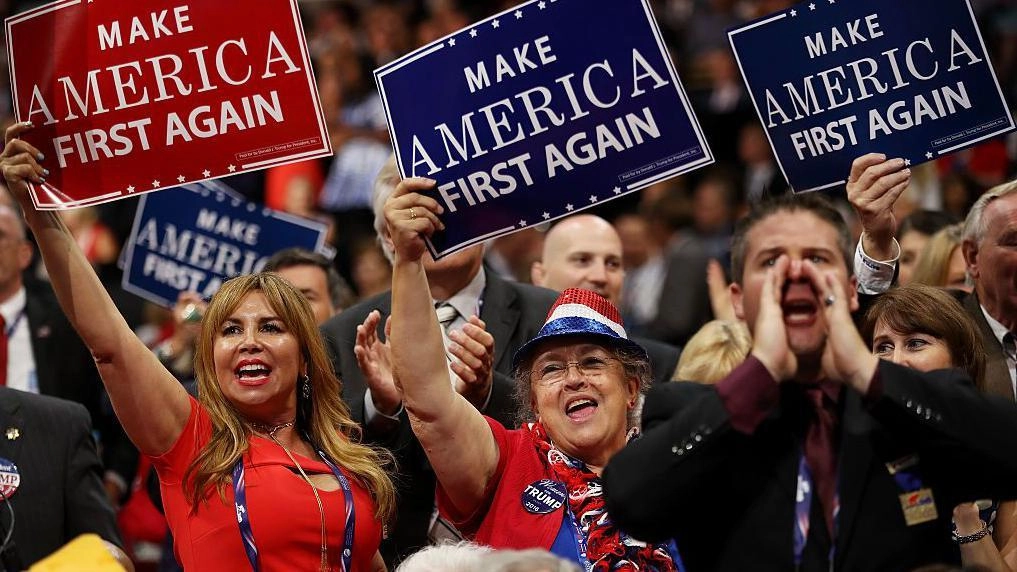

He didn't just throw Argentina a lifeline.
In addition to approving an unprecedented financial bailout, the United States government has given political support to President Javier Milei during his visit to the White House on Tuesday.
A boost that doesn't hurt the Argentine president at all, just days before his party faces legislative elections that could define the future of his political project.
"The election is near and victory is very important. We are here to support you," said US President Donald Trump, referring to the October 26 elections, in which support for Milei's party, La Libertad Avanza, is in the spotlight.
The economic reform program of the Argentine leader, who came to power in December 2023, could suffer a severe setback if the opposition gains ground in Congress.
After the economic rescue announced a few weeks ago - which includes the purchase of Argentine pesos and a $20 billion currency swap financed with US Treasury funds - Trump declared that his support for the South American country is due to the "great philosophy" of his political ally in the Southern Cone.
"If a socialist or a communist wins, you feel differently about making an investment. If (Javier Milei) loses a far-left candidate, we won't be generous with Argentina," he noted.
US Treasury Secretary Scott Bessent added that financial aid is a great opportunity for Argentines. "It's better to build economic bridges with our allies."
Bessent, the US finance chief, is the one who has led the rescue (the details of which are still unknown) and has insisted on the political closeness of the governments.
"US first does not mean US alone."
In a play on words, Bessent has said that the government's slogan "America First," used to defend US interests over those of other countries, It does not mean “America Alone,” that is, it does not mean “the United States alone.”
The official said this to defend financial aid to Argentina at a time when the US is facing its own internal conflicts, with a “closed” government – ????temporarily with its hands tied in financing public spending – and with farmers overwhelmed by economic problems.
If the slogan is to support those who share a similar vision to expand US regional influence, many wonder if there is something beyond ideological affinity.
“Supposedly it has to do with Milei's political alliance with Trump and the fact that she has no other allies in relatively large Latin American countries in her competition with China,” Victoria Murillo, professor of Political Science and director of the Institute of Latin American Studies at Columbia University, tells BBC Mundo.
“Milei has always been very loyal to Trump,” says the researcher. “There doesn't seem to be an explanation beyond geopolitics and the connection between the two.”
The bailout, some analysts argue, allows Trump to reinforce the idea that shock therapy works to cut public. spending and that the libertarian ideas promoted by Milei are viable.
And for Milei, in addition to giving her a breath of fresh air amid an extreme shortage of dollars, it would help strengthen her narrative of the “success of the model” on the eve of the legislative elections and, more long-term, the possibility of reelection.
Nevertheless, Washington's generosity usually comes at a price.
Trump has two main motives for this unprecedented financial bailout, says Benjamin Gedan, a researcher at Johns Hopkins University (United States).
“One is his undeniable respect for the Argentine far-right leader and the other is a less ideological interest in the success of Milei's pro-market agenda,” he comments in an interview with the BBC World.
The conservative agenda shared by both leaders explains a lot, but not everything, he warns.
“Milei is also a faithful ally in terms of foreign "Dollars are going to be coming out of our ears," Milei said in Buenos Aires, just before boarding the plane to Washington.
Argentina has had to do everything possible to calm investors by restoring the damaged confidence in its ability to stay afloat.
The markets are very sensitive,particularly now that debt maturities are approaching and the country is on the verge of elections that will function as a plebiscite on the Mileist model focused on austerity and the reduction of public spending.
Amid this turbulence, there is another important factor in the equation: China.
Some analysts consider the US bailout to be a strategy to counteract China's influence in the region and favor its own political and economic interests.
In this sense, the financial aid not only seeks to prevent the return of the Kirchnerist opposition to the Casa Rosada, but also to show China that it is not the only country interested in investing and strengthening commercial ties with the South American country.
Trade tensions between the US and China continue to escalate with new tariff threats and technological disputes that could find another stage in which to bare their teeth on Argentine soil.
After all, it is not minor that Argentina has vast reserves of oil, gas, lithium, and rare earths, which are fundamental for the energy transition.
Trump would be betting on a strengthened Milei who can obtain reelection in 2027, ensure the continuity of the model and provide a counterweight to Beijing's influence in Latin America.
Criticism generated in the US by the bailout of Argentina
Financial aid to Argentina has caused a political whirlwind in the US.
Farmers who produce soybeans - direct competitors of Argentina in the Chinese market - angrily complain that the bailout contradicts the promise of "America First" and threatens their income.
"The frustration is overwhelming," wrote Caleb Ragland, president of the American Soybean Growers Association. “Prices are falling, the harvest is underway, and instead of securing a deal with China, we're seeing $20 billion being given to Argentina.”
The news has also not gone down well with some Republican representatives representing agricultural states who, instead of supporting Trump, have been up in arms.
“Why help Argentina while taking away our producers' largest market?” asked Senator Chuck Grassley, a representative from Iowa, a major soybean producer.
Congresswoman Julie Fedorchak of North Dakota called it a “bitter pill” that weakens the United States' negotiating position with China.
The controversy transcends the agricultural sector.Some government supporters have questioned how the bailout fits within the “America First” doctrine and American nationalism.
The harshest backlash has come from the Democratic opposition.
“Instead of using our dollars to buy Argentine pesos, Donald Trump should help Americans afford healthcare,” wrote Democratic Senator Elizabeth Warren on social media.
Warren, along with a Senate Democratic bloc, introduced a bill to prevent the Trump administration from providing economic aid to Argentina.
The bill proposes prohibiting Treasury Secretary Scott Bessent from using the Exchange Stabilization Fund (ESF) for financial rescue operations.
Critics of the Trump administration claim that the financial lifeline does not really seek to stabilize the Argentine economy, but rather to protect the interests of large private investment funds such as BlackRock, Fidelity, and Pimco.
“It's a bailout of the rich disguised as international aid,” she said Warren, calling for an investigation into financial ties between Trump administration officials and “hedge funds with investments in Argentina.”
“Trump promised to put America first, but he's putting his billionaire friends before the people,” Warren concluded.
She categorically rejected the idea that the financial support was an aid to her “billionaire cronies.”
“This idea that we're helping wealthy Americans with interests there is completely false,” she said in an interview with CNBC earlier this month.
“What we're doing is maintaining the United States' strategic interest in the Western Hemisphere,” she said, warning that inaction could lead to a “failed state.”
All sorts of theories have surfaced in the Argentine press about what Trump might get in return for backing Milei. Theories range from an alleged preferential delivery of Argentine mineral resources to US companies, to a commitment to limit the South American country's economic ties with China, something Bessent has denied.
But while more details about the terms of the agreement and the behind-the-scenes negotiations are not known, little can be ventured about what other elements could be part of the ongoing negotiations between the economic teams of both countries.