

"Ask for help. We are here": the testimonies after the powerful earthquakes in Venezuela
The images arriving from the Venezuelan capital show some collapsed buildings and others with significant damage

“It's the strongest tremor I've ever felt in my life,” says Nicole Kolster, a journalist and contributor to BBC Mundo. "It was so strong that I thought the building was going to fall on me."
He lives on the 7th floor of an apartment in the Palos Grandes sector, in eastern Caracas, where the shaking of the magnitude 7.2 earthquake registered this Wednesday afternoon in Venezuela and its almost immediate 7.5 aftershock were felt with intensity.
At the moment, the extent of the damage caused by both tremors is not known, although the United States Geological Survey (USGS) alert and the images anticipate that there may be fatalities and significant economic losses.
The interim president of Venezuela, Delcy Rodríguez, announced the declaration of a state of emergency and the suspension of non-essential activities. "The first message for our population is to maintain the union to save lives," he said on national television.
"It started shaking, I saw the windows move, and what I thought to do was get between the front door and a stone wall, which in my opinion is quite strong, to try to protect myself," Kolster tells BBC Mundo.
There he stayed "for a long time", until he heard the neighbors shouting for him to go down to the street.
"It is the first time in 37 years that I feel an earthquake of this magnitude," he says, while telling BBC Mundo that in the rubble of a collapsed building people can be heard calling for help.
“Call for help. We're here,” he says.
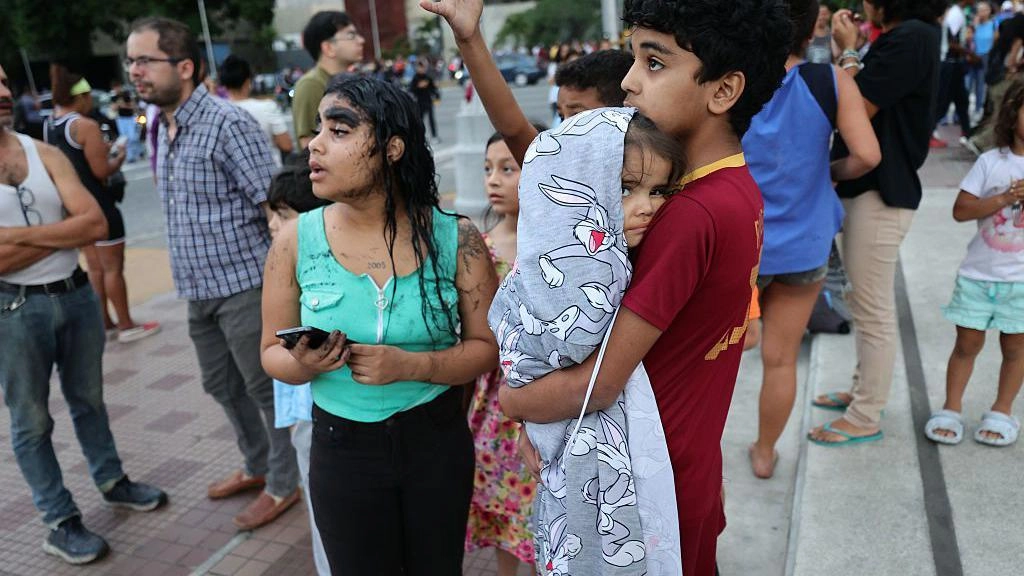
In the photographs and videos shared, the neighbors are seen in the street, some barefoot, others crying, hugging.
"Oh my God! Oh my God!" Vanessa Silva can be heard saying in a video she recorded at the time of the tremor from her home. "Grab my mom," he yells at a relative.
"An hour after the tremor, everyone is outside waiting to protect themselves from an eventual aftershock," continues Kolster.
"There are very sad people, powerless because they could not get their pets out. Others tried to take their cars out of the basements of the buildings, for fear that there will be a replica and it will be worse," he adds. "The recommendation is not to go back up to the building," he explains.
“Our apartment has some cracked walls. There are fallen poles, we have no light, no signal," says Maria Elise, another neighbor in this central area of Caracas.
About 10 kilometers away, in Altamira, another central area of the capital, Anais López also waits on the street.
“We're waiting for someone to say it's safe to come back,” he says.
He says that it was difficult for him to open the door of his house on the eighth floor of an apartment block, "because there was a lot of debris from things that fell", and that he ran down with what he was wearing, without even having time to put on his glasses.
Gustavo Duque, the mayor of the municipality of Chacao, to which Palos Grandes and Altamira belong, reported the collapse of an 8-story building and a 12-story building, adding that authorities managed to rescue 18 people alive.
The earthquake occurred at 18:04 local time and had its epicenter near the city of San Felipe, in the state of Yaracuy, about 280 km west of Caracas. And its even more powerful replica, with a magnitude of 7.5 according to the USGS, was recorded near the municipality of Yumare, a little further north.
Dozens of people inside the Maiquetía International Airport screamed and ran while significant structural damage occurred, videos on social networks show. President Rodriguez confirmed that the airport was closed.
The direct natural gas service, which supplies thousands of homes in Venezuelan cities, was interrupted as a precautionary measure to avoid "some type of accident," said Venezuelan Interior Minister Diosdado Cabello.
Electricity service and internet signal were immediately interrupted after the earthquake in several parts of the city.
According to Cabello, in addition to Caracas, both shocks were felt in the states of Trujillo, Yaracuy, Carabobo, Miranda, and La Guaira.
A woman from Calabozo, in Guárico, 270 kilometers south of Caracas, tells BBC Mundo that she was knitting at her workplace when an earthquake alert arrived on her cell phone.
"I hadn't finished saying it when my chair began to move, but strong, very strong."
Minister Cabello confirmed on state television that houses and buildings collapsed due to the earthquake, adding that "all the security and assistance agencies, civil protection, volunteers, firefighters, police" had been deployed.
The minister urged all Venezuelans in the affected areas to evacuate buildings, to stay safe in case of aftershocks, and called for calm.
The United States Geological Survey (USGS) warned that numerous casualties and widespread damage are likely.
"The disaster is likely to have an extensive scope," the agency said.
According to the agency, there is a significant risk of landslides and soil liquefaction.
On the other hand, the tsunami warnings issued shortly after the earthquakes for Venezuela, Aruba and Bonaire, as well as preventive warnings for Puerto Rico and the British Virgin Islands were already canceled.
“Based on all available data… the tsunami hazard from this earthquake has passed and there is no longer a threat,” the U.S. Tsunami Warning System said.