

“Sister, I thought we were going to die”: the hours of chaos and anguish that I experienced until I located my family af
During the first hours communications were interrupted and for many it was impossible to confirm how their relatives were doing.
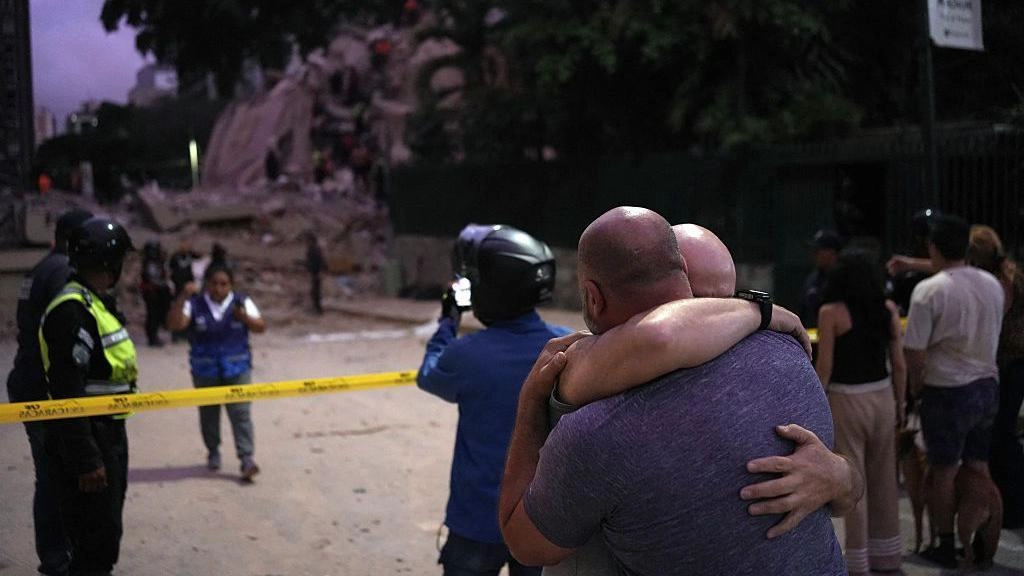

At 6:06 in the afternoon, Caracas time, I received an audio via WhatsApp from my sister Verónica that said: “He just shook horribly, he is still shaking.”
She was panting as if she were running and my mother's voice sounded in the background, too far away to understand what she was saying.
"The apartment broke down. This was very strong," said Verónica with labored breathing. “We are at home.”
Just two minutes earlier, the United States Geological Survey (USGS) had recorded a first earthquake in Venezuela of magnitude 7.2 on the Richter scale. And 39 seconds later, a jolt worse than the first, measuring 7.5, occurred.
Once I finished listening to the audio, I called Verónica on WhatsApp. She lives on the first avenue of Los Palos Grandes, known as an area of high seismic impact, judging by the memory of Caracas residents like my mother, who experienced the great Caracas earthquake in 1967.
Since this Wednesday was a holiday in Venezuela, my sister and my mother had gathered to spend the day together. Otherwise, they would have been separated at the time of the earthquake, each one busy with their usual tasks.
The call rang, but Veronica did not answer. I called my mother through the same messaging app, but she didn't answer either.
Messages do not arrive
I asked in a chat with several journalist friends who live in Caracas if someone could help me understand the scale of what was happening. “Was there an earthquake in Caracas?” I asked them at 6:09 in the afternoon.
“Fucking,” said one. “Ugh, very hard,” replied another. “HORRIBLE,” wrote the third in sharp capital letters. I told them what my sister had said in the message and one of them replied that she had probably lost the signal.
Although they were chatting, they said that the phone lines and internet were down. I asked my sister to call me back, but the message showed a single check mark.
Individual and group WhatsApp chats began to beep one after another: earthquake alert in Venezuela affecting Colombia, Trinidad and Tobago and the Netherlands Antilles; tsunami warning...
I asked one of my journalist friends to try calling my sister from her Venezuelan line, to see if he could reach her.
While he was contacting her, I started scanning my WhatsApp contacts to prioritize who to call first. What would have happened to my aunt in La California? And my uncle who lived in Aragua? And my cousin from Portuguesa?
Friends from school, who also live outside Venezuela, wrote to me to ask how they could locate their respective mothers in Caracas. They had already written to other relatives and neighbors and no one responded.
“There are surely a lot of dead people there.”
Videos of people screaming and crying began to appear in journalists' chats while trying to leave their buildings. Some raised their dogs, while pieces of walls fell off the upper floors.
What would have happened to our cats?
Suddenly, a friend asked in a chat if anyone knew neighbors who lived on the first avenue of Los Palos Grandes. Apparently a building had fallen.
I wrote to him privately to ask for more information and he sent me a video of a building that had disintegrated like a cookie. I recognized it immediately: it was a few meters below the block where my mother and sister were.
In another video, taken from the same street further down, another building was seen that had fallen. But this time I couldn't get my bearings. I opened Google Maps to understand the location from the corner, but I was confused and feared it might be my sister's.
By that time, videos of the ravages of the earthquake were already circulating in other areas of Caracas such as San Bernardino, where buildings had also fallen; the Simón Bolívar International Airport in the state of La Guaira and other areas in the interior of the country.
The government had not reported numbers of deaths or injuries, although in several videos that circulated on social networks the same comment was repeated by witnesses to the fallen structures: “There are surely a lot of dead people there.”
“I was practically left homeless”
In the flood of messages he received through the chats, the message from the journalists rang. One of them had managed to communicate with my sister and put her on speakerphone.
“Hello Herma, we are fine,” said Verónica. "We are on the corner outside the house. The building is all broken, the walls are cracked. I have no signal, I can't communicate."
That message brought me back to my senses. I managed to understand the map and locate the buildings that had fallen. A friend told me that his apartment was probably no longer “livable.”
Another friend sent a video she took in the living room of her house, full of debris that fell from the walls.
"I'm fine, but I'm practically left homeless. I love you."
A friend who lives near the National Pantheon, in the center of Caracas, said that no rescue team had arrived in the area to help the people living in the most affected buildings.
“I thought we were going to die”
When my sister managed to regain her internet connection, two hours after her first audio, she called me to tell me that they were safe, although she had probably also lost her home.
He said that his phone and my mother's had rang strangely seconds before the first earthquake. When he looked at the screen, he discovered a Google shaking alert.
Since there were so many aftershocks and the building had lost power, he did not dare go back to check if the cracks in the walls were as serious as he had thought when pieces of the ceiling began to fall during the shaking.
He explained to me how they took refuge in the area of the apartment that seemed safest to them. The cats hid under the bed, so he had to drag them out to put them in the kennel and take them away.
My mother said that the 1967 earthquake couldn't compare to this experience. This time the shaking had been much longer and more intense.
“I never thought we would experience something like this,” she told me with a broken voice, with the tone she adopts when she tries to hide her crying so as not to worry me.
“Herma, I thought we were going to die,” Verónica told me before hanging up. Tomorrow he will return home to see if he still has a place to live.