

How language made it possible for animals to leave the sea and live on land
Without water and with air and gravity, a completely different mechanism was required to feed us, and the tongue took up the challenge.
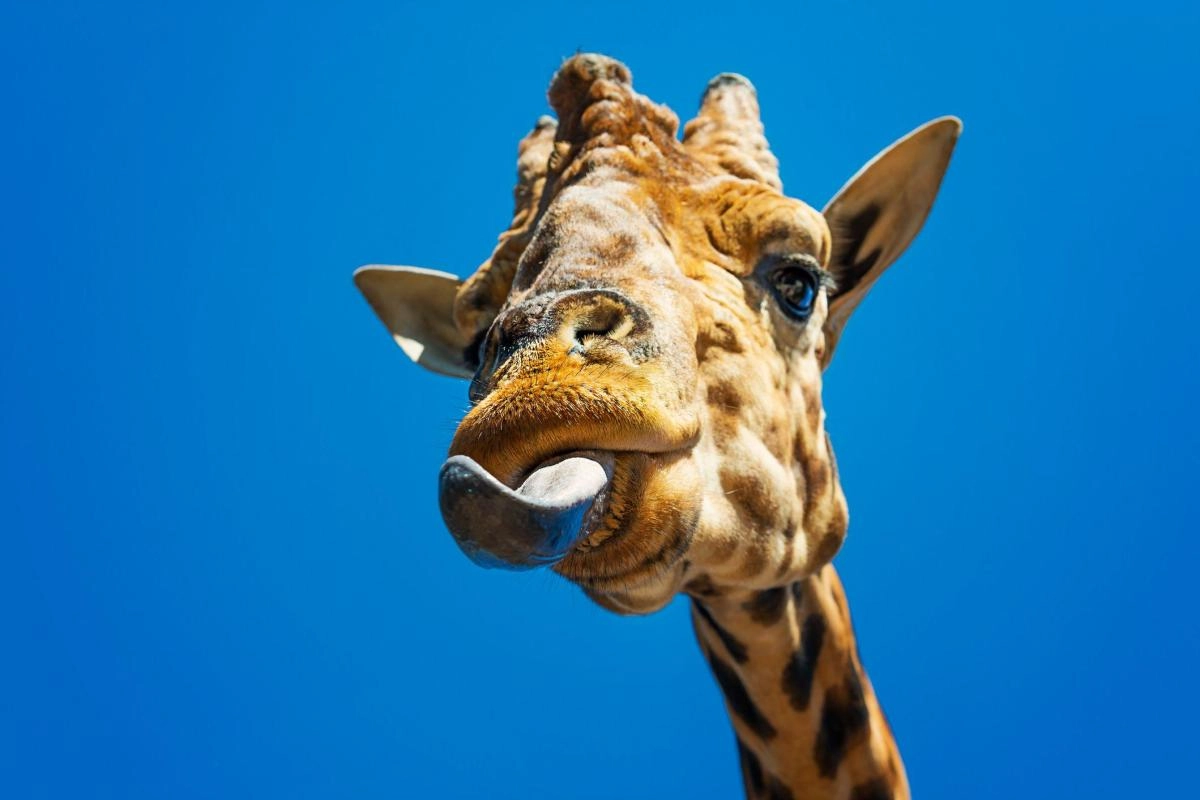

Blue like that of a giraffe, very long like that of an anteater or fast like that of a chameleon, tongues are one of the most versatile and varied organs in the animal kingdom.
That of macaws, for example, like those of all parrots, “has a bone inside,” Jessica Ray, chief keeper at London Zoo, tells the BBC.
"It looks a little like your slightly curved index finger, but it's leathery and very dark. It allows them to manipulate their food. They crack the nut with their beak and then use their tongue to peel it, separate what they want and spit out what they don't."
This, Ray says, “is great” particularly if what you eat is a lot of seeds and nuts. Over millions of years, that type of language turned out to be a success… although it may sound like something out of a horror movie (no offense to the macaws).
But at some point deep in our evolutionary history, macaws and humans shared a common ancestor. How did these birds end up with basically a finger inside their mouth and humans end up with a flat, pink muscle? Where did languages begin?
“Because we evolved from fish ancestors, and those ancestors foraged in water, when they eventually transitioned to life on land, they needed to find a way to both capture food and manipulate it in the mouth that didn't involve water,” explains evolutionary biologist Kurt Schwenk.
In water, prey float, so there is no need to worry about gravity. The vast majority of fish use suction: they rapidly expand their mouth and throat and absorb water. Any prey that gets caught enters the mouth.
But above land, the air is not viscous, meaning the possibility of floating food was eliminated.
"With gravity, food has weight, so you have to physically lift it and put it in your mouth. My feeling is that the tongue was made from the muscles that were already present in the fish, to replace water," says the professor of ecology and evolutionary biology at the University of Connecticut, USA.
"Instead of sucking, they stick out their tongue, grab the prey with it, and pull it into their mouth. And once inside, they can pick it up, move it back and forth, and push it down their throat to swallow it... all the things that water did ancestrally."
But that was just the beginning.
To cut, to smell...
Languages have existed for hundreds of millions of years.
They began as a simple way to put food in the mouth and evolved to become as different as cats and dogs: in felines, rough as sandpaper; and in the canines, softer and more flexible.
“The main reason why animals have different tongue shapes is that they use them to capture prey in different ways,” emphasizes Callum Ross, a professor at the University of Chicago, USA, specializing in feeding systems.
“Herbivores, carnivores, nectivores (animals that survive by eating nectar), all have different languages,” he adds.
Cows, for example, “have modified papillae that allow them to grab grass and trim it with their tongue.”
All mammalian tongues are covered with papillae, small protuberances that help manipulate food and, in some cases, perceive flavors.
Thus, after our ancestors washed ashore, languages evolved and specialized.
In several cases, such as a frog's sticky tongue, it seems like the result of a brilliant plan, but evolution has no plan, only variations within a population with some giving individuals a better chance of surviving and passing on their genes.
That's particularly important for an organ that helps feed us.
And in some species, the language went further.
One of the most well-known and feared languages is that of king cobras, the largest venomous snakes in the world.
"When they stick out their tongue, they look for chemical signals in the environment. And being bifid, they can perceive things differently on each side: they are like detecting in stereo," says Ben Tapley, curator of amphibians and reptiles at London Zoo.
“Once the tongue is back in their mouth, they have an organ in the roof of their mouth called the Jacobson organ, which interprets what it picks up.”
Thanks to the two tips of its forked tongue, it can compare signals from both sides, 'smell' the air, and detect the direction of a trail with extraordinary precision.
It seems that we humans lose out in comparison. We do not have tongues to sniff in stereo or with bones to have extraordinary dexterity, nor sharp papillae to crumble food.
Does our language have something special?
A water balloon in the mouth
With a tongue made only of muscle, mammals gain very skillful movements inside the mouth and that is key to manipulating food while we chew, Ross highlights.
One doesn't usually think about it, because it is something we do almost automatically, but we use the tongue to place the food in the correct position between the teeth.
Try chewing without using it and you will see how difficult it is.
And also think about how well coordinated it is, something that becomes painfully evident when you accidentally bite into it instead of food.
This almost invisible precision in everyday life is possible thanks to a sophisticated anatomical structure.
"The tongues of mammals have a lot of musculature, organized in a very complex way. The fibers are imbricated: vertical, transverse and longitudinal, all within the tongue," explains Ross.
Schwenk uses an analogy to explain: "Imagine an elongated balloon filled with water. Water cannot be compressed. If you squeeze the balloon, the volume doesn't change: it just stretches and gets longer. When you make it narrow, it gets longer. When you make it wider, it gets shorter."
Our language works in a similar way. If you want to take it out, you have to make it narrower. If you want to flatten it, you have to shorten it.
Organs that move using only muscle, without bones or joints, are called muscular hydrostats. It is the same thing that happens with the arm of an octopus or the trunk of an elephant.
"Thanks to that arrangement, you can change the shape of the tongue in very complex ways. And that's something that mammals have and that most other vertebrates don't," adds Schwenk.
Even among mammals there are notable characteristics.
The giraffe's tongue, for example, measures about half a meter, is bluish gray (to protect itself from the African sun) and is highly prehensile.
“With their necks they can reach things that other animals can't, but they also have a tongue, which helps them bring the branches closer to their mouths,” explains Nick Garrett, from London Zoo.
From there, the tongue takes care of the rest: it wraps itself around the branches and strips them of their leaves with astonishing speed.
Although, well, ours doesn't do anything bad with ice cream.
But so many other skills remain to be mentioned, such as the fact that thanks to them we distinguish sweet from bitter, we feel what burns, we find a bone among the fish and we form each syllable we sing.
As if this were not enough, he has a less showy but vital talent.
The danger of swallowing
Every time we swallow, the tongue saves us from disaster.
“The tongue pushes food backward, through the oropharynx, into the esophagus,” explains Ross.
The problem is that the oropharynx is a crossroads: the respiratory and digestive tracts intersect there.
We breathe through the nose and the air goes down into the trachea. But the food has to go into the esophagus, which is behind.
“It's not the best design for evolution,” Ross admits.
To make it all work, the tongue narrows laterally and, as it does so, part of it moves backwards, pushing the food out. But this mechanism only works if the mouth is closed.
Try to swallow with your mouth open. Difficult, right?
“The tongue is essential to quickly push food and prevent it from entering the lungs.”
That coordination is so precise that we barely notice it… until something goes wrong.
It's happened to all of us: a bite that goes the wrong way and leaves us coughing. In healthy people, it is a temporary scare.
But for those who have lost that control due to a stroke, Parkinson's, cancer or other conditions, every bite can end in choking or pneumonia.
“Better understanding the mechanics of the tongue will help us treat people with dysphagia (difficulty swallowing),” says Ross.
From swallowing to chewing, from hunting prey to “sniffing” the air, tongues are one of evolution's most versatile tools, and are essential for survival.
And all this diversity arose from the same primitive structure, present in a remote aquatic ancestor who one day left the water and encountered an unprecedented challenge: how to feed on dry land.
*This article is an adaptation of the episode “What’s the deal with tongues?” from the BBC series CrowdScience, available wherever you listen to your podcasts.
CrowdScience answers questions submitted by people around the world, consulting specialists who are at the forefront of knowledge. If you want to contact them, click here