

The mystery of the “dancing plague”: The historical epidemic that modern science has failed to explain
In 1518, hundreds of people began dancing uncontrollably in Strasbourg. More than five centuries later, the case remains without a definitive explanation
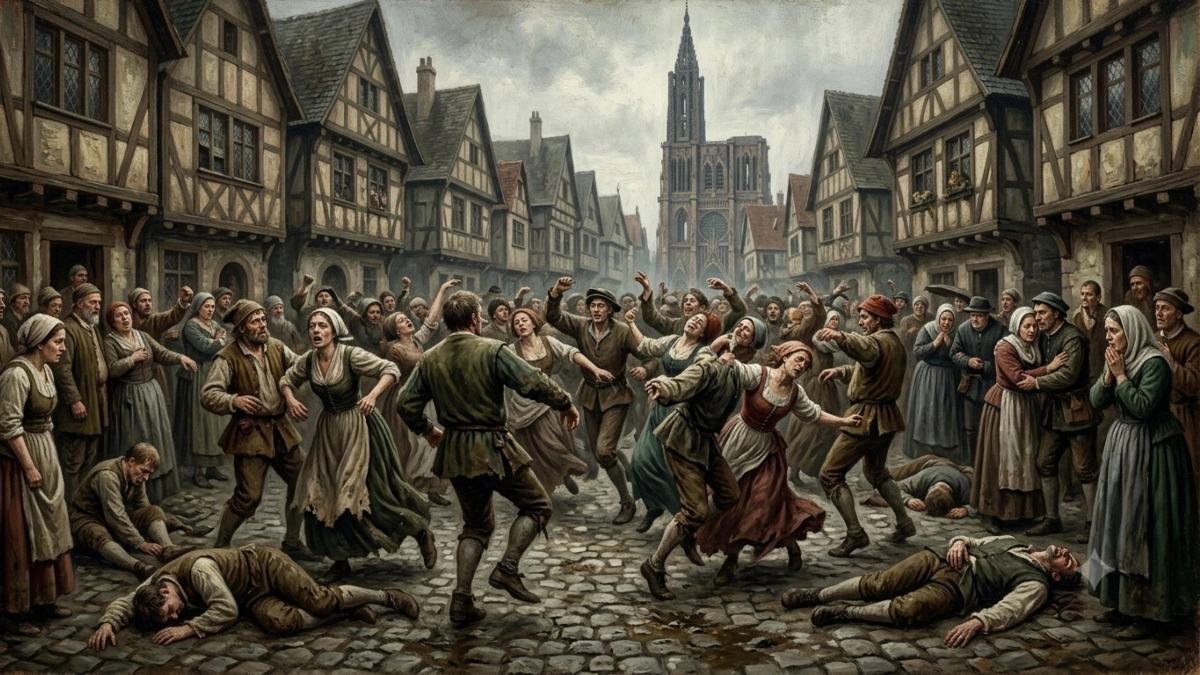

July 14, 1518 is recorded as one of the most baffling dates in European history. In the city of Strasbourg, which today is part of France, an episode known as the “dance epidemic” or “dancing plague” began, a phenomenon that still arouses the interest of historians, doctors and scientists.
The strange behavior of a single woman ended up turning into a situation that involved hundreds of people, who began to dance compulsively for days, to the point of fainting and even dying from exhaustion.
More than five centuries later, there is no definitive explanation for the origin of the mystery.
Read also: A town called Hell is for sale in Michigan: how much does it cost to buy “a piece of hell”
How the so-called “dancing plague” originated in Strasbourg
According to National Geographic magazine, it all started when a woman identified as Frau Troffea went out onto a street in Strasbourg and started dancing for no apparent reason. He was not participating in a celebration or responding to a popular tradition.
His movements were constant and seemed completely involuntary, but the most striking thing was that he failed to stop. He remained dancing for several days in a row, despite extreme fatigue, until collapsing due to physical exertion.
What was initially seen as an isolated case quickly changed dimensions. Within a few days other people began to experience the same behavior and joined in that strange dance without control.
The number of people involved increased rapidly. In the first week, more than 30 people were already affected before the end of the month the figure was around 400 people.
Accounts from the time describe scenes that are difficult to imagine: men and women danced for days in a row, completely exhausted. Some asked for help because they could not control their movements.
The physical consequences were serious. Many collapsed from dehydration and exhaustion, while others suffered heart attacks or strokes.
And just as it began, the epidemic disappeared weeks later. The survivors stopped dancing for no clear reason and the city gradually returned to normal.
Theories that try to explain the epidemic
Doctors of the time ruled out supernatural punishment and attributed the phenomenon to a supposed excess of “warm blood,” a theory based on 16th century medical knowledge.
Meanwhile, modern science has proposed different hypotheses to understand what happened, although none has managed to completely solve the mystery.
One of the best known points to ergotism, a poisoning caused by ergot, a fungus that can contaminate cereals. This organism produces substances chemically related to lysergic acid, capable of causing neurological alterations and hallucinations.
Another theory is mass psychogenic disorder, also known as mass hysteria. At that time, Strasbourg was going through a situation marked by epidemics, poverty, poor harvests and a profound influence of religious beliefs.
This environment of constant stress would have favored a collective psychological reaction that ended up manifesting itself physically.
Finally, there was the popular belief in the so-called “Saint Vitus dance”, a supposed curse that forced people to move without rest. For many researchers, the combination of fear, suggestion and social tension could have triggered this extraordinary phenomenon.
More than 500 years later, the Strasbourg episode remains one of the greatest mysteries in the history of medicine and psychology.
· It looks like a floating city: this is the gigantic “turtle cruise” for 60,000 people · AI reveals the face of Jesus Christ, the most hyperreal in memory · What was there before the creation of the world? AI theories that will make you sigh