

SM-39 Razor: The sixth-generation fighter with a bat design that wants to revolutionize the skies
The SM-39 Razor fighter jet seeks to replace the veteran F/A-18E/F Super Hornet used by the United States Navy
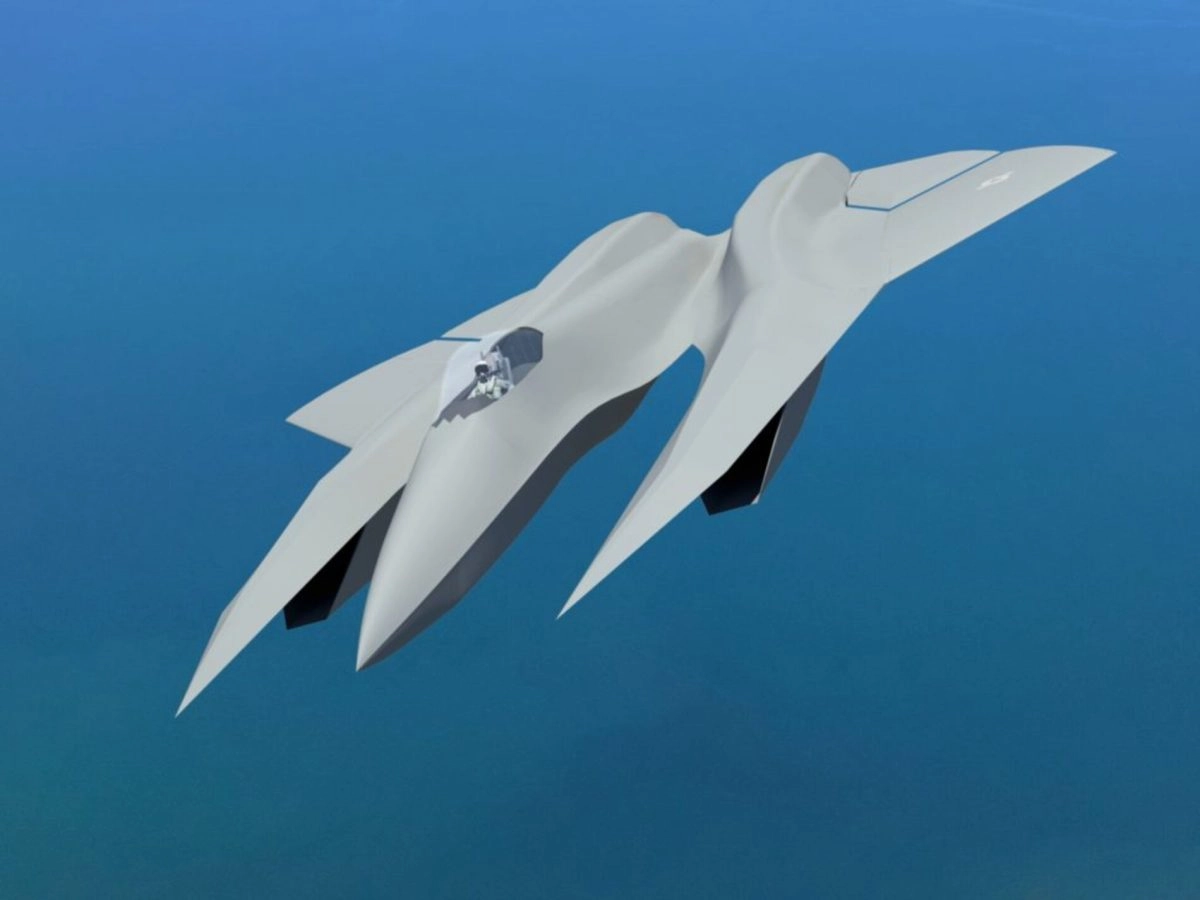

The SM-39 Razor is a concept aircraft that looks like it came straight out of a science fiction movie and is making the giants of the defense industry tremble. Stavatti Aerospace, a private company based in New York, officially unveiled this design in early 2026 as its independent proposal for the U.S. Navy's F/A-XX program, the project seeking to replace the veteran F/A-18E/F Super Hornet.
What makes the Razor so striking isn't just its name. It's its silhouette. At first glance, it resembles a giant bat, with a wing-integrated body design—known as a blended-wing body—that eliminates the traditional separation between wings and body. The result is an aircraft that looks more like a combat drone from the distant future than a conventional fighter jet.
A Tri-Fleet Design That Defies All Precedents
The most radical aspect of the SM-39 Razor is, without a doubt, its tri-fuselage architecture. While all current fighter jets feature a single central fuselage, the Razor integrates a central main fuselage flanked by two lateral secondary fuselages, all joined under a variable-sweep wing. This approach isn't just aesthetic—it has a very specific engineering reason: to reduce supersonic wave drag and more efficiently distribute fuel, sensors, and electronic warfare systems along the fuselage. The aircraft's structure utilizes cutting-edge materials such as titanium diboride cermet and titanium foam sandwich construction, capable of withstanding the extreme heat generated by hypersonic flight. It also features thrust-vectoring nozzles, twin-slotted boundary-layer blown flaps, and full-motion horizontal stabilizers—without a traditional vertical tail. Stavatti describes the Razor as “a direct bridge between atmospheric aircraft and future reusable space fighters,” which sounds ambitious.But it fits perfectly with the trend among the world's most advanced militaries to develop platforms that operate at the edge of space.
Mach 4 Speed ??and Technology That Surpasses the F-47
In terms of performance, the SM-39 Razor doesn't mince words. Stavatti promises that the aircraft can maintain sustained supercruise above Mach 2.5, with bursts capable of exceeding Mach 4—making it roughly twice as fast as the U.S. Air Force's own sixth-generation F-47. Its operational service ceiling would reach 100,000 feet, and its internal payload capacity would reach 25,000 pounds.
Propulsion is provided by two state-of-the-art adaptive-cycle turbofan engines with afterburners, based on the patented NeoThrust concept or equivalent engines from the most advanced American adaptive demonstrators. This type of variable-cycle engine is key: it allows the aircraft to be efficient in subsonic cruise and, at the same time, unleash brutal power when the situation demands it. For combat, the Razor integrates two internal weapons bays—thus preserving its low-observability profile—and features active stealth capabilities, state-of-the-art avionics, and what Stavatti calls "Synthetic Intelligence," a system that enables autonomous operations without a pilot on board. In fact, the aircraft is available in three configurations: single-seat with pilot, two-seat, and a fully autonomous unmanned variant. Can the SM-39 Razor compete in the real world? Here comes the part that generates the most debate among experts. Stavatti Aerospace is not Boeing or Northrop Grumman. The company, relatively unknown in the defense industry, is competing directly against these two giants, which are the leading candidates for the Navy's F/A-XX contract. Furthermore, to date, Stavatti has not produced any operational prototypes, which raises legitimate doubts about the project's short-term viability. The U.S. Navy has also not officially confirmed that the Razor has been submitted as a formal proposal within the acquisition process. However, the concept has enormous value as a benchmark for innovation: it demonstrates that there is room to think radically differently about the design of next-generation fighters, especially in a geopolitical context where China and Russia are also developing their own sixth-generation aircraft. What is undeniable is that the SM-39 Razor has captured the attention of the defense and aviation world. In a sector where conventional designs have dominated for decades, such a bold proposal as this—triple fuselage, hypersonic speeds,Exotic materials and synthetic intelligence—it deserves to be taken seriously, if only as inspiration for what the fighter jet of the future could be. If a prototype of this beast ever takes to the skies, the world of military aviation will never be the same.