

This website tells you when the apocalypse arrives by tracking millionaires' planes
A Los Angeles programmer tracks private jets with simple and disturbing logic. When the world ends, the rich will find out first.
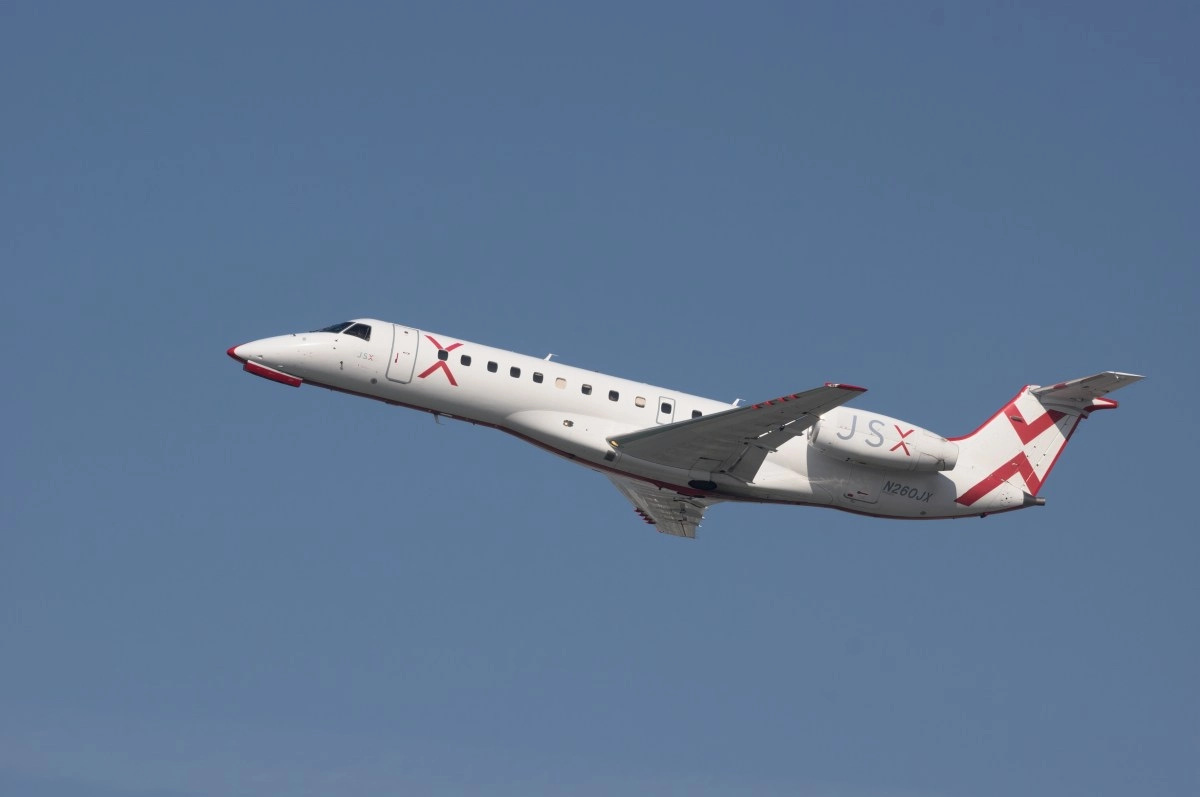

The idea is simple, perhaps obvious. If the end of the world is approaching – or at least a nuclear attack, a civilizational crisis – the rich will probably find out first. Not because they are part of a conspiracy, but because they tend to be closer to the centers where strategic information circulates. And if they know, they will get on their private jets. And if they all upload at the same time, the data will show it.
That was the intuition that Kyle McDonald, a programmer and artist from Los Angeles, had, who has applied that idea to the era of data and private aviation. The result is his Apocalypse Early Warning System, a tracker of private jet movements around the world that McDonald interprets as a possible sign of unease – or even panic – among global elites.
“If a real global catastrophe were to happen, your friends would probably find out first,” McDonald wrote in an essay for Business Insider.
How does the private jet tracker work?
According to Vice, the system listens to a global network of radio receivers that capture ADS-B signals – the same ones that transmit the position, speed and altitude of aircraft in real time – and filters that data to capture some 11,000 private and charter jets.
It then compares how many of those planes are in the air at any given time to a historical baseline that takes into account daily, weekly and even holiday patterns. From this comparison, an alert scale from 1 to 5 emerges: level 1 corresponds to a normal day, while level 5 indicates aerial activity greater than any other time recorded during the previous year.
If the figure suddenly spikes – more than five standard deviations above the mean – the system can send automatic alerts via Telegram, email or text message.
The origin: a threat from Trump and nuclear anxiety
The idea, however, was not born out of academic curiosity, but out of anxiety. McDonald says that everything began to take shape after reading a threat from President Donald Trump against Iran, in which he warned that an “entire civilization” could disappear if a ceasefire was not reached.
That statement led him to wonder who would have access to critical information before the rest of the population. After all, as McDonald assures, people close to power have already sometimes benefited from inside information in areas such as prediction markets, politics or cryptocurrencies. If that happens with economic or geopolitical issues, he reasoned, why wouldn't it also happen with a truly existential threat?
Once the model was finished, he decided to put it to the test by reviewing historical data looking for the biggest spikes in activity. The result surprised him. The sharpest spike yet recorded occurred on April 6, the same day Iran launched a massive offensive against US and Israeli targets.
“That disturbed me,” he wrote in his Business Insider essay. "I remember thinking, 'Oh my God, it's real.'"
Still, McDonald insists that his tracker is far from a scientific apocalypse detector. A level 5 can be activated for perfectly mundane reasons, from the Christmas holidays to large political events involving mass movements of wealthy people. But he argues that the mere fact that recognizable patterns appear already raises interesting questions about how elites react to situations of uncertainty.
Art, surveillance and vibe coding
McDonald has been programming for 25 years, although in the last year and a half he has been constantly working with artificial intelligence. The tracker was built using vibe coding, an increasingly popular technique in which the developer guides the AI with instructions and the AI is responsible for writing much of the code. In his case he used Claude Code and says he hardly programs by hand anymore.
Half of his income comes from consulting for technology companies and artists; the other half, from exhibitions in Europe and East Asia. He pays himself $60,000 a year – modest for Los Angeles, he says – and the rest goes back to his projects. The tracker also generates something: some 2,488 people have subscribed, most for free via Telegram, and others paying five dollars a year for alerts by SMS or email.
“What fascinates me is that people basically pay me five dollars a year for the chance to not receive a text message,” he wrote. “That seems to me like a conceptual intervention, a work of art and a software service, all at the same time.”
This is not his first project on the border between surveillance and activism. He previously built applications to track LAPD helicopters – and discovered, he says, that the police frequently concealed the identity of their aircraft – and more recently he has developed facial recognition tools to identify law enforcement officers, projects that have earned him media coverage, criticism and even death threats. The common thread, he says, is to reverse the logic of surveillance: use it to scrutinize power instead of the citizen.
Elite movements as a social signal
According to The Washington Post, this idea connects with the reflections of writer Douglas Rushkoff, who has spent years studying the obsession of some billionaires with preparing for social collapse. In his book Survival of the Richest (2022), he documented how many ultra-rich not only build bunkers, but also transform existing properties into self-sufficient shelters prepared for extreme scenarios.
From that perspective, for Rushkoff, McDonald's tracker would not be so much a catastrophe detector as a thermometer of elite fear.
And that fear does not arise in a vacuum. The very possibility that some can escape while the majority does not have that option points to a deeper issue: the growing concentration of wealth and power.
According to Federal Reserve data cited by The Washington Post, the richest 1% in the United States hold 31.9% of all the country's wealth, while the poorest half own just 2.5%.
Despite the seriousness of this background, McDonald prefers to approach the subject with humor rather than solemnity. It is not intended to offer grandiose answers. It is enough for people to see the project, laugh a little and recognize the absurdity of this.
“I hope they see it and see the humor in our situation – that we are caught in a battle between the ultra-rich and the working class,” he told The Washington Post. "And to remember that there are still things we can do. We are not completely down and hopeless."
And if one day the system were to trigger a particularly alarming alert, McDonald already has its emergency plan prepared. At least in theory. According to him, he once half-jokingly told a well-known billionaire: “I'll stay with you.”