

The Secrets of a Dangerous Amazon River That an Indigenous Community Is Beginning to Reveal
An Indigenous Community in the Amazon Is Discovering Amazing Species in Its Waters
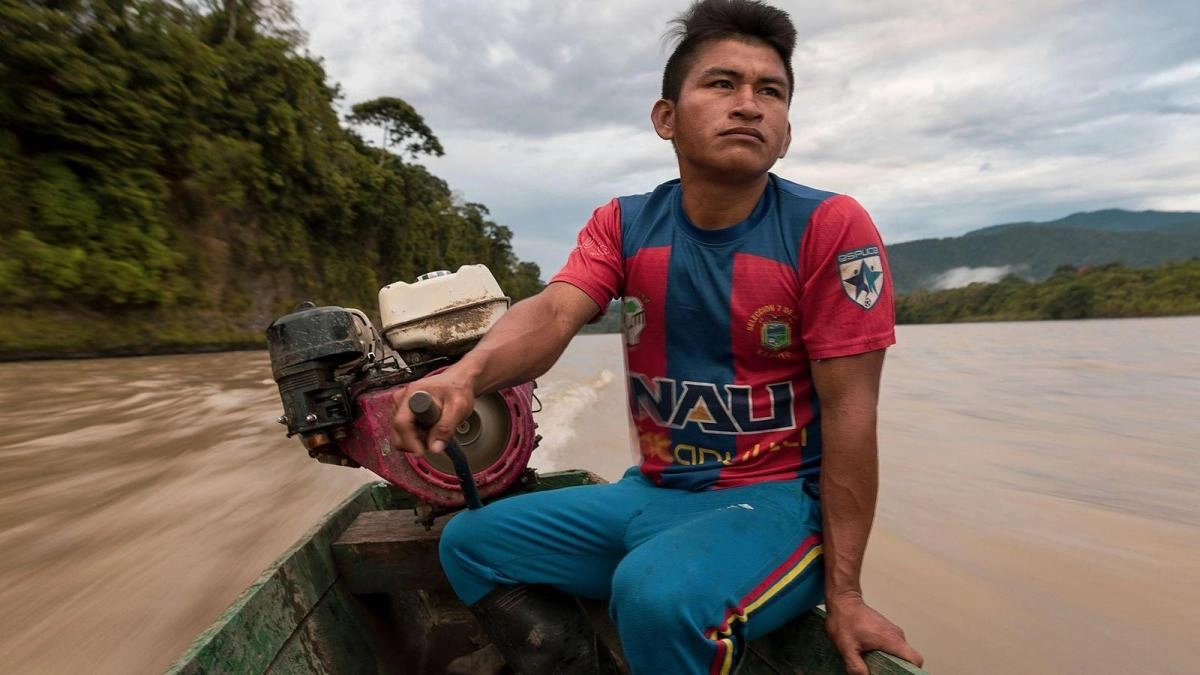

We climbed into a wooden canoe bobbing on the murky waters of the Santiago River, ready to visit one of the least-known ecosystems in the Amazon region.
Until recently, scientists didn't even know what kinds of fish inhabited this part of the river, because it had never been studied.
Now, after two days of travel by bus and truck from Quito, Ecuador, photographer Karen Toro and I were approaching our destination: Kaputna, an Indigenous community that has discovered new species of fish. Surrounded by virgin rainforest where jaguars, peccaries, and pumas still reign peacefully, Kaputna is a town on the banks of the Santiago River with 145 inhabitants who are members of the Shuar, one of the 11 Indigenous nations living in the Ecuadorian Amazon. Although Ecuador is considered a hotspot for freshwater fish biodiversity, a group of scientists warned in 2021 that the lack of information about its species was “staggering” and that more research was urgently needed. A group of Kaputna residents has helped fill that gap, discovering a large number of fish living hidden in the river, camouflaged by brown and silver shadows, with mouths specially adapted to feed on the rocks beneath the surface. water.
Thanks to monitoring efforts carried out between 2021 and 2022, which combined scientific and traditional knowledge, the indigenous community was able to identify nearly 144 species of fish in the Santiago River.
Five of them had already been identified in other countries, but never in Ecuador. One of the species is still being studied and could be entirely new, according to the biologists who participated in the research.
Some fishermen from Kaputna, such as German Narankas, were co-authors of the scientific article that was published with the findings.
“Their knowledge of the territory is essential for discovering new species,” Jonathan Valdiviezo, a biologist who participated in the sample analysis, told the BBC.
For Fernando Anaguano, the study's lead author and a biologist with the Wildlife Conservation Society (WCS) who accompanied Kaputna throughout the process, the study marks a significant shift in how scientists work with and recognize local collaborators.
“It's not common for the work of local people to be recognized in scientific publications,” he notes.
A River That Swallows Canoes
Local legends say that, before motorboats appeared, people who set out on the lower part of the river would disappear.
A hole would “swallow” the canoes, and those who came from outside never managed to reach the community.
This is why this area is called Kaputna, which means “area where the river flows quickly,” according to those who live there. To get there, we had to drive for 10 hours from Quito to Tiwintza, an Amazonian town on the border with Peru. The next morning, German Narankas, a fisherman from Kaputna, was waiting for us at the bus terminal with his fishing net on his back. “Today the heat is going to be infernal. It hasn’t rained in three days,” he warned us, as he rolled up his sleeves to avoid getting sunburned. At 9:00 a.m., the temperature was already 35°C (95°F).
We embarked on a 40-minute truck ride to the port of Penas on the Santiago River, where Narankas's canoe was waiting for us, moored and moving with the river's strong current.
Canoes equipped with gasoline motors, known as peque-peques, are the only means of transportation to reach Kaputna.
Narankas knows the Santiago River like the back of his hand. Even before joining the scientific monitoring project, he was familiar with the different types of fish that inhabit the river.
In 2021, when the project began, he learned to identify the differences between the species and started calling them by their scientific names.
He remembers seeing a sign in 2017. For the Shuar, the river is more than just a body of water or a means of access.
On its banks, the ayahuasca ritual is traditionally performed, in which the plant also known as yage is consumed. The Shuar believe that the visions it produces reveal the future and guide the actions of those who take it. “I had dreams that I was going to change the system. In the visions, there was a man traveling to other countries, and that was me, traveling with this project. I didn't know it then,” he says. Four years later, in 2021, researchers from the WCS office in Ecuador asked him to be part of a study focused on discovering the biodiversity of the Santiago River.
Narankas and other community members collected fish, took photos of them, and uploaded them to an app called Ictio, along with other important information such as the location where they were caught, the fishing gear they used, and the characteristics of the fish.
“There were at least three of those fish that I had never seen in my life,” he says.
During the trip down the river, the sound of crickets drowned out the noise of the motor. As we ventured deeper into the jungle, the water became clearer.
“We have reached the Yaupi River,” Narankas announced. The Yaupi is one of the tributaries of the Santiago River, where some samples were also taken.
This is a favorite fishing spot for locals because the waters are crystal clear and free of the mining waste that has polluted many other rivers in the Amazon region.
Amidst the jungle foliage, the flags of Ecuador and Peru can be seen.
Narankas, his sister Mireya, and his son Josue jumped into the water to fish.
The fisherman cast his net into the river with all his might and then slowly hauled it in to see what he had caught: a fish he calls “carachama,” about 10 cm long.
It belongs to the Loricariidae family, and this particular species is called Chaetostoma trimaculineum: a brown fish with some dark spots and a round mouth.
“Near here we found a species of fish that [the Researchers said it had never been studied before. It was very similar to this carachama,” Narankas explained.
The fish in question was Peckoltia relictum, a new species in Ecuador. It measures approximately 15 centimeters and usually clings to rocks.
Its mouth is like a suction cup and, instead of scales, it has a kind of plate, a characteristic that distinguishes the carachama (Loricariidae).
During the research, Narankas and his collaborators also took some specimens to a room in Kaputna, which served as a small laboratory where they measured and weighed the animals, removed parts of their tissues with a scalpel, and preserved them in formaldehyde.
“It was very exciting to learn and collect information. I feel a bit like a scientist,” Liseth Chuim, a fisherwoman who participated in the monitoring, told the BBC.
“We would take a piece of its flesh and sew a stamp on it with its name and a number,” explained Johnson Kajekau, another Kaputna resident who supported the monitoring team.
One of the fish that the three remember most is a a type of catfish that measured over a meter. Also, one that had a "yellow belly" and another that was silver in color.
WCS biologist Fernando Anaguano and his colleagues were responsible for collecting the samples and taking them to laboratories in Quito.
Unveiling the Mystery
For the biologists, the collaboration with the locals allowed them to unlock an ecosystem that was a mystery to people outside the community.
“The Santiago River basin is one of the least explored. There are very few studies that detail the diversity of fish in that area,” explains Anaguano, who has been researching freshwater fish for more than a decade.
He attributes this to the remoteness of the region, the difficulties in reaching it in the past, and also to the fact that freshwater fish have often been overlooked by researchers.
Researchers generally focus on more “charismatic” animal groups, such as mammals or birds, and when fish are studied, it is usually marine species. However, Anaguano points out that freshwater fish play a fundamental role in aquatic ecosystems and are a source of food and an economic resource for indigenous communities. Previous research had recorded approximately 143 species in a large area encompassing the Santiago River and its tributaries below 600 meters in altitude. This area, known as the “Morona Santiago ichthyographic zone,” covers 6,691 square kilometers. In comparison, the study with the Kaputna community identified a total of 144 species in an area of ??just 21 square kilometers within this zone. Of these species, 77 had not been reported in previous research in the Morona Santiago area. The diversity found in the study represents 17% of all freshwater fish species in Ecuador (836) and 20% of those recorded in the Ecuadorian Amazon (725). This is a very significant percentage, considering that the study area where these species were found is very small, as Anaguano points out. In fact, fish diversity in the Amazon region is enormous. Its basins, located in Ecuador, Peru, Colombia, Bolivia, Brazil, Venezuela, Guyana, and Suriname, have the greatest variety of freshwater fish in the world. So far, 2,500 species have been recorded, and it is estimated that thousands more remain to be discovered. These rivers are also home to the longest migration on the planet: that of the golden catfish, which travels nearly 11,000 kilometers from the foothills of the Andes to the Amazon estuaries in the Atlantic Ocean. However, freshwater fish like those in the Amazon are seriously threatened.According to the Living Planet Index (LPI) report on migratory freshwater fish, their populations have declined by 81% in the last 50 years. And in Latin America alone, the decline is even greater: 91%. Anaguano explains that, beyond the fish's contribution to maintaining the balance of life on the planet, these animals are part of the culture and worldview of indigenous peoples. Food security is another problem. “Fish are a source of protein for local communities.”
That’s why, through this type of research that includes the perspective of the fishermen, we seek not only to conserve the fish but also to guarantee the long-term sustainability of the fishery,” adds Jonathan Valdiviezo, a biologist at the National Institute of Biodiversity (Inabio), where the study samples were processed and stored.
For Valdiviezo, who has more than 17 years of experience working with fish, one of the crucial points of the process was the training that the Kaputna fishermen received to correctly label the samples.
“That helped us avoid problems when registering the species and confusion,” he says.
Even so, the discovery was full of twists and surprises. During the tissue analysis, which included DNA analysis, the researchers discovered that one of the fish they believed to be new to science had already been described in 2011.
“When we realized that this species was very rare, “We extracted DNA from a small fragment of muscle,” Valdiviezo explains. Then, they compared the results with tissue from other related species recorded in their database. “It’s similar to the process used to determine paternity,” the biologist explains. If they had any doubts, they sent a sample to Canada, where it was confirmed to be a specimen of Peckoltia relictum, a known fish. However, it was a new species for Ecuador, as were four others discovered as part of this research. Both researchers believe that many more species remain to be discovered in the murky waters of the Santiago River. For now, Valdiviezo says, they are continuing to analyze one of the catfish found, as they believe it to be a new species to science. Its main characteristic is that it has black stripes all over its body. Anaguano comments that they hope to publish a second article, co-authored by the fishermen of Kaputna, this year.
Sitting in Kaputna at sunset, under a starry sky, we asked Narankas what it meant to him to see his name in the published article. His eyes filled with tears.
“I feel proud,” he explained, smiling.
But the impact has been even deeper.
After this experience, in August 2025, the 34-year-old returned to high school. In a year and a half, he hopes to graduate and then study biology to continue uncovering the secrets of the Santiago River, whose story of scientific discovery is only just beginning.