

Trump reestablishes the blockade of Iranian ports and imposes a 20% surcharge on cargo transiting the Strait of Hormuz
Less than a month after the signing of the ceasefire, Iran and the US exchange attacks again and Trump reestablished the naval blockade on Iranian trade
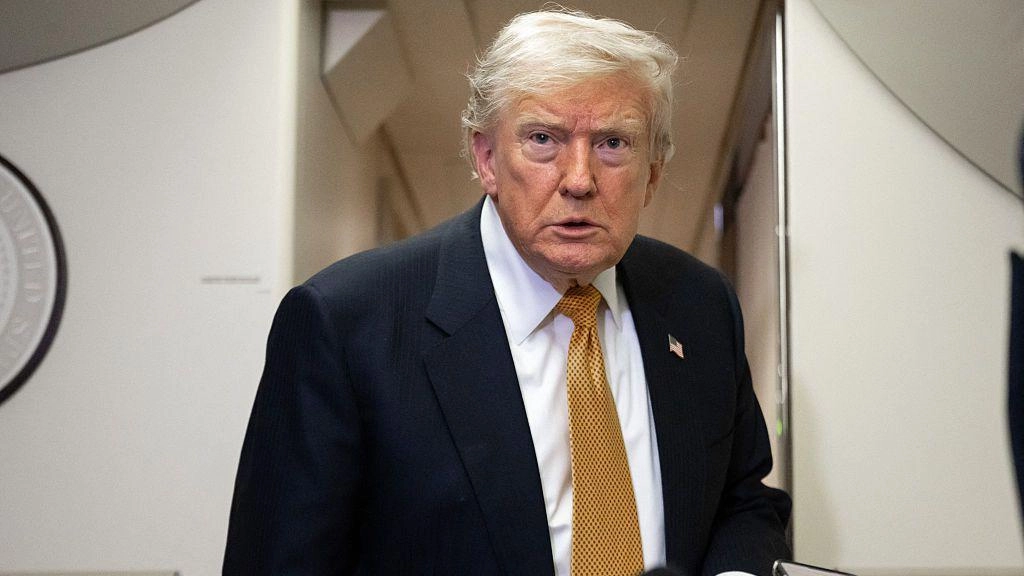

Three months after having applied it for the first time, US President Donald Trump announced this Monday the reimposition of the maritime blockade on Iranian ports.
"The Strait of Hormuz is open and will remain open, with or without Iran. We are reestablishing the Iranian blockade, so called because it only prevents ships from Iran or its clients from entering or leaving. All other countries will have fair and open access to the strait," Trump wrote in a message on his Truth Social network.
In addition, he indicated that Washington will give protection to ships that transit through that sea route, but in exchange it will begin to charge them a payment equivalent to 20% of the value of their cargo.
"From this moment on, the United States will be known as 'the guardian of the Strait of Hormuz'; but, as such and as a matter of justice, it will receive compensation equal to 20% of all cargo transported, to cover any and all costs necessary to fulfill the task of providing security and protection in this most volatile area of the world. The process and its implementation will begin immediately," he wrote.
The reimposition of the blockade on Iranian ports occurs almost a month after that measure was lifted by the US following the announcement that that country and Iran had reached a ceasefire agreement in the war that has pitted them against each other since the end of February.
On June 14, the government of Pakistan - which acted as mediator between the parties - announced that an agreement had been reached and a few days later both governments signed a Memorandum of Understanding (MoU) on the basis of which they were going to negotiate to seek a definitive agreement to end the war within a period of 60 days, extendable by mutual agreement between the parties.
Navigation through the Strait of Hormuz, through which around 20% of the world's oil regularly circulates, has been affected since the beginning of the war that the US and Israel launched against Iran at the end of February and which had the then supreme leader of Iran, Ali Khamenei, among its first casualties.
In response to this offensive, Iran began to launch attacks against US-allied Gulf countries, as well as against commercial ships circulating through the Strait of Hormuz, leading to a virtual paralysis of maritime traffic through that route.
In response, after several weeks, Trump established a naval blockade of Iranian ports, thus affecting both that country's oil exports and imports of inputs required by its economy.
A confusing agreement
The reestablishment of the maritime blockade occurs after successive disagreements between Washington and Tehran regarding the application of the agreement embodied in the MoU.
Since its content was made known, this agreement was marked by ambiguities and contradictory interpretations between the parties.
As initially reported, the Strait of Hormuz would be free to maritime traffic and exempt from toll collection for 60 days. However, Tehran has always insisted on its interest in controlling the flow of ships through that route and, in fact, in charging for allowing this transit.
Before the start of this war, ships from all over the world circulated through the strait freely without paying anyone. However, in recent months Iran established a mechanism to charge a kind of toll to ships that wanted to use that route. The Trump administration has always opposed that possibility, but now seems to signal its interest in being the one to apply it.
Last week, three commercial ships were attacked while transiting the Strait of Hormuz, following which the US government launched attacks on Iran and withdrew authorizations it had issued to allow the sale of Iranian crude, while Trump announced that the ceasefire agreement had come to an end.
For its part, Tehran has accused Washington of not honoring the preliminary agreement, violating "Iranian adjustments" in the Strait of Hormuz and maintaining threats of new attacks.
Trump's plan for Hormuz: was it predictable or a contradiction?
Bernd Debusmann Jr., BBC correspondent at the White House
On the one hand, President Trump's announcement that the United States will impose a 20% tax on all cargo transiting the Strait of Hormuz fits, broadly speaking, with his foreign policy.
Trump often claims that America's allies do not pay enough for their own defense or security. According to him, the US assumes the financial and logistical burden of global security problems.
Demanding compensation for the significant deployment of U.S. naval and air power to protect shipping in the Gulf is consistent with that vision, even though allied countries may object.
On the other hand, the measure directly contradicts recent statements by his own Secretary of State, Marco Rubio.
“No country is authorized to collect tolls or fees on an international waterway,” Rubio told reporters in early July.
"That's what current international law says. That's how international waterways work around the world and that's how we expect it to work here."
Looking ahead, the White House is likely to take steps to publicly differentiate between the tolls announced by Trump and those previously claimed by the Tehran government.