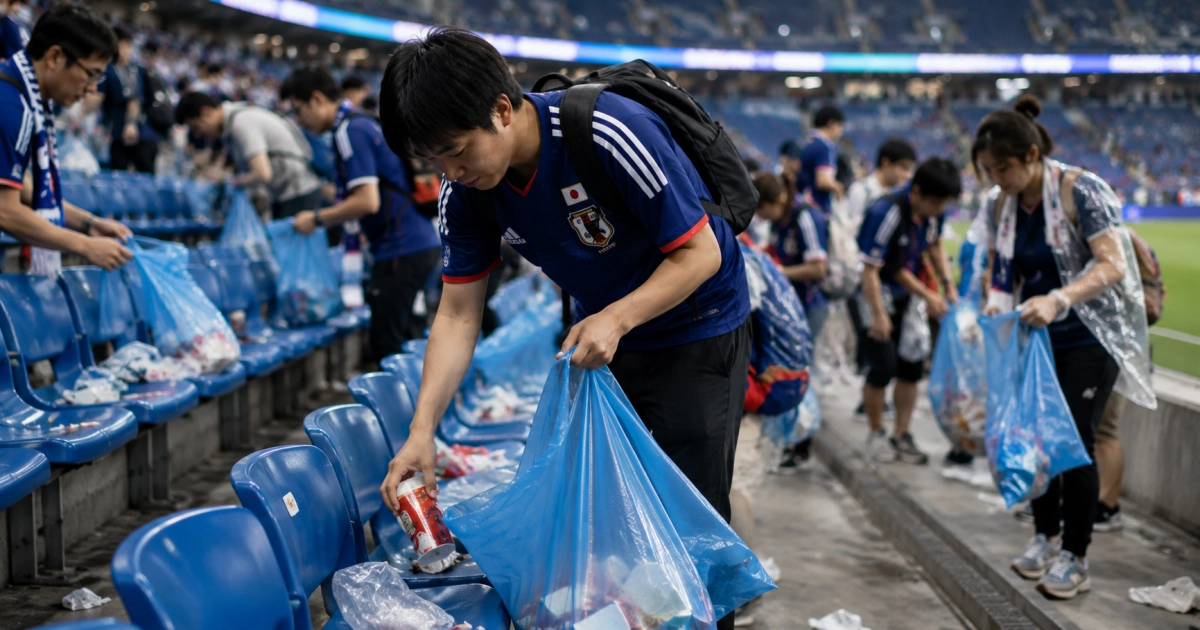

Every time Japan participates in a World Cup or Olympic Games, there is a scene that repeats itself and once again draws the attention of the rest of the world. While most fans quickly leave the stadium after the game, many Japanese fans remain in their seats collecting wrappers, empty cups and other debris before leaving.
This is not an organized campaign nor a requirement from the sports authorities. They also receive no rewards for doing so. So why do they do it?
The answer has more to do with a way of understanding coexistence than with a simple question of cleanliness.
A custom that starts from childhood
In Japan, it is common for children to participate in cleaning their own schools. Students often collaborate on tasks such as sweeping classrooms, tidying up common spaces, and keeping bathrooms and hallways clean. The idea behind this practice is not to replace cleaning staff, but to convey shared responsibility for the places that everyone uses.
Many specialists consider that this daily experience helps develop respect for public spaces and the awareness that each person has a role in collective well-being.
The idea of not causing inconvenience to others
There is also a cultural concept very present in Japanese society: avoiding causing unnecessary inconvenience to other people. In practice, this can be reflected in small actions, such as speaking quietly on public transport, standing in orderly lines or collecting one's own waste before leaving a place.
From this perspective, leaving trash in a stadium for someone else to pick up can be interpreted as transferring one's own responsibility to others. It is much more than an obsession with order and cleanliness: it has to do with respect for shared space.
The stadium, the train, the school or the park are seen as places that belong to everyone and whose care is also a collective responsibility. Therefore, for many people in Japan, picking up trash before leaving does not represent an extraordinary effort or a heroic act. It is simply the right way to leave a place that others will use later.