

Historic record of the Porsche Cayenne EV in the United Kingdom
The electric Porsche Cayenne has yet to make its official debut, but it has already made history on one of the most iconic tracks in British motorsport
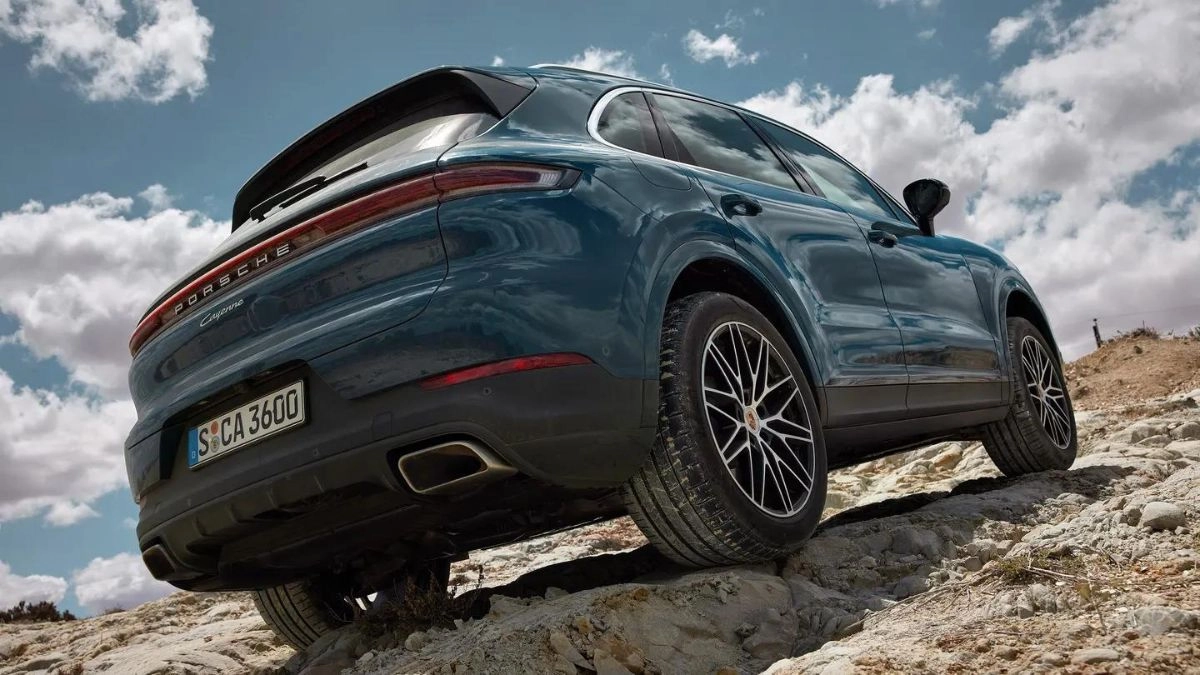

Few saw it coming. In an environment dominated by tradition, roaring engines and British precision, a camouflaged electric prototype burst onto the scene unannounced to snatch a record that seemed untouchable.
Also read: First autonomous Teslas are already circulating in Austin
It was the next electric Porsche Cayenne, which without even having been officially presented, had already been crowned the fastest SUV on the legendary Shelsley Walsh hill climb in the United Kingdom.
You can read: This is how the Xiaomi SU7 makes history in Gran Turismo
There were no announcements or press conferences. Just an unexpected participation in the “Road Cars Series Production Electric” category of the British Hill-Climb Championship, which left everyone with their mouths open.
The Porsche prototype, still covered in vinyl to hide its final shapes, managed to complete the 914-meter course in just 31.28 seconds, a time that places it above any other SUV that has competed there.
Behind the wheel was professional Porsche Formula E driver and developer Gabriela Jílková, who not only was key in the technical execution of the climb, but also helped validate the vehicle's dynamic capabilities in real-life competition conditions.
Broke records without competition preparation
This achievement becomes even more significant when you consider that the vehicle was not modified for competition. It did not have a roll cage, nor racing tires, nor any other type of adaptation. It even had a roof rack, which in theory penalizes aerodynamics.
And yet, it dethroned the Bentley Bentayga W12, which until then held the SUV record with a time of 35.53 seconds. The Cayenne EV not only lowered that time by more than four seconds, but also beat the time of a production electric sports car: the Porsche Taycan Turbo S, which had a time of 31.43 seconds on the same course.
A prototype that already speaks for itself
The feat makes it clear that Porsche's future SUV is not simply an electric reinterpretation of the traditional Cayenne.
It is a vehicle with clear aspirations for leadership in dynamics, acceleration and energy efficiency, all with a design still under wraps. The only visible clues during its time at Shelsley Walsh were its general lines, the grille on the roof, the masked headlights and a camouflage that covered almost the entire body.
In addition, the model emitted a clearly perceptible artificial sound, not because it has a real exhaust system, but because it must comply with regulations that require electric vehicles to alert pedestrians of their presence.
Shared technology, but with its own ambition
This electric Cayenne is based on the PPE (Premium Platform Electric) platform, developed jointly by Porsche and Audi, which also serves as the basis for the electric Macan. It is expected to use an all-wheel drive system using a dual electric motor, powered by a high-voltage battery.
Although Porsche has not revealed the power or range figures, the vehicle's behavior at Shelsley Walsh suggests that the specifications will be above what is conventional for a luxury SUV.
Acceleration was one of the most outstanding: the prototype reached the first 18 meters in just 1.94 seconds, according to reports from the event. That figure is similar to that of professional racing cars.
Performance was further enhanced by the active suspension, which controlled body roll in an exemplary manner.
In many electric vehicles, the low center of gravity imposed by the battery improves stability, but Porsche has gone a step further with a setup that minimizes mass transfers and enables precise traction in tight corners and on steep gradients.
A track with history, a record for the future
The Shelsley Walsh hill climb, opened in 1905, is the oldest hill climb in the world still in use. The 914-meter (exactly 1,000 yards) layout has a vertical drop of 100 meters and a maximum gradient of 16%. It is a technical, demanding course with tight corners that demand acceleration, control, and a refined set-up.
Historically, it has been dominated by internal combustion vehicles. That's why seeing an electric SUV—still in the development phase—establish itself with such clarity marks a change of era.
A preview of what's coming in 2025
Despite the public presentation, Porsche is keeping the technical details and final design of the Cayenne EV secret. The brand has confirmed that its official presentation will take place sometime in 2025,at a global event that will also announce major updates to the internal combustion engine Cayenne range. This confirms that the current Cayenne won't be replaced immediately, but will coexist with its electric sibling for several more years. In fact, Porsche has indicated that it will continue to offer gasoline versions of the Cayenne until at least 2030, to serve markets where the electric transition is progressing more slowly.