

Lack of Workers in Texas: The Jobs You Can Get Fastest
Texas faces a shortage of workers in trades like electricians and welders. What jobs can you get faster and how much they pay
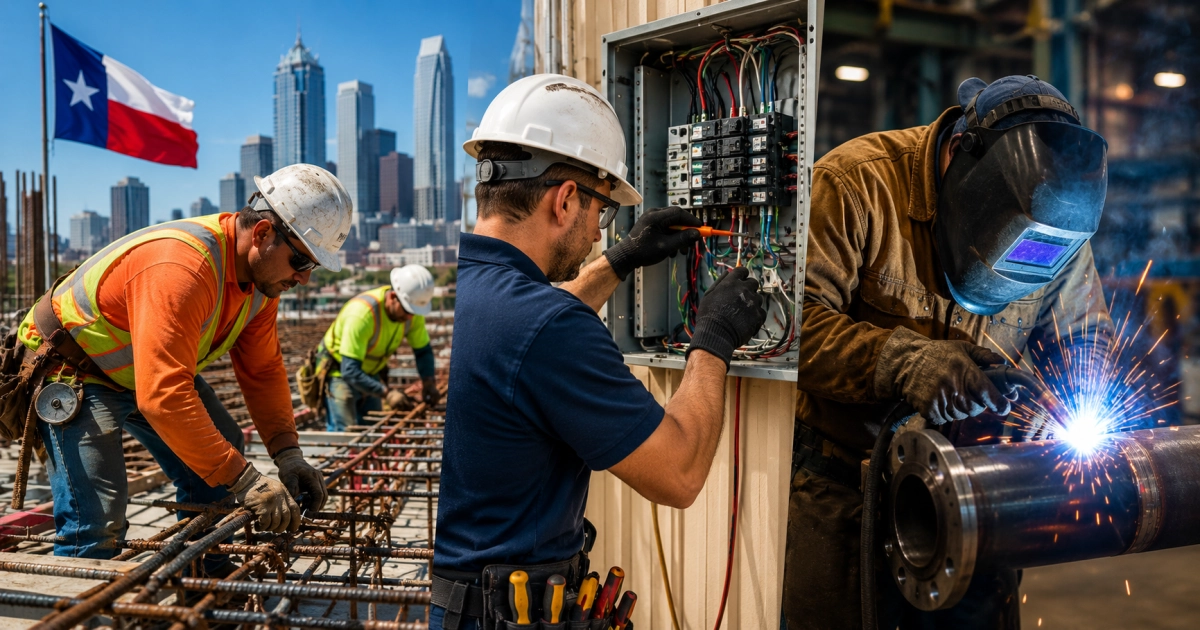

Texas is going through a sustained labor shortage in technical trades and operational jobs, in a context of strong economic growth, construction and industrial expansion. “We need more electricians and so lders to cover the labour demand of the state,” Governor Greg Abbott highlighted, and warned that there is a deficit of workers in key areas and that there are many opportunities for those looking for a first job.
At an event, the Republican governor noted that the state required to produce “thousands of these degrees and certifications” to meet the demand for the coming months.
According to the U.S. Bureau of Labor Statistics (BLS), occupations such as electricians, welders, and construction workers remain in high demand and projected growth over the next decade, driven by infrastructure, energy, and manufacturing projects.
The Texas Workforce Commission also warns in its reports that several of these occupations remain among those with the highest demand in the state. For this reason, there are many open searches and the hours of work are paid increasingly better.
Why are workers missing in Texas?
The shortage responds to a combination of factors. On the one hand, Texas is one of the states growing the most in population and economic activity. On the other hand, sectors such as energy —traditional and renewable— and construction are in full expansion.
Added to that is a structural problem: fewer young people are entering technical trades, which creates a gap that is difficult to fill.
The jobs where there are more opportunities
The deficit is not uniform: it is concentrated on technical and manual jobs that require specific skills, but not necessarily a university degree.
Among the most demanded appear:
In many cases, employers prioritize availability and practical experience over formal academic training.
How Much Does an Electrician or Welder Earn in Texas?
One of the factors that explains the interest in these jobs is the salary level. Unlike other entry jobs, technical trades can offer competitive income from relatively early stages.
According to data from the U.S. Bureau of Labor Statistics (BLS):
In both cases, income can increase with overtime, certifications or specialization. In addition, they are jobs where salary progression is usually faster than in low skilled jobs.
What you need to work in construction
Entering the construction sector in Texas is, in many cases, more accessible than in other fields. University training is not always required, but certain basic conditions are.
In some cases, specific training or prior experience are valued, but there are opportunities for beginners who learn on-the-job.
Agencies such as the Texas Workforce Commission promote vocational training programs, which facilitates access to this type of jobs.
What you need to start
One of the factors that explains the rapid job insertion is that many of these jobs do not require a university degree. However, they do may require basic technical training, specific certifications (in some cases) and practical experience or on-the-job learning.
Texas has training and apprenticeship programs, that facilitate entry to these sectors.
A market with real opportunities
The current scenario shows a clear pattern: there are jobs available, but not enough trained people to fill them. That opens up opportunities for those looking for quick employment or to change sectors.
In a context of high cost of living in other areas of the US, Texas is positioned as a state where it is possible to enter the workforce more quickly, especially in trades.