

The crisis over the Boyle Heights fire is not over
The Los Angeles Fire Department estimates that the warehouse fire could be extinguished by Friday; thousands of air purifiers are distributed
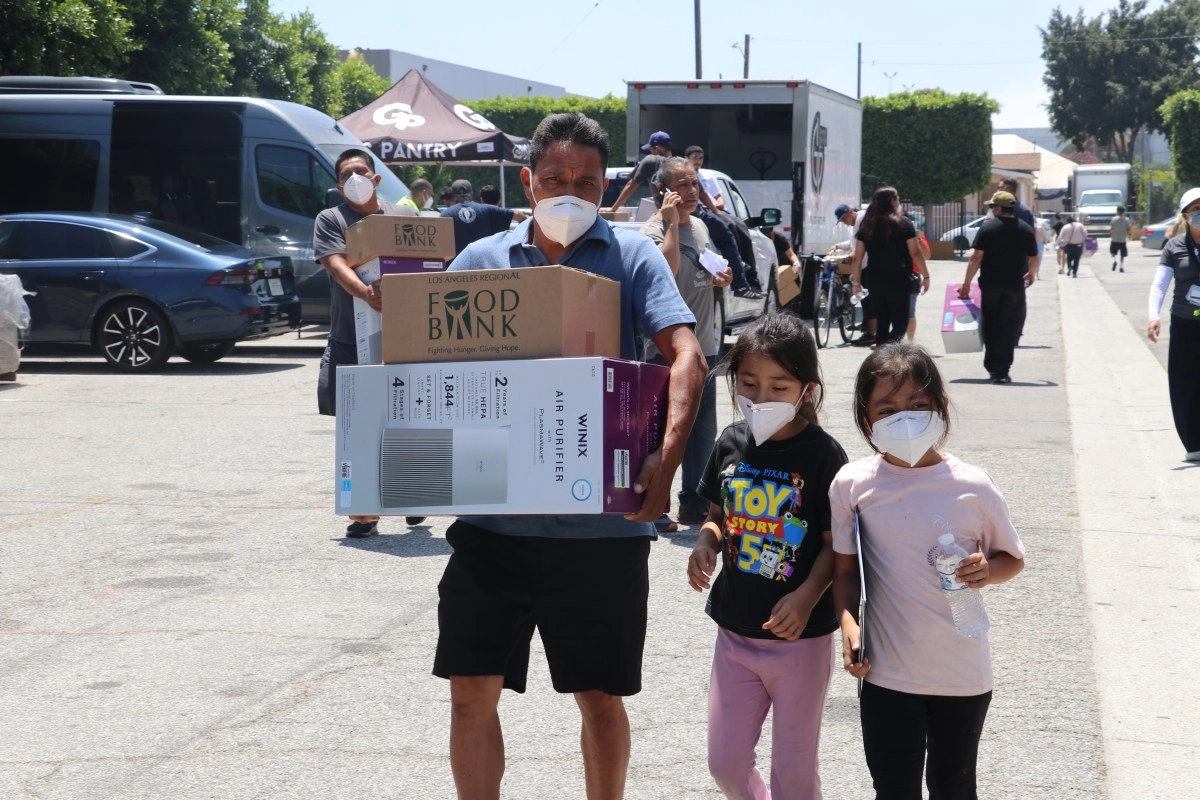

As smoke continues to emanate from the massive cold storage warehouse that burst into flames on Wednesday, Los Angeles city and county officials continued the task of distributing thousands of masks and air purifiers to residents closest to the raging fire on Indiana Street and Union Pacific Avenue in Boyle Heights.
This Monday, hundreds of people lined up at the Nuestra Señora de la Victoria church, in East Los Angeles, where about 300 purifiers were distributed by staff from the office of county supervisor Hilda Solís.
In front of the offices of the councilor for the city's 14th district, Ysabel Jurado, at least 1,000 purifiers would have to be distributed. Families received boxes of food at both sites.
“I came for a purifier for my father [Juan Vázquez] who is 90 years old and lives with my sister Cecilia,” said Gabriela Vázquez Barba. “My dad complained that he couldn't breathe properly.”
The fire remained active for the sixth day and continued to deteriorate air quality within a 2.5-mile radius of the Lineage Logistics warehouse, located at 1400 S. Los Palos St., near the Indiana Street exit of the Golden State (5) Freeway.
Jaime E. Moore, chief of the Los Angeles Fire Department, reported significant progress to control the incident, where water cannons and heavy machinery have been used, and emphasized the need for area residents to remain inside their homes.
“The magnitude of what you are seeing in Boyle Heights reflects what is important about how this region responds when the challenge is significant enough,” he said of the help they are receiving from numerous fire agencies, from San Luis Obispo to Orange County.
All available resources
Moore indicated that his LAFD men have returned to normal operations and continue to serve communities throughout Los Angeles, although he clarified that the fire has required specialized aerial operations, high-capacity water cannons and personnel specialized in fighting oil well fires, in addition to heavy equipment operators and restoration and recovery contractors. Approximately 12,000 gallons of water were released every minute, it was reported.
He noted that, under the current fire conditions, fire activity continued to decline throughout yesterday.
“Heavy equipment operators are systematically removing sections of exterior walls, allowing our firefighters to direct streams of water into previously inaccessible areas of the building and extinguish remaining fire spots and hot spots where those fires are located,” Moore explained. “As suppression efforts continue, we will continue to make progress.”
Crews were also tearing down the exterior walls of the structure to make it easier for firefighters to access more areas of the building that stored millions of pounds of food.
Moore did not say how long it would take crews to fully extinguish the flames, but said he hoped to return control of the building to Lineage on Friday.
They ask to stay at home
Addressing the issue of smoke in the air, the LAFD chief sent a message to the community: “If you are sensitive to smoke or have any respiratory problems, stay indoors, close your windows, and set your air conditioning units to recirculate air instead of taking in air from outside.”
“Incredibly, this fire has been burning since last Wednesday, and I want to make it very clear that this crisis is not over,” said Councilor Ysabel Jurado. “Families continue to deal with the smoke, the smell, the ash, the closure of parks and community spaces, the disruption to their routines, and grave concerns about what they are breathing.”
The official insisted that an independent investigation be carried out into the causes and origin of the fire, which is, for now, in charge of the Los Angeles Fire Department. However, the Bureau of Fire Prevention is also assisting through the arson investigation section, not because it is arson.
The building was leased to Lineage Logistics, which then leased the roof to a solar energy company that had had a fire before. Solar systems had been discontinued.
"You have to keep in mind that when you have solar panels and there is sun, like in Southern California, they continue to generate energy and there is still an electrical risk. So last week when the fire started they were working on the system. They tried to extinguish it. They called 911 and all hell broke loose," explained Chief Moore.
“People are tired, anxious and deserve answers,” said Councilwoman Jurado, who thanked the firefighters and other agencies and organizations. "But as the emergency response continues, we can't lose sight of what residents are experiencing on the front lines. My office has been out in the community distributing masks and air purifiers, connecting residents with resources to alleviate the effects of the smoke, and prioritizing the blocks most affected by the fire, including homes directly across from the warehouse."
Area for low-income families
Aaron Katon, spokesman for the Los Angeles County Fire Department, told La Opinión that there were many chemicals inside the refrigerated goods and meat warehouse.
"One of our first concerns was removing the ammonia because it posed a great danger to both the community and our firefighters. And in order to fight efficiently we have to ensure that our equipment is safe," he said.
After six days of fighting the fire, Katon said that the most important thing that remains is to convince people who are susceptible to the smell of smoke emanating from the destroyed building to stay at home and, if they cannot do so, to go out wearing a mask and protect their health.
The fire occurred in an area where low-income Latino families predominate and where, historically, factories and businesses are installed that produce great pollution to the air, and the environment in general.
“I just had to come home to make food for my family,” said Lety Contreras, whose home is less than 500 meters from the intersection of Union Pacific Avenue and Indiana Street, where the conflagration occurred. “We are going to go to a sister's house.”
She, who does tattoos, and her husband, Edwin Contreras, a hairdresser, did not want to expose their two daughters to suffering from any respiratory illness and would also take their pit bull, “Wish,” from the area.
“I had to stop working because of the smoke,” said Antonio Flores, a construction worker from Jalisco. “Here things got ugly, because when the fire started I heard such a loud roar that I even thought Iran was attacking us or that a plane had gone down.”
Flores, 80, who lives near Third and Indiana Streets, said that, despite being “a strong man,” he suddenly felt dizzy for two days after inhaling the initial black smoke from the fire.
The impact of the fire has already been felt in different businesses in the area adjacent to Lineage Logistics.
“We have had to reduce our operations by 90%,” reported Rodolfo Chavez, owner of La Indiana Tamales. “Despite the losses, customers continue to visit the store, which is a recognition of God who protects us.”
“The clients have stopped coming because they closed the streets and I have only been coming to carry out the work that I had pending,” he told La Opinión. “But, if I calculate the reduction in income, so far it would be about $15,000, and there is no one to claim damages from.”
“We live in a dangerous area”
Carlos Montes, a leader and activist with the Boyle Heights CSO Center, said it was not surprising that the large fire occurred at the 491,000-square-foot Lineage Logistics warehouse.
“The problem is deeper in the area because there are a large number of factories and businesses that pollute the environment especially in the area of Union Pacific Avenue and Indiana,” Montes said. “We are attached to the city of Vernon, where the Exide company's decades-long contamination occurred.”
Montes added that along several miles of the Los Angeles River, along Soto Streets and Washington Boulevard, there are numerous polluting factories, and the heavy traffic of heavy trucks adds to the chain of pollution between the 5, 10 and 710 freeways.
“We live in a dangerous area because we breathe the most polluted air in Los Angeles,” he said. "Millionaires build businesses, large plants, and accidents have always occurred; their criminal pollution practices do not end."