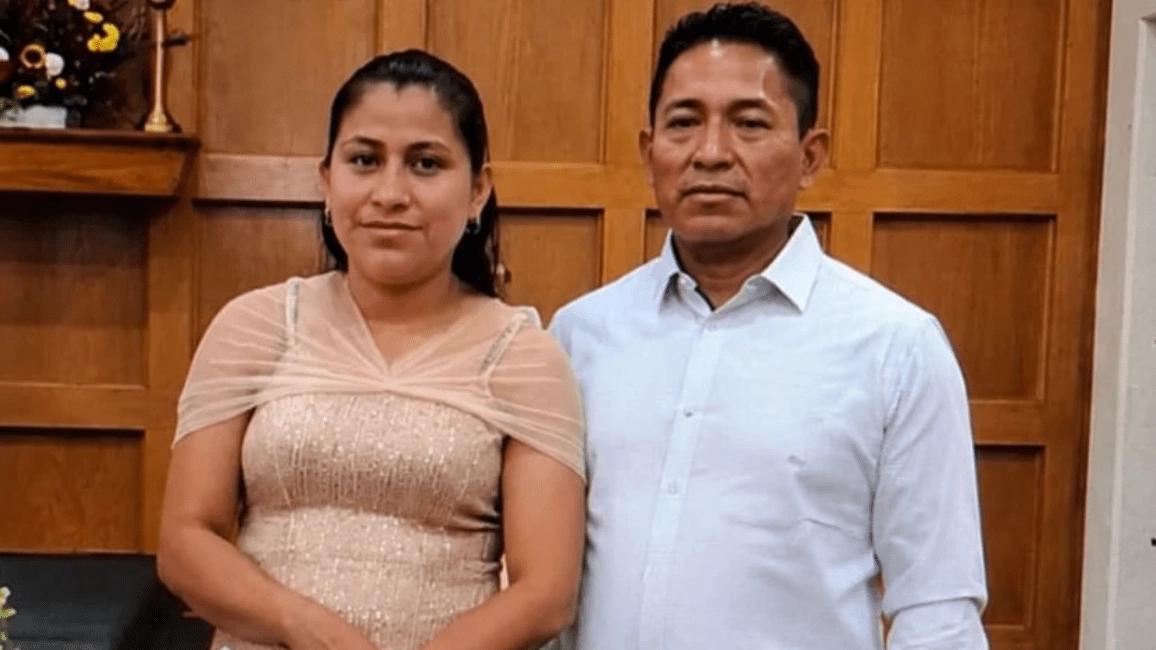

The “American dream” of Nixon Pérez Paz and Glendy González de la Cruz ended in a sugarcane field in southern Guatemala.
Their bodies were found there, with gunshot wounds, on July 21.
It had been just over a year since Pérez Paz, 43, had been deported from the United States, and barely a month since González, 25, decided to return to her native country with their three daughters, to join him and continue their family life there.
Next to the bodies, the police found the youngest of the girls, Giovanni, 14 months old, alive but seriously dehydrated.
“This is how many of the immigrants in the US fear that they will end up,” a friend of the couple named Liliana, who prefers to identify herself only by her first name, tells BBC Mundo.
“We live with that fear that they may catch us and separate us from our husbands, our children, or that they will return us to the dangerous country from which we fled,” he adds.
Detention and deportation
In 2019 they left Guatemala behind to look in the US for an alternative to poverty and violence. He emigrated first, crossing the border from Mexico irregularly, and she followed him months later, along with her then only daughter, Marisol.
After a brief stay in Texas, they found stability in Overland, a quiet city of about 15,000 inhabitants in the state of Missouri, in the American Midwest.
There they had their second daughter, while Pérez Paz worked as a roofer and González alternated jobs in fruit packing plants, bottling plants and other factories.
In March 2021, his brother, Rolando Pérez Paz, joined them, as he told BBC Mundo.
The family's ordeal began on April 15 of last year, when at the start of their work day, both brothers were intercepted by the Immigration and Customs Enforcement Service (ICE).
“Several agents got out of an unmarked vehicle and surrounded us,” Pérez Paz recalls by phone from Guatemala.
After being forced out of their work truck, they were placed in handcuffs and shackles and taken first to a detention center and then to the Phelps County Jail.
“They told us that they were arresting us for having entered the country irregularly and that they were going to deport us,” says Pérez Paz, who confirms that neither he nor his brother had legal status.
When asked by BBC Mundo, ICE confirmed the arrest.
“Nixon Pérez Paz, a criminal illegal immigrant from Guatemala, was arrested during targeted immigration control operations,” reads the message attributed to an agency spokesperson and sent to this media by email.
“He had been convicted twice of driving under the influence in Overland, Missouri, once in 2020 and once in 2024,” he continues. “He received due process, a final expulsion order was issued on April 21, 2025, and he was deported to Guatemala in May” of that year.
A month later his brother was also expelled. “I stayed fighting my case with the help of an organization, but there was no way,” he laments.
Pregnant again, González de la Cruz remained in Overland, where a month later she would give birth to her third daughter.
“After being left alone to care for the family, Glendy struggled for an entire year to make ends meet,” the Missouri Workers Center (MWC) organization says on its social networks.
The Guatemalan collaborated with this group, advocating for the rights of migrants through its organizing committee, called Fuerza.
"Glendy started coming to Fuerza meetings three weeks after giving birth. Even though she had two jobs, she showed up, brought in new members, even when she saw her world falling apart," MWC recalls in her message.
“In June, to protect her daughters and keep the family together — and fearing that she could lose custody of the girls — Glendy made the difficult decision to return to Guatemala, despite having an appointment for her asylum process set for 2027,” adds the organization, something that BBC Mundo has not been able to corroborate.
So far this year, the Central American country has received 38,720 deportees, according to the most recent figures from the Guatemalan Migration Institute (IGM), an increase of 47% compared to the same period last year. More than 90% of those deported were sent from the US, and the rest from Mexico.
With gunshot wounds
Back in their native country, the family settled in the municipality of San Andrés Villaseca, a rural area in the department of Retalhuleu, 175 kilometers west of the capital.
The last time they were seen alive was on July 20, when they left their house to carry out some procedures.
“When we saw that they did not return, we reported the disappearance to the police and the community authority,” recalls Rolando Pérez Paz. “Thank God the communities here were willing to help.”
Alerted by the cries of a baby, the next day the neighbors discovered the couple's bodies in a nearby sugar cane field.
Upon arriving at the scene, as confirmed by the National Civil Police (PNC) to BBC Mundo, the agents found them with their hands tied behind their backs and gagged, without belongings and with possible gunshot wounds to the neck and head.
In the area they also found shell casings, a towel and a white and pink Champion brand shoe cataloged as evidence, and they seized a red motorcycle at the scene.
The PNC did not respond to BBC Mundo's question about whether the couple was the target of violent incidents in the past or reported threats, and, according to local media, it is now working together with the prosecutor's office to try to clarify what happened.
“This case reflects how broken the system is”
Guatemala went from 16.1 homicides per 100,000 inhabitants in 2024 to 17.65 in 2025, more than double the world average, according to the Center for National Economic Research. And although in the first half of 2026 there was a decrease compared to that same period last year, in June the numbers rebounded again.
Experts attribute it mainly to power struggles between different gangs, in addition to drug trafficking.
Already at the beginning of last year, a wave of violence that started with simultaneous riots in three prisons revealed the power that these groups still have in Guatemala, and especially Barrio 18, which disputes the hegemony of the streets of the capital and other locations with its eternal rival, the Mara Salvatrucha (MS-13).
That forced President Bernardo Arévalo to decree a state of siege, accusing “political-criminal mafias” of trying to destabilize a government surrounded by violence and growing institutional tension.
The identity of those responsible for the death of Glendy González and Nixon Pérez in Retalhuleu and their motives remain to be clarified.
Whoever it was, “they took away what I loved most,” Rolando Pérez Paz laments today.
“My brother, my sister-in-law, (were) people who wanted to work, who wanted to fight,” he emphasizes. “In the last few months we always lived in fear of raids, of being caught,” he admits.
“Now what constantly comes to mind is that if immigration hadn't stopped my brother, my sister-in-law might still be alive and the girls wouldn't be going through this pain.”
To help with the support and education of the minors, who were left in the care of the extended family in Guatemala, funds are being raised through the GoFundMe platform.
He also organized a vigil Sunday in front of Overland City Hall to honor the couple's memory.
“This case reflects how broken the system is,” Zachary Mueller, strategist at States at the Core, a non-profit entity that promotes inclusive democracy and works with organizations like MWC, tells BBC Mundo.
"It disproves the idea that any of this [the deportations] has to do with public safety. Now there are two people dead and three little girls who were left without their parents for the rest of their lives."