

The slave Isaura, the fascinating story of the white servant that led Fidel Castro to suspend the electricity rationing
The Brazilian soap opera premiered in 1976, based on an 1875 novel, toured the world and won hearts.
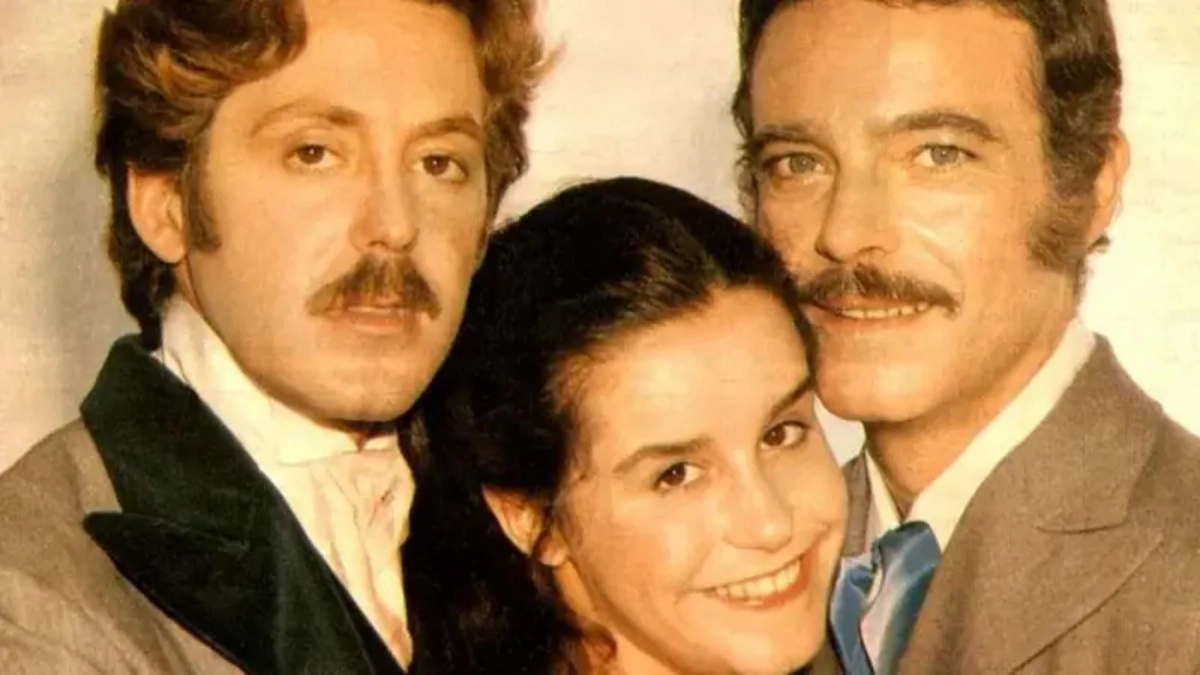

In 1985, Lucelia Santos traveled to China for the first time time, and visited the Great Wall.
“The crowd was so large that it was covered by the press,” recalls retired ambassador Paulo Antônio Pereira Pinto, who served in Beijing between 1982 and 1985.
“Elizabeth Taylor, who was there at the same time, only appeared in a discreet photo in the newspaper.”
Lucelia flew about 25 hours to receive the Golden Eagle award, the “Chinese Oscar.” Unlike other awards, winners are not chosen by a special jury, but by popular vote.
The Brazilian, the first foreign actress to win in the Best Actress category, received 300 million votes.
At the Beijing airport, on her way home, Lucélia heard a chorus of hundreds of voices: “Isola, laila!” (Come back, Isaura!)
China was one of more than 120 countries that, according to a TV Globo survey, watched the soap opera “Esclava Isaura,” written by Gilberto Braga based on the novel by Bernardo Guimaraes (1825-1884).
Guimaraes was born and died in Ouro Preto, Brazil, and studied law at the Faculty of Law in Sao Paulo, where he met future writers, such as the novelist Jose de Alencar, author of “El Guarani” and “Iracema”; and the poet Alvares de Azevedo, of “The Twenty-Year Lyre” and “Night at the Tavern.”
He was a judge and the author of 17 books, including novels and poems.
But “The Slave Isaura” (1875), about a white slave who lived on a farm in Campos dos Goytacazes, is his most famous work.
So much so that, during a visit to Minas Gerais in 1881, the then Emperor Dom Pedro II wanted to meet him.
“He was an excellent storyteller who enjoyed success in virtually all media: circus, theater, cinema, radio soap operas, and even comics,” says Mauro Alencar, a doctor in Teledramaturgy from the University of Sao Paulo and author of “Brazilian Hollywood.”
The book “The Slave Isaura” was published 150 years ago, in the midst of the abolitionist campaign.
Thirteen years later, in 1888, the Golden Law was signed, ending slavery in Brazil.
In the story, Isaura is the daughter of the maid Juliana and Miguel, the foreman of Commander Almeida’s estate. The girl loses her mother and is raised by Ester, the Commander’s wife, who promises to free her before she dies.
However, her only son, Leoncio, inherits the property and, in love with Isaura, does not keep his mother’s promise. Ester dies without seeing Isaura free.
The television adaptation
The idea of adapting Guimaraes's book for television, however, did not come from Gilberto Braga, the author of the soap opera, but from his former literature teacher at Colegio Pedro II in Rio de Janeiro, Eneida do Rego Monteiro.
"You hit the nail on the head. There is no better book," the former student told her.
Braga read the first ten pages and called director Herval Rossano. Together, they had already adapted “Helena” (1975), from the play by Machado de Assis, and “Señora” (1975), by José de Alencar.
When writing the script for “The Slave Isaura,” Braga made adjustments to the original: he created characters, like Tobias (Roberto Pirillo), and changed endings, like that of Malvina (Norma Blum).
In the book, Malvina abandons her husband, Leoncio (Rubens de Falco); in the novel, she dies in an arson attack.
Malvina’s death, in fact, was an imposition of censorship: a married man could not “court” another woman, in this case, Isaura.
When it came time to choose the actress to play the main character, Rossano invited Débora Duarte. Pregnant with her second daughter, she declined the invitation.
It was then that the director remembered a newcomer who was starring in a play in Rio de Janeiro.
Lucélia was 19 years old and had never acted for television.
At first, Braga did not approve of her choice; He preferred another actress.
'Romanticized Discourse'
The cast, however, was the least of the author's problems.
In the first chapters, the censors were bothered by the depiction of the mistreatment of black people.
They even banned the use of the word “slave,” which referred to an uncomfortable subject for a regime not at all interested in criticism and historical revisions.
Skillfully, Braga had to replace it with “piece.”
“Slavery was seen by the dictatorship as a stain on history that should be erased or shown without much fanfare,” explains journalist Maurício Stycer, co-author of the biography “Gilberto Braga, the Balzac of Globo.”
In the last chapter, they even hinted at Leoncio's suicide. The solution was to simply leave it understood.
In the biography “And Thus Was Born the Slave Isaura” (1985), historian Armelim Guimarães, grandson of Bernardo Guimarães, recounts that his grandfather had the idea of writing the book in 1874 after witnessing a whipping scene.
“It is obvious that if Bernardo had imagined a Creole slave, his novel, written during the slave regime, would never have achieved the resounding success it had,” he declared in 1998 in a text published on the website “Life and Work of Bernardo Guimaraes.”
“Whoever reads this immortal book will find Bernardo’s repudiation of discrimination against black people and the captivity imposed on our brothers of color.”
“The Slave Isaura” captivated not only readers and viewers, but also critics and scholars: it was the subject of several articles, theses, and dissertations, such as that of journalist Luciana Barros Goes, who holds a specialization in Film and TV and a master's degree in History.
“For decades, 'The Slave Isaura' represented the portrait of slavery in Brazil. It is a soap opera that portrays the slave past from a romanticized discourse,” she laments.
A good example of this “romanticized discourse,” the researcher points out, can be seen in the last chapter, when Álvaro (Edwin Luisi) announces, together with Isaura, the manumission of the hacienda captives.
The blacks, all smiling, listen to the speech and then celebrate with their masters, the benevolent white men.
It is a narrative that incorporates a historiography based on a Eurocentric perspective. A version of the so-called official history in which the liberation of slaves only occurred thanks to whites, without any act of resistance on the part of blacks.
For 23 years, “La esclava Isaura” was the TV Globo soap opera that broke sales records abroad. In 1999, its record was surpassed by “Tierra Nuestra” by Benedito Ruy Barbosa.
“The Slave Isaura” was so successful abroad that, ten years later, TV Globo decided to adapt “Niña moza” (1986), written by Benedito Ruy Barbosa based on the novel of the same name by Maria Dezonne Pacheco Fernandes, published in 1950.
When the television network announced that the protagonists would be played by Lucélia Santos and Rubens de Falco, the same duo from “The Slave Isaura,” expectations rose to the peak.
Even before the telenovela premiered, 50 countries had already expressed interest in buying it. In total, 63 countries, according to unofficial estimates, saw the plot of “Nina moza.”
The adaptation reproduces the same romanticized discourse as “The Slave Isaura,” Goes denounces.
In the last chapter of “Young Girl,” the protagonist welcomes the Italians who, riding in carts, arrive at the Araruna farm to work.
In the following scene, the blacks, now freed, walk barefoot, shirtless, and with a hoe on their shoulders, in the opposite direction.
“…And of all they planted, nothing remained: neither the land nor the fruits. Only freedom,” wrote the author Barbosa.
“Another scene that demonstrates an idealized slave regime. Without any act of resistance, we now have a new Brazil. A country of hope that is reborn with the work of immigrants,” says Goes.
“It is difficult to talk about progress.”
Distinguished viewers
Before Despite the criticism that would come in the following decades, the soap opera “La esclava Isaura” - which aired on TV Globo from October 11, 1976 to February 5, 1977 - attracted illustrious viewers.
He had barely finished the first episode when the author’s home phone began to ring.
Over time, he would learn to guess who was calling: the writer Nelson Rodrigues.
A fan of Isaura, he wanted to know firsthand what would happen in the next episodes.
“Lucelia became a kind of muse for Nelson,” says journalist Ernesto Rodrigues, author of a trilogy about TV Globo.
Throughout her career, Lucelia Santos made a television miniseries, two plays, and four films based on the work of the “Pornographic Angel,” as Nelson Rodrigues was called in a biography written by Ruy Castro.
“The soap opera was a hit before it even aired,” Lucelia Santos told the website Memoria Globo.
“The day after the first trailer was released, people started recognizing me on the street. When I had to leave the house, the kids would follow me humming the opening theme song: 'lerê-lerê,'” the actress laughs, referring to the song “Retirantes,” with lyrics by Jorge Amado and music by Dorival Caymmi.
Not even Josef Mengele, the Nazi doctor who lived as a fugitive in Brazil for almost 20 years, missed a single episode of “The Slave Isaura.” This was revealed by journalist Betina Anton in “Baviera Tropical” (2023).
“He said he didn’t like the play because it had too many black people in it. But he watched it anyway for the pleasure of seeing how the slaves were mistreated,” the author recounts in the book.
Another regular viewer was Cuban President Fidel Castro.
“The soap opera was a ratings phenomenon in the country,” says researcher Aladim Miguel,creator and editor of a website dedicated to actress Lucélia Santos.
“In addition to watching every episode, [Fidel] ordered the suspension of traditional electricity rationing during the telenovela’s broadcast.”
Among the most valuable objects in his collection, Aladim highlights two donated by Lucélia herself: a sticker album from Cuba, La Esclava (1984), and a painting by a Polish visual artist.
Thanks to the telenovela, actor Edwin Luisi, who played Álvaro, visited countless countries, including Portugal, the United States, and Mexico. However, nothing compares to what he saw in Cuba.
“They received me like a rock star,” he laughs.
“I felt like one of the Beatles.”
The reason for so much success? The eternal struggle between the oppressed and the oppressors, says the actor.
“Lucélia played the oppressed; Rubens de Falco, the oppressor; and I, the liberator,” he explains.
In an interview for the book “A continuación, figuras del siguiente capítulo” (Next, Scenes from the Next Chapter) (2009), Gilberto Braga said he didn’t understand why it was so successful.
“'The Slave Isaura' isn’t exactly a well-written novel, although it has an absurdly good plot,” he conceded.
Even so, he risks offering an explanation.
“The slave desired by her owner provokes fear in the viewer, perhaps the most intense of all feelings.
“We all fear those who are stronger. “Who wouldn’t identify with this slave?” she asked in the same interview.
Manual for Success
If today “Avenida Brasil” is, according to a TV Globo survey, the best-selling soap opera on Brazil’s main television drama channel, having been exported to 147 countries, this is thanks to “La esclava Isaura.”
It was Globo’s first soap opera sold to countries behind the former Iron Curtain (which divided the communist and capitalist blocs in Europe), such as Latvia, the Czech Republic, and Ukraine. And on the African continent, such as South Africa, Zimbabwe, and Madagascar.
In Europe, “La esclava Isaura” has already been performed three times in Switzerland, five in Germany, and seven in France.
It was responsible for, among other feats, a stunt competition in Poland in 1985, which attracted 8,000 candidates.
And, according to some Reports of a ceasefire in the Bosnian War in 1995.
“There was no bombing during the telenovela’s broadcast,” Lucelia Santos recalled on the program Uncensored, aired on May 21, 2025.
In at least two countries, Poland in 1984 and Hungary in 1986, viewers held fundraising campaigns to “buy” Isaura’s freedom.
Along with Ivani Ribeiro’s “The Journey” (1994),“La esclava Isaura” (1976) is the most re-run soap opera on Brazilian television: four times on Globo (1977-1978, 1979-1980, 1982 and 1990) and once on Canal Viva 70 Fest (2024).
Since 2023, the soap opera is available, in its entirety, on Globoplay.
On television, Guimarães’s novel was also reinterpreted by Record, “La esclava Isaura” (2004), written by Tiago Santiago and directed by Herval Rossano.
“Herval Rossano liked to say that, when directing 'La esclava Isaura', he followed the script of the Mexican soap opera to the letter,” reveals journalist Ernesto Rodrigues.
“If you’re bad, you have to do something evil in every episode. If you’re good, you have to suffer one evil thing per chapter.”