

Operation Midnight Hammer against Iran was the largest B-2 bombing in the history of the USA, the Pentagon affirms
Secretary of Defense Pete Hegseth said that no other country in the world could have carried out a bombing like this in Iran
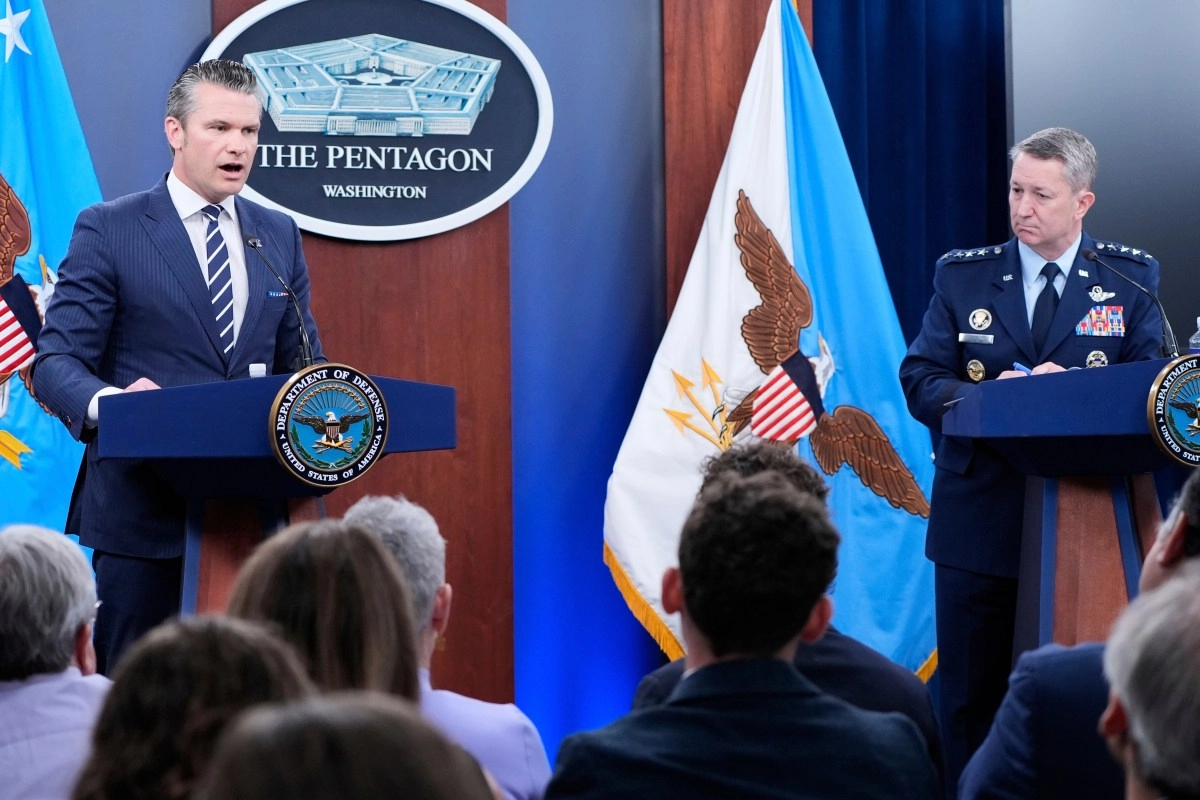

Operation Midnight Hammer, with which the United States attacked Iranian nuclear facilities by surprise, was the largest B-2 bombing in the history of the country, in an operation that had been prepared for months and that used decoys to take Tehran by surprise.
That’s how senior Pentagon officials described it Sunday at a press conference to provide details of the operation with which US President Donald Trump entered Israel’s war against the Islamic Republic last night with the official goal of preventing Iran from obtaining a nuclear bomb.
“No other country in the world could have carried out an operation like this,” said Defense Secretary Pete Hegseth, who stressed that the United States has “the greatest military power the world has ever seen.”
The largest B-2 bombing in history
In total, more than 125 aircraft participated, including seven B-2 bombers, refueling tankers, reconnaissance aircraft and fighter jets. 75 bombs and missiles were used in the attack.
B-2 Spirit bombers are strategic fighter aircraft designed by the United States to penetrate heavy air defenses and carry out precision strikes, capable of achieving high radar invisibility.
These aircraft dropped more than a dozen 13,600-kilogram bunker-busting bombs on two key nuclear facilities: Fordó and Natanz. The United States also fired Tomahawk missiles from a submarine at Isfahan.
This was the largest B-2 bombing raid in U.S. history, and the longest B-2 mission since the September 11, 2001, attacks, according to Joint Chiefs of Staff Chairman Gen. Dan Caine.
Operation Timeline
The operation began Friday night and continued through Saturday, Washington time.
The bombers took off from Whiteman Air Force Base,in Missouri. Some flew to Guam in the Pacific as decoys, while the rest secretly headed east on a flight that lasted about 18 hours.
At 5:00 p.m. (9:00 p.m. GMT), a US submarine launched more than two dozen cruise missiles at the Isfahan nuclear facility as the aircraft entered Iranian airspace.
At 6:40 p.m. (10:40 p.m. GMT and 2:10 a.m. Sunday in Iran), B-2s dropped two GBU-57 heavy bombs on the Fordó nuclear site.
The rest of the attacks then continued, and the last targets were hit at 7:05 p.m. (11:05 p.m. GMT).
After completing the attack, the US forces returned without suffering casualties or receiving enemy fire. “The Iranian fighter jets did not take off, and their surface-to-air missile systems did not appear to detect our presence,” General Caine said.
Trump oversaw the operation from the White House situation room, where he arrived late Saturday after spending the day playing at his New Jersey golf course.
Undetectable to Iran
Pentagon officials said the operation was planned for weeks and months, even as diplomatic talks with Tehran were underway seeking a deal on its nuclear program. “We had to be ready for when the president made the call,” Hegseth said.
It was a highly classified mission: very few people in Washington knew its timing or nature, Caine added.
The defense secretary insisted that it was a surgical strike against Iran’s nuclear program, with no troops or civilians affected.
“This mission was not intended to lead to regime change. The president authorized a precision operation to neutralize the threats to our national interests posed by Iran’s nuclear program and to defend our troops and our ally, Israel,” Hegseth said.
In an address to the nation Saturday night, Trump said the Islamic Republic must now choose between “peace or a tragedy greater than you’ve seen in the last eight days.”
But the Republican, who campaigned critical of U.S. operations in the Middle East, now faces internal dissent within his own movement that opposes interventionism. military.