

“Goleada” for SoFi Stadium workers: they get up to $40 per hour
About 2,000 SoFi Stadium workers avoid going on strike days before the World Cup match between the United States and Paraguay
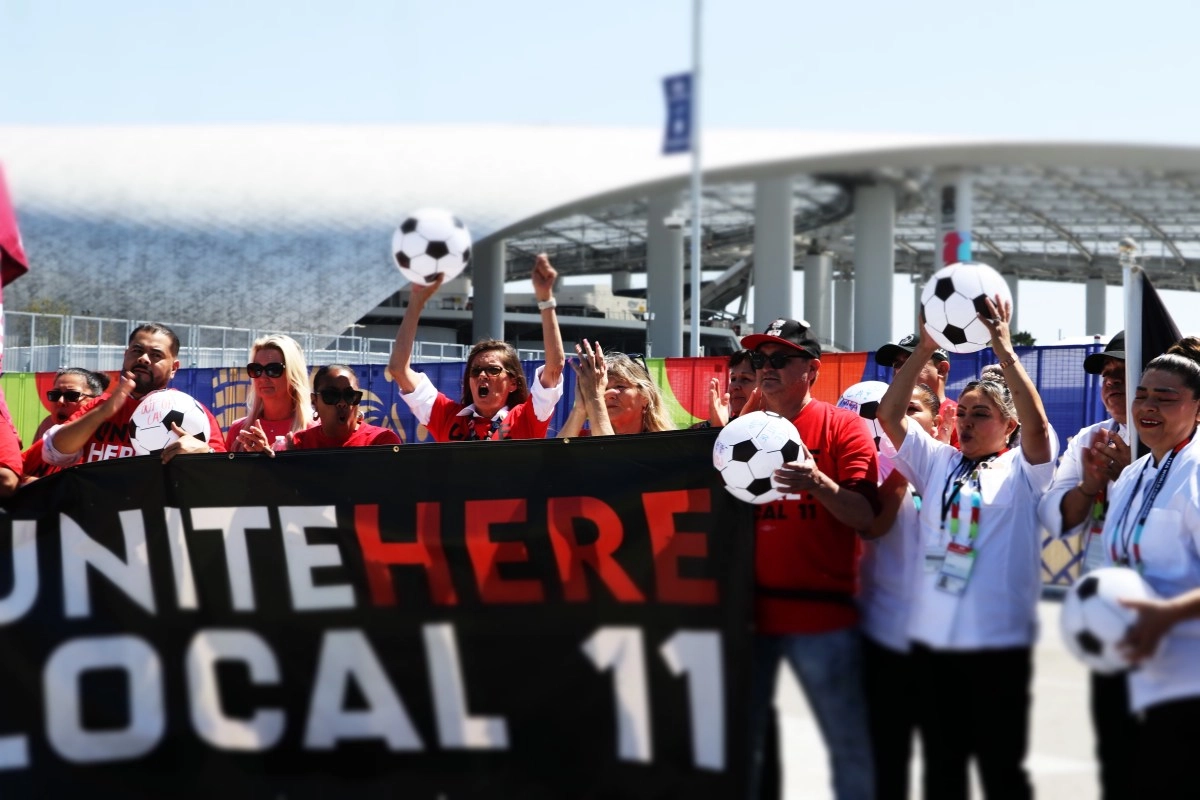

The slightest presence or activity of Immigration and Customs Enforcement (ICE) agents inside or around SoFi Stadium before, during or after the 2026 FIFA World Cup matches will be cause for at least 2,000 unionized workers to break the contractual agreement they reached this Tuesday and go on strike.
Amid hubbub and caution, leaders of the Unite Here Local 11 union and workers declared a “historic victory” by achieving salaries of up to $40.00 an hour and becoming the highest paid in NFL stadiums.
“We won by a landslide 3-0,” celebrated Raymundo Millán, who has worked as a cook at SoFi Stadium for five years. “The goals were scored by the cooks, bartenders and all our colleagues from the dream team that was negotiating the defense of our rights.”
The provisional agreement with the powerful company Legends Hospitality was reached before the first match of the World Cup, this Friday, June 12, in the debut of the national teams of the United States and Paraguay, in Group D action complemented by Australia and Turkey.
“Until the last moments they said that they had no money, but they realized that we would not give in,” added Millán, born in Mexico City. “We were determined to do everything.”
Unprecedented provision if there was a threat from ICE
The interim agreement guarantees substantial wage increases, historic labor protections and pioneering privacy rights.
The negotiation also agreed to include the explicit right to strike if ICE or Border Patrol activities in the workplace threaten the safety of employees; a provision that legal experts say is unprecedented in modern American labor history.
If ratified, the contract will expire on April 30, 2028, aligning with more than 100 concession contracts in stadiums, hotels and airports that expire before the Olympic Games.
"These workers are heroes. They stood up to FIFA. They stood up to ICE. They got a historic contract and are prepared for whatever the World Cup brings. If federal immigration agencies threaten the safety of workers, our members have the right to walk off the job. That's already stipulated in their contract," said Kurt Petersen, co-president of UNITE HERE Local 11.
The union had expressed concern about FIFA's accreditation process for World Cup workers, which requires the submission of personal information, including Social Security numbers and fingerprints.
At the end of the negotiations, the agreement stipulated that future accreditation processes for major sporting events will be regulated, guaranteeing that workers will not be required to provide the same level of personal information for events such as the Super Bowl or the Olympic Games.
Union leader: “We had many MVPs”
“We won 10-0… the food and drink workers were the ones who scored all the goals,” Petersen told La Opinión. “We had a lot of MVPs—most valuable players—in this battle.”
The union leader emphasized that "the final battle has not been won, because they [ICE] could still launch their terror campaign. So what we managed to get was a tool for the workers to protect themselves: the strike. It was the last one we had yet to win; but, after the vote in favor of the strike, the company clearly understood that we were not going to give up that right."
Yolanda Fierro, a candy dispenser at SoFi Stadium and a member of the UNITE HERE Local 11 union, recalled that workers made it clear that ICE should be left out of the World Cup.
"We do not want them to have any role during the matches. We are seriously concerned that FIFA, by being here, could disclose our most sensitive personal information; this would not only violate our rights under California law, but would also affect those of us who will be working here during the World Cup," he said.
In fact, they specifically asked FIFA not to share workers' information or data with ICE, foreign countries or intelligence agencies.
“We cannot celebrate the World Cup while workers, tourists, our immigrant families and local communities feel unsafe in Los Angeles,” Fierro said. "We should be a city that welcomes everyone, not one that instills fear. We demand that ICE stay out of it."
Isaac Martínez, cook at SoFi Stadium, highlighted that having achieved a salary of $40 an hour will help him improve his quality of life, although they still need more to cover high costs such as gasoline, recurring payments and the basic food basket.
“Since January, when the NFL season ended, I was living off unemployment, but now I will have a guaranteed stable job,” he shared.
For her part, Susana Lahorgue, 64, a leader in food sales and who for more than a decade has gone from job to job, believes that her life will change thanks to the new employment contract: "You get tired of walking around in life. That's why we have to always keep fighting."
Summary of the workers' triumph
Historic pay increases: The largest increases in history for stadium workers, with significant bonuses for events like the World Cup and the Super Bowl.
Worker Housing Fund: Legends will make a multimillion-dollar contribution to a fund aimed at developing housing for hospitality workers.
Historic labor protections: A 75% reduction in subcontracting over the life of the agreement, backed by an industry-first penalty mechanism.
Restrictions on AI and automation: New self-checkout systems, kiosks, and cashierless technology cannot be implemented, protecting jobs.
Pioneering privacy rights: Workers cannot be forced to hand over their Social Security numbers, immigration status or country of origin to obtain accreditation for mega-events like the World Cup. The contract prohibits compliance with FIFA accreditation requirements in this regard.
Unprecedented right to strike: Workers have the contractual right to walk away from their jobs if the union determines, in good faith, that actions by federal immigration agencies threaten the safety of employees during a World Cup match.