

Sheinbaum's paradox in the World Cup: Between the popular refuge in CDMX and Donald Trump's diplomatic box
The president of Mexico did not attend the opening of the World Cup in CDMX, but she will travel to New York to witness Argentina vs. Spain
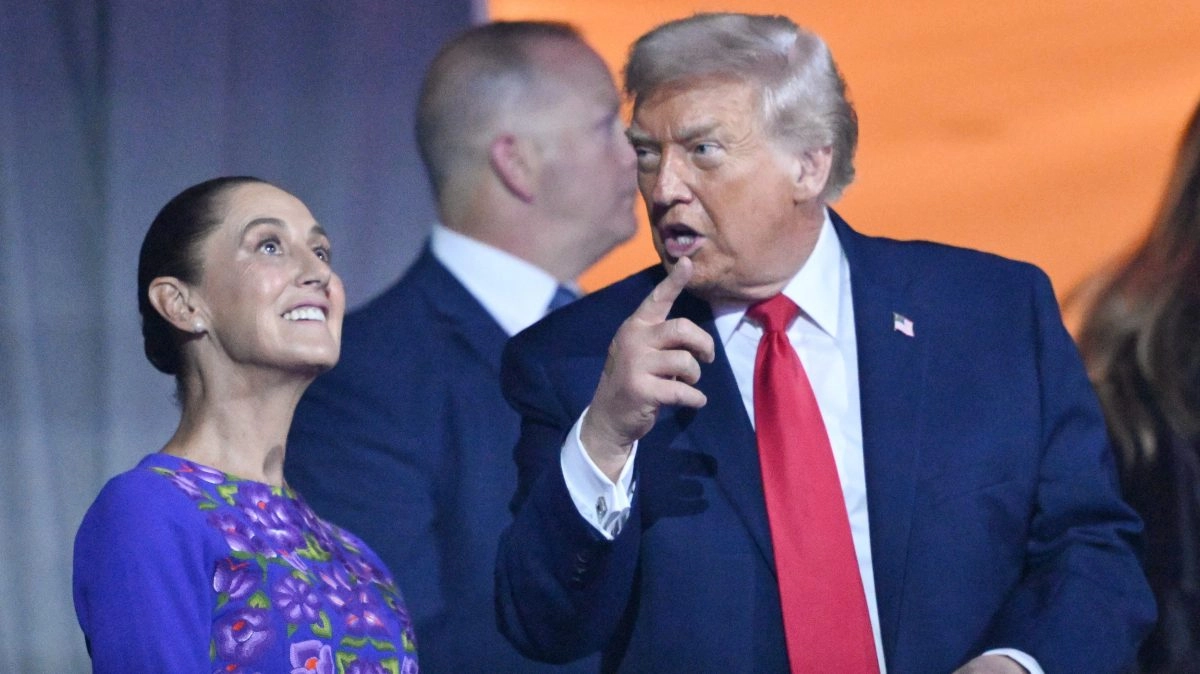

From local protection to American VIP diplomacy: after avoiding the opening of the 2026 World Cup at the Banorte Stadium (formerly the Azteca Stadium) presumably to shield herself from the boos of the Mexican public, President Claudia Sheinbaum confirmed that she will travel to New York to attend the grand final of the tournament.
Directly invited by her counterpart Donald Trump, the president will occupy a place of honor at MetLife Stadium, a controlled international stage where analysts predict that she will be safe from protests, questions or dissatisfied citizens.
Did you break protocol at the inauguration?
The president of Mexico, Claudia Sheinbaum Pardo, broke with the traditional protocol of leaders at large-scale sporting events. Instead of occupying the presidential box of the Mexico City Stadium (Azteca Stadium) for the opening of the 2026 World Cup, the head of the federal Executive chose to follow the debut match of the Mexican National Team against South Africa from the Deportivo Hermanos Galeana, a public space located in the Gustavo A. Madero mayor's office.
Accompanied by the head of Government of Mexico City, Clara Brugada, the president lived with hundreds of fans who gathered at one of the 18 giant screens and free Fan Zones distributed in the capital. However, its absence in the Santa Úrsula colossus sparked an intense political debate between the government's austerity narrative and the opposition's unofficial versions.
The official version: Austerity and a free ticket
During the days before the start of the tournament, Claudia Sheinbaum argued that her decision not to attend the stadium responded to a policy of consistency and austerity. The president described as “inaccessible” the ticket prices for the general public, which were quoted at up to 120 thousand pesos in the most exclusive areas, and that she preferred to be with the poor.
A month later, his rhetoric apparently changed and he will be present in New York on a trip that represents an expense for the public treasury, contradicting his austerity policy.
As part of this message, the Federal Government announced that protocol ticket number 001, assigned to the presidency by FIFA, was donated to Yolett Cervantes. The 21-year-old girl, originally from the municipality of Tlaquilpa, Veracruz, gained access after winning a national ball pull-up contest organized by the Mexican authorities to promote community sports.
Unofficial versions: Avoid the booing at the Azteca?
Despite the institutional narrative, various political analysts, columnists and users on social networks pointed out a different reason for the presidential absence. Unofficial versions suggested that Sheinbaum's team of advisors recommended avoiding the Mexico City Stadium to shield the president's figure from possible massive booing.
Critics recalled that soccer stadiums in Mexico have historically been scenes of protests or expressions of discontent against the rulers in power, regardless of party color. According to this perspective, a controlled and popular environment such as the sports environment in the Gustavo A. Madero mayor's office—a bastion traditionally aligned with his party—guaranteed an atmosphere of shelter and applause, minimizing the risks of a negative impact on the presidential image in an international broadcast.
Party atmosphere at Gustavo A. Madero
Oblivious to the discussions in the political arena, Deportivo Hermanos Galeana registered a full house for the opening match. Sheinbaum and Brugada shared live broadcasts on their social networks wearing the team's green shirt and celebrating the plays with the attending families.
With this movement, the president marked a clear distance from her predecessors in the 1970 and 1986 World Cups, prioritizing a community profile event that, for better or worse, became the first focus of political discussion of the 2026 World Cup.