

The 2026 World Cup will have a new champion, according to German mathematician
The Netherlands would be the unprecedented champion of the 2026 World Cup. Joachim Klement's model predicts that Argentina will be eliminated by CR7's Portugal team
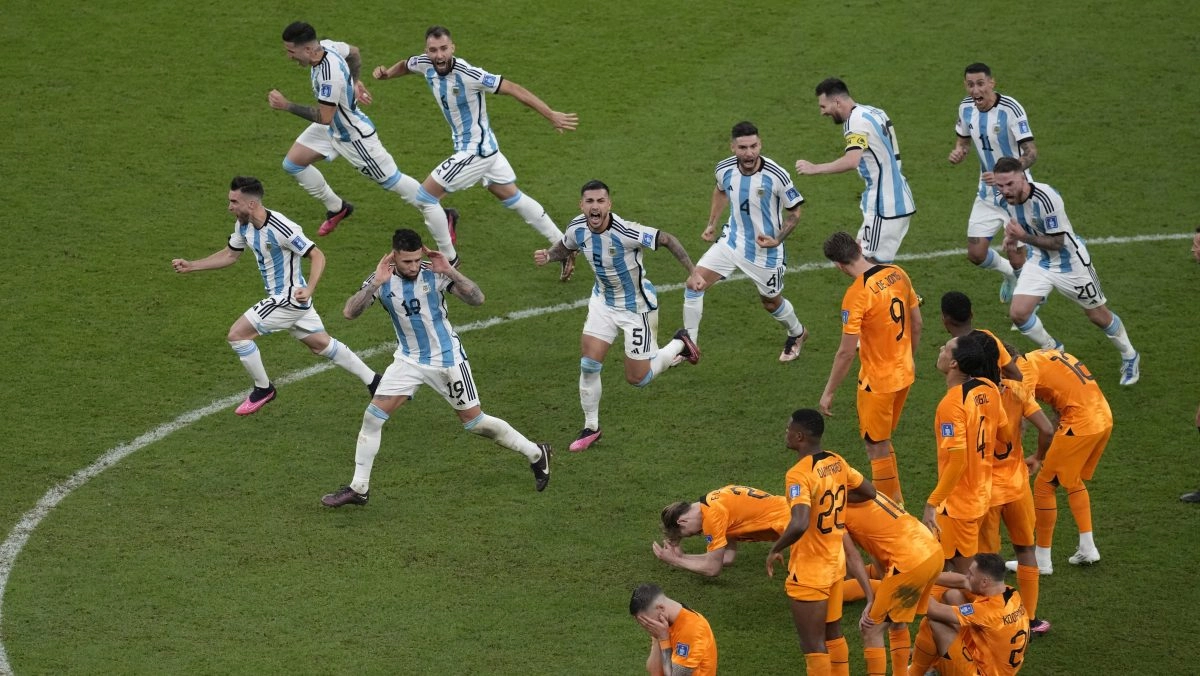

The German mathematician Joachim Klement, who works as an investment advisor and is a skeptic regarding models to predict the future, has however, on three consecutive occasions, correctly guessed the outcome of the world championship with a system he created himself.
Initially, his intention was to demonstrate that making a forecast of this type was practically impossible and he admits, in an interview with the magazine “Der Spiegel”, that the first time he used the model, and he was right, - in 2014 - he was “horrified”.
“The first time I was horrified when Germany became world champion in Brazil, also due to the fact that all the experts had previously remembered that a European team had never won a World Cup in South America,” he said.
He has since been right twice more, with France in 2018 and Argentina in 2022, and now, using his own model, he sees the Netherlands as champion - who would beat Spain in the semi-final and then in the final against Portugal - although he continues to show a certain degree of skepticism regarding his own predictions.
"It is something that is not rational at all, it is like playing the lottery. I always say that if someone bets based on my prediction on who will be the next world champion, it is someone who has no choice," he maintains.
The model contemplates a series of fundamental variables such as the GDP per capita of each country - since this has an impact on the sports infrastructure -, the size of the population, the position that football has in society, the position occupied by the team in the world ranking and a remnant of chance that Klement insists on highlighting.
"It's like tossing a coin. It may happen that one has predicted that the coin will land four times in a row on heads and not tails and that it happens like that. But that does not guarantee that the next time it will happen again," he explains.
Other variables
Klement explains the forecast for this year's World Cup by saying that the Netherlands is among the strongest footballing nations among those that have not won the tournament, although he adds that he may have unconsciously added certain variables to the model so that, finally, the prediction does not come true.
Another important factor, Klement points out in a note published on the Internet in English, is the temperature. "If a country is too cold or too hot, it is impossible to play football. The ideal temperature is an annual average of 14 degrees, as occurs in southern Europe and South America. "Is it a miracle that, except for England in 1966 and Germany in 1954, 1974, 1990 and 2014, all the world champions come from those regions?" , he asks with some irony.
Being the host country, Klement admits, is something that can also help. Using all these variables, according to the mathematician, the success of a country throughout a World Cup can be explained by 55 percent. But 45 percent, he adds, has to do with luck.
In his explanation of the model, Klement warns that for this World Cup, because it has one more round of direct elimination, luck and chance may have a greater weight. “Lower category teams can defeat others that are superior in a single match,” he says.
European semi-finals
Klement predicts a purely European semifinals in which Portugal will eliminate England and the Netherlands will eliminate Spain. Of the South Americans, the only team that would reach the quarterfinals would be Lionel Messi's Argentina, which would fall to Cristiano Ronaldo's Portugal.
The biggest surprise that the forecast contemplates is the elimination of Brazil in the round of 32 at the hands of Japan while Ecuador would fall in the same instance against Senegal, Colombia against Croatia and Uruguay against Argentina.
"Japan is on a roll. They defeated Germany in the last World Cup, defeated Brazil 3-2 in a friendly in October 2025 and have defeated England and Scotland in recent weeks," Klement writes to defend his prediction.
The forecast in favor of Croatia, and against Colombia, is based on the greater experience of the Croats and in the match between Senegal and Ecuador alludes to the better form of the Senegalese.