

Why the oldest piece of ice on Earth can revolutionize what we know of climate change
These ice samples could “revolutionize” our knowledge of climate change
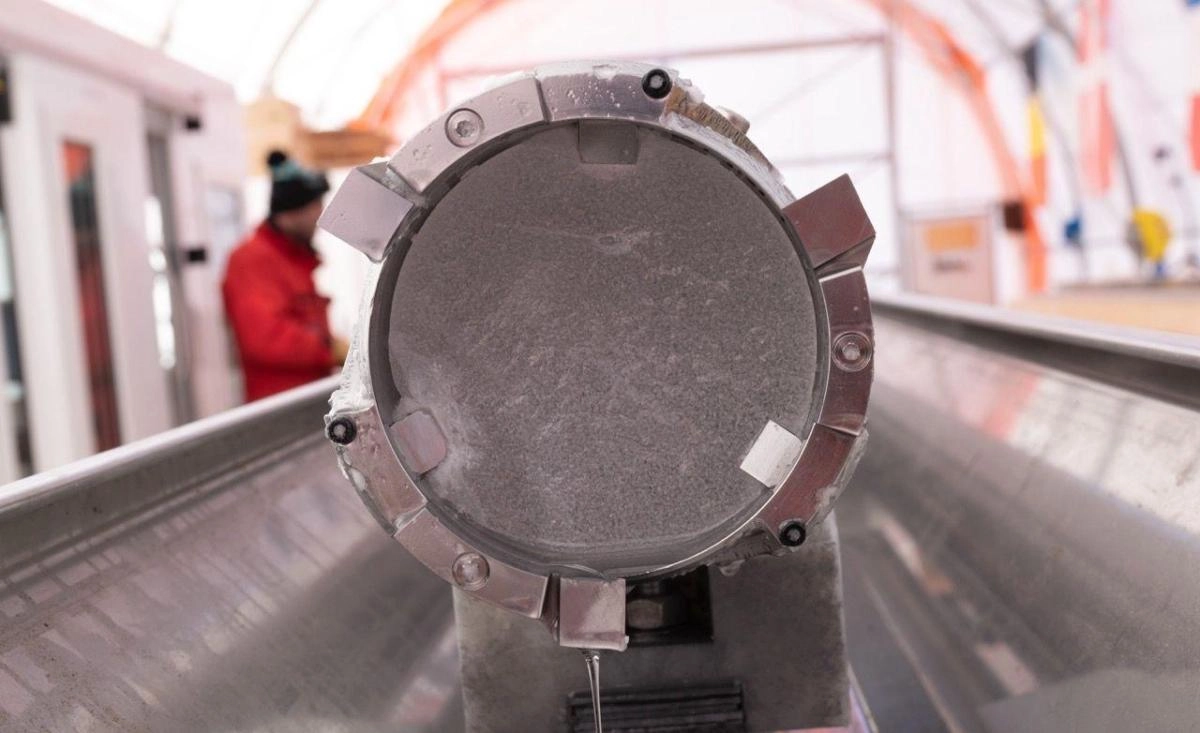

An ice core that could be more than 1.5 million years old has arrived in the United Kingdom, where it will be melted down by scientists to reveal vital information about the Earth's climate.
The cylindrical sample is the oldest ice on the planet and was drilled from deep within the Antarctic ice sheet.
Frozen inside is thousands of years of new information that scientists say could "revolutionize" our understanding of climate change.
The BBC went inside the -23°C cold storage facility at the British Antarctic Survey (BAS) in Cambridge, England, to see the priceless boxes of ice.
"This is a completely unknown period in Earth's history," says Dr. Liz Thomas, head of ice core research at the BAS.
Above the door, signs blink red warning lights, and inside there's an emergency escape hatch to a tunnel in case anything goes wrong.
Regulations stated that we were only allowed inside for 15 minutes at a time, wearing padded coveralls, boots, hats, and gloves.
The electronic shutter on our camera jammed, and our hair began to crunch as it froze.
On a shelf, next to stacked boxes of ice, Dr. Thomas points out the oldest cores, which could be 1.5 million years old. They sparkle and are so clear we can see our hands through them.
Over seven weeks, the team will slowly melt their hard-won ice, releasing ancient dust, volcanic ash, and even tiny seaweeds called diatoms, which were trapped inside when the water turned to ice.
These materials can tell scientists about wind patterns, temperature, and sea level from more than a million years ago.
Tubes will feed the liquid into machines in an adjacent lab,one of the few places in the world where this science can be done.
From Antarctica to Europe
Extracting the ice cores in Antarctica was a huge multinational effort, costing millions of pounds.
The ice was cut into one-meter blocks and transported by ship and then by refrigerated truck to Cambridge.
Engineer James Veale helped to core the ice near Concordia Station in East Antarctica.
“Holding it in my carefully gloved hands and being very careful not to drop the sections… was an incredible feeling,” he says.
Two institutions in Germany and Switzerland also received cross-sections of the 2.8-meter core km.
Teams could find evidence of a period more than 800,000 years ago when carbon dioxide concentrations may have been naturally as high or even higher than today, according to Dr. Thomas.
This could help them understand what will happen in the future as our planet responds to greenhouse gases trapped in our atmosphere.
The mysteries of ice
“Our climate system has undergone so many changes that we really need to go back in time to understand these different processes and tipping points,” she says.
The difference between now and previous times of high greenhouse gas levels is that humans now caused the rapid increase in greenhouse gases greenhouse gas over the past 150 years.
This takes us into uncharted territory, but scientists hope that the record of our ice-enclosed planet's environmental history may offer some guidance.
The team will identify chemical isotopes in the liquid that could tell us about wind, temperature, and precipitation patterns over a period of 800,000 to 1.5 million years, or possibly longer.
They will use an inductively coupled plasma mass spectrometer (ICP-MS) to measure more than 20 elements and trace metals.
This includes rare earths, sea salts, and marine elements, as well as tracers of past volcanic eruptions.
The work will help scientists understand a mysterious change known as the Middle Pleistocene Transition, which took place between 800,000 and 1.2 million years ago when the planet's glacial cycles suddenly shifted.
The transition from warmer to cold ice ages, when ice covered more of the Earth, used to happen every 41,000 years, but suddenly switched to every 100,000 years.
The cause of this change is "one of the most exciting unsolved questions" in climate science, according to Dr. Thomas.
The cores could contain evidence of a time when sea levels were much higher than now and Antarctica's vast ice sheets were smaller.
The presence of dust on the ice will help us understand how the ice sheets shrank and contributed to rising sea levels, which is a major concern this century.
Click here to read more stories from BBC News.
Sign up here for our new newsletter to receive a selection of stories every Friday Our best content of the week.
You can also follow us on YouTube, Instagram, TikTok, X, Facebook, and our WhatsApp channel.
And remember, you can receive notifications in our app. Download the latest version and activate them.