

How Milei changed her controversial style in the run-up to the midterm elections in Argentina
The Argentine president promised on Monday, August 4, to change his ways to see if the political opposition is in a position to discuss ideas.
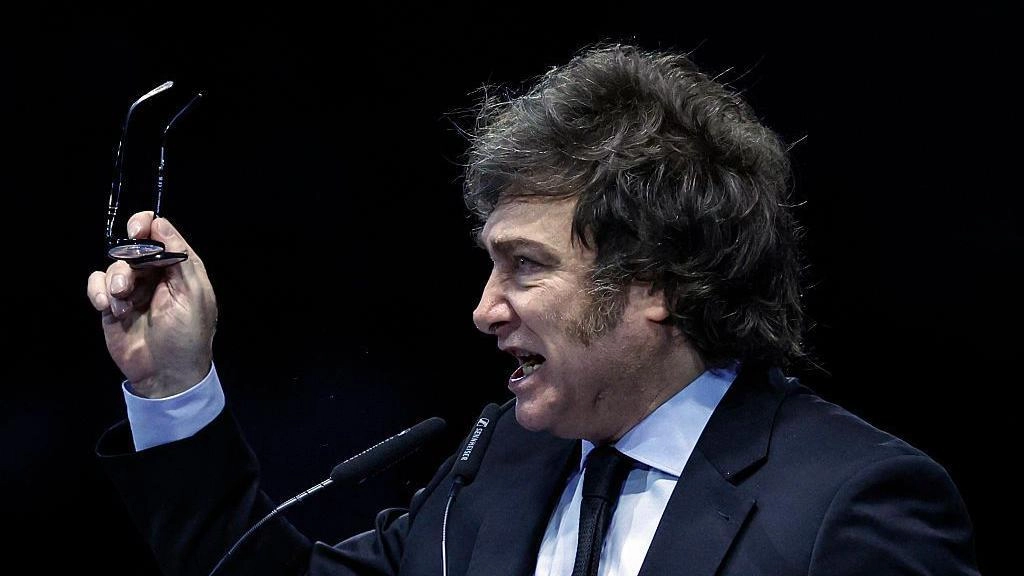

"I'm going to stop using insults, let's see if they are in a position to discuss ideas."
That was the promise made by the President of Argentina, Javier Milei, last Monday, August 4, August.
“The dictatorship of forms… We are going to confront them by respecting their forms… We are going to use the forms that you like, do you know why? To make it evident that you are an empty shell,” he added.
The president was alluding to a practice that is and has been a constant in his political narrative even before assuming the Presidency: the permanent use of insults in his interventions.
“Eunuch donkey,” “econochantas,” “group of baboons,” “filthy rats,” “mental parasites,” “enveloped” are some of the libertarian leader's favorite insults.
His public commitment to abandon these forms occurred two days after the newspaper La Nacion published a report revealing that in her first 12 months in office, she hurled 4,149 insults at those she identified as adversaries.
"We have been measuring Milei's political insults because they are something very striking in Argentine and global politics, both for their content, their quantity, and their virulence. While it is something that is seen in the extreme right, it seems to me that there is nothing at this level," Paz Rodriguez, one of the authors of the report, said in conversation with BBC Mundo.
This year, according to the La Nacion article, Milei increased her hostile rhetoric, going from 0.70 insults with sexual content per hour to 1.62 in the last 100 days.
The president's decision to put the insults aside also came in the week in which alliances were being finalized for the midterm legislative elections on October 26, in which Argentina will renew just under half of its National Congress. And just one month before provinces like Buenos Aires elect their local representatives.
Tailored Insults
Milei's warmongering narrative is nothing new to Argentines. In fact, it was part of the style with which she managed to reach the Presidency in 2023.
With unvarnished criticism and—with profanity in between—her challenge to what she called the "caste" (the political establishment) was one of the emblems of her campaign and subsequent electoral victory.
Her irreverent, outspoken leadership is something that Milei has consolidated in power; a characteristic that in the world of populism is understood as a virtue.
Milei has always used her social media to issue these types of virulent comments. She does this, in general, by reposting her political followers, a community that has a strong presence in spaces like X, YouTube, and Instagram.
"Argentine political culture has always been tremendously antagonistic, but since 1983, one of the legacies of the democratic transition was precisely that in politics there were certain things that couldn't be said. And Milei broke with many of those frameworks," says Argentine political scientist María Esperanza Casullo.
“The use of personalized insults and its violent sexual metaphors were not part of the established political language,” she adds.
One of the most repeated violent sexual metaphors that the political scientist refers to is that of “baboons” - in reference to red-bottomed apes - as a way of shooting his enemies, using the idea of anal sex as an analogy for political submission.
The president has also made it a common practice to attack media outlets and journalists who cover his government, calling some of them "ensobrados," alluding to the fact that they would receive envelopes containing money to promote information with particular interests.
He has used the same tone to refer to critical economists, whom he has called "econochantas" (chanta in Argentine slang refers to a person who deceives or swindles).
"There is a mechanism: the government or these sectors of the extreme right identify the enemy in quotation marks. Let's see who they target. Based on the characteristics of that person or that sector, they look for a vector through which to attack," opposition legislator Esteban Paulón tells BBC News Mundo, adding: "In Milei's operation this is: if you are gay you are a pedophile and it is linked to HIV, if you are a journalist you are an envelope-pusher, if you are left-wing you are an impoverisher, if you are a public servant you are a gnocchi, that is, people who do not work."
The parliamentarian and LGBTIQ+ rights activist - who denounced Milei for "inciting hatred and collective violence" - emphasizes that the objective of these attacks "is aimed at disciplining, generating fear and silencing" social or political sectors that the government considers opposed to its ideas.
"The truth is that we are quite calm for everything they do to us," responds libertarian filmmaker Santiago Oría, who participated in Milei's presidential campaign and currently works as Director of Audiovisual Production for the Presidency.
"We are reacting to their aggression. If they did not attack, we would not react that way either," he tells BBC Mundo, referring to the criticism the president is receiving.
Regarding Milei's decision to put aside the disqualifications, Oría believes that "it will be shown that not only are the opponents of Milei's government wrong in the essence of their ideas, but it will also be clear and obvious that the only thing they had to stop discussing was the issue of forms."
The motivation behind the announcement
Milei's promise to put aside such violent rhetoric comes at a time when several opinion polls have reported exhaustion on the part of the population with the use of such hostile language.
According to the July 2025 National Monitor by the consulting firm Analogies, 73% of Argentines reject Milei's style, while two out of three people consider it violent.
“What once worked for her no longer works for her,” says Paulón.
"Many people voted for Milei because they were angry, and he was the one who best interpreted that anger. Society needed someone to shout on its behalf; against the caste, the cuts, the economic crisis, inflation. But once the economy stabilized and the government was in place, society began to say: now there is no need for someone to shout for me, we need someone to administer and govern for the general well-being," adds the legislator.
Casullo agrees: "There is undoubtedly an electoral component; there are a large number of people who say that this doesn't suit them." “like it.”
"At one point it was liked, because this type of language has its effect. Someone who doesn't sound like a politician is speaking to me, someone who sounds authentic. But now that you're the president, when you have other responsibilities and other powers..."
“I think someone told him, 'Look, I'm looking at the polls, and the truth is that most people would prefer you to speak differently,'” the academic concludes.
For journalist Paz Rodríguez, Milei's motivation is explained because "this is an election year and he needs to improve his situation in Congress."
"We had the evidence last week where he did very poorly in several votes, he lost very important votes, because by not having a large party structure, in order to have governability and guarantee governability he needs more legislators."
But libertarian filmmaker Santiago Oría distrusts the polls that have shown an increase in rejection of Milei's hostile rhetoric and does not believe that the president's decision has to do with an electoral or strategic issue:
"The president has never been a slave to the polls or a slave to momentary public opinion. He is a person who has an ideal, who has a mission, he has a way of being and he does not change it, let's say because of the polls," he says.
The president's digital environment
Beyond whether Milei will be able to fulfill her commitment to no longer use insults, it also remains to be seen what will happen to other people linked to the libertarian movement who use their social networks and streaming programs to defend the presidential administration and attack their political adversaries.
The case of the deputy Paulón - openly gay - was paradigmatic: at the beginning of July he received accusations of pedophilia due to his sexual orientation from the influencer Pablo Pazos on his X account (formerly Twitter), after questioning a government decision.
"Pedophile, operator, communist and face of an idiot. AIDS FOR YOU," wrote Pazos.
This message was furthered on the streaming program La Misa, hosted by the libertarian influencer known as Gordo Dan, whose real name is Daniel Parisini.
This generated strong unrest in various sectors of the Argentine political spectrum, from where they came out to defend the legislator.
Oría himself, who has been retweeted by Milei on several occasions (a practice that -according to local media- functions as a kind of prize in the libertarian world) has used his networks to question the opposition, even with insults typical of the president.
On June 30, Oría targeted the journalist María O' Donnell - who has been Criticism of Milei's violent rhetoric - whom he called a "mandrila."
"María O'Donnell has been comparing us to Nazism for over four years now. I honestly don't know what's more insulting, more offensive, or more unfair," says the filmmaker.
The president has filed criminal charges against three journalists for slander and libel for calling him a Nazi, but María O'Donnell is not one of them. The accused are Carlos Pagni, Ari Lijalad, and Viviana Canosa. At least in the first two cases, the complaints have been dismissed.
From insult to aggression?
Casullo asserts that virulent political discourse later allows Milei to justify decisions that directly affect people, such as the cuts she has pushed through to programs for people with disabilities or funding for scientific research.
But do these speeches have direct consequences on the streets?
"One of the questions we ask ourselves is this. After the violence in the discourse, does violence come in the actions? And it's difficult to answer," says journalist Rodriguez, adding:
"This always raises alarm bells, because the discourse endorses or incentivizes some fanatics. But to date, none of the analysts and specialists we spoke with have responded to this." is saying that this has already been transferred to the actions."
However, for Congressman Esteban Paulón, this violent rhetoric has transcended speeches and social media.
That is why - in addition to denouncing the president after his speech in Davos, where Milei linked "gender ideology" and the LGBTIQ+ agenda to child sexual abuse and pedophilia - the legislator has also denounced the libertarian influencer Pablo Pazos.
The congressman is convinced that the attacks against him were not personal but rather exemplary and extended to all homosexuals in the country.
"It seems to me that this has a collective impact and that is what motivated me to denounce," he says, adding:
"There have been a series of attacks and hate crimes recently. It's like if a climate is developing that will obviously, sooner or later, end up resulting in concrete violence. And that's serious."
A report by the National Observatory of LGBTIQ+ Hate Crimes revealed a 70% increase in crimes against lesbians, gays, bisexuals, and trans people in Argentina compared to the previous year.
Ingenuity and Normalization
Among political scientists, academics, and even political adversaries, Milei is recognized for the ingenuity with which she has crafted the rhetoric she now promises to abandon.
Although her insults are morally questionable, she is recognized for a certain creativity and, above all, a method that - exhausted or not - It had its benefits.
In sectors of the opposition, there are several who have been tempted to play on the same level as him. And although they don't reach the level of insults, it seems that the virulence in the Argentine political debate is becoming naturalized.
"There are some figures in the opposition who say, 'Well, we have to start talking this way. If this is the game, let's play.' Some figures in the Chamber of Deputies.But I don't know to what extent that will be successful," says Casullo.
While Paulón acknowledges that "like everything in politics, what is perceived to work, someone wants to copy it. So, we have some here who want to do Mileiism, Milei culture, on the left, in Peronism, in Kirchnerism, on the right... And it seems to me that that is a mistake."
But Rodríguez adds an element relevant to understanding Milei's turn: "What they say in her environment, and what our journalists assigned to the Casa Rosada have written, is 'don't believe that Milei is going to change, we don't want her to change, because an important part of the logic of her character is that she is like that.'"
"Nobody wants to prune Milei and turn her into something she is not. Milei is this; It's anger, rage, it's all volcanic, he says whatever. And that's what brought him to power. He's not going to make a fundamental change, but he is willing, they say, to moderate his ways."