

KF-21: the combat aircraft with which South Korea wants to compete with the most advanced jets in the world
The KF-21 Boramae is capable of reaching speeds of up to Mach 1.8 thanks to its two GE F414-GE-400K engines
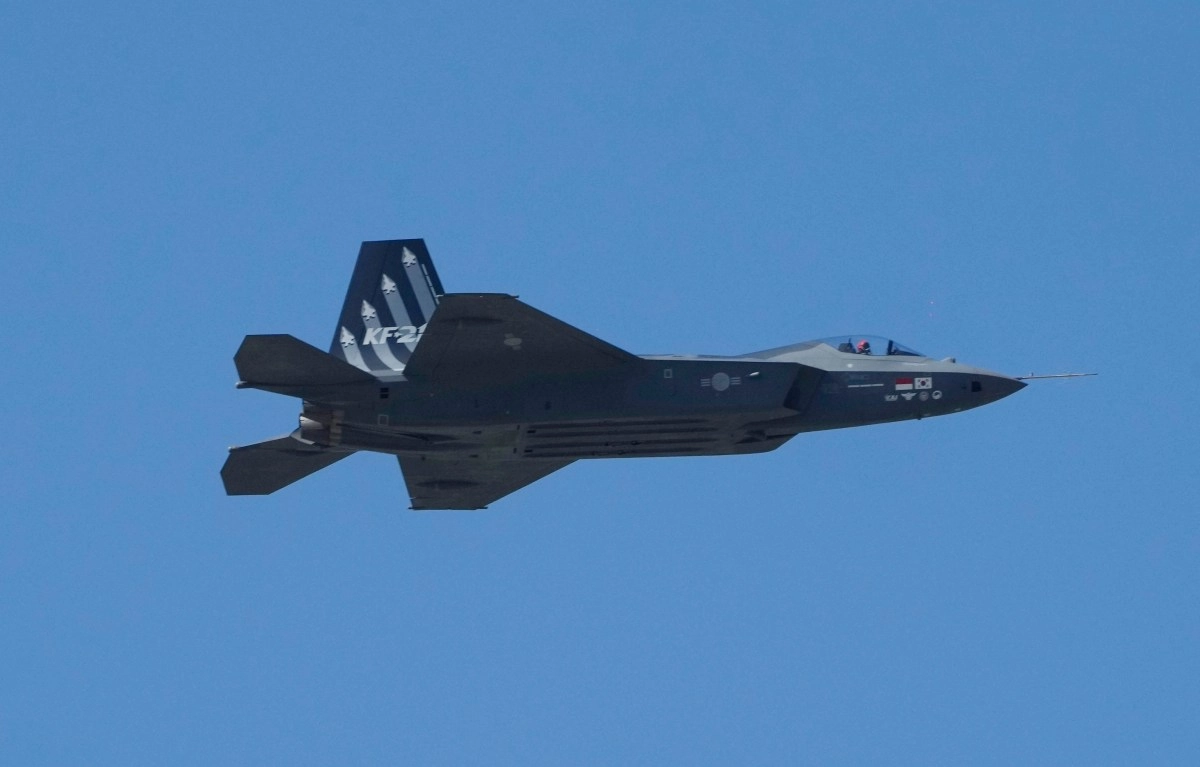

The world of military aviation is experiencing a true revolution, and one of the unexpected protagonists comes from South Korea. We're talking about the KF-21 Boramae, a fighter jet that many already see as the beginning of a new technological era in the Asian country. Designed to rival some of the most advanced jets on the planet, this project not only seeks to strengthen national defense but also to put Korea at the forefront of next-generation fighter manufacturers.
Although it is officially classified as a 4.5-generation aircraft, its design, capabilities, and future projection show a clear intention: to compete head-on with fifth and even sixth-generation standards. All this at a much more competitive cost than its direct rivals, making it a tempting proposition for nations seeking top-tier air power without breaking the bank.
Development began in 2001, when it became clear that the F-4 and F-5 fleet was no longer up to the task. Since then, Korea Aerospace Industries (KAI) and the Defense Development Agency have put everything on the table: latest-generation radars, proprietary electronic systems, and technological integration that seeks to minimize foreign dependence.
Impressive technical capabilities
This jet has a multirole twin-engine, capable of reaching Mach 1.8, with a range of about 2,900 km and the ability to carry up to 7.7 tons of weapons in its fuselage. It is powered by two GE F414-GE-400K engines, renowned for their reliability in other fighters such as the Gripen and the F/A-18.
As for its arsenal, the KF-21 can be equipped with long-range air-to-air missiles such as the Meteor or the AMRAAM, as well as short-range options such as the Sidewinder. For air-to-ground missions, it has the capacity to carry Taurus, Maverick or Harpoon missiles, along with precision-guided bombs. In other words: it is prepared for any type of scenario.
And if we talk about operational autonomy, it has already successfully passed the aerial refueling test,a key step for any fighter jet looking to play in the big leagues.
What does the KF-21 EX offer and why is it generating so much excitement?
The KF-21 isn't content with what it is now. Plans call for an evolution into an EX version with internal weapons bays to reduce its radar signature, next-generation sensors, and design improvements to bring it closer to complete stealth. It will also feature an advanced electro-optical system under the nose and data links that will allow it to operate alongside combat drones, something that defines modern warfare.
The schedule is already in motion: by mid-2027, the Boramae is expected to incorporate all air-to-ground functions, and by the 2030s, the leap to its most advanced version should be ready. In addition, variants such as a two-seat trainer, electronic warfare versions, and even a platform for launching hypersonic cruise missiles capable of flying between Mach 5 and Mach 10 are being explored.
As if this were not enough, South Korea is already working on developing its own engines by 2036, reducing its dependence on foreign manufacturers and strengthening its position as a technological and military power.
The KF-21 Boramae is not simply an aircraft: it is proof that South Korea wants and can play in the top league of global combat aviation.