

Why Venezuela came to have highly enriched uranium and what was the recent secret operation to deliver it to the United
In April, the governments of Venezuela, the United States and the United Kingdom carried out an operation to remove a shipment of highly enriched uranium from Venezuela.

It happened one night at the end of last April.
A Venezuelan military convoy traveled as discreetly as possible the 160 kilometers that separate the headquarters of the Venezuelan Institute of Scientific Research (IVIC), located on the outskirts of Caracas, to the port of the town of Puerto Cabello, in the state of Carabobo.
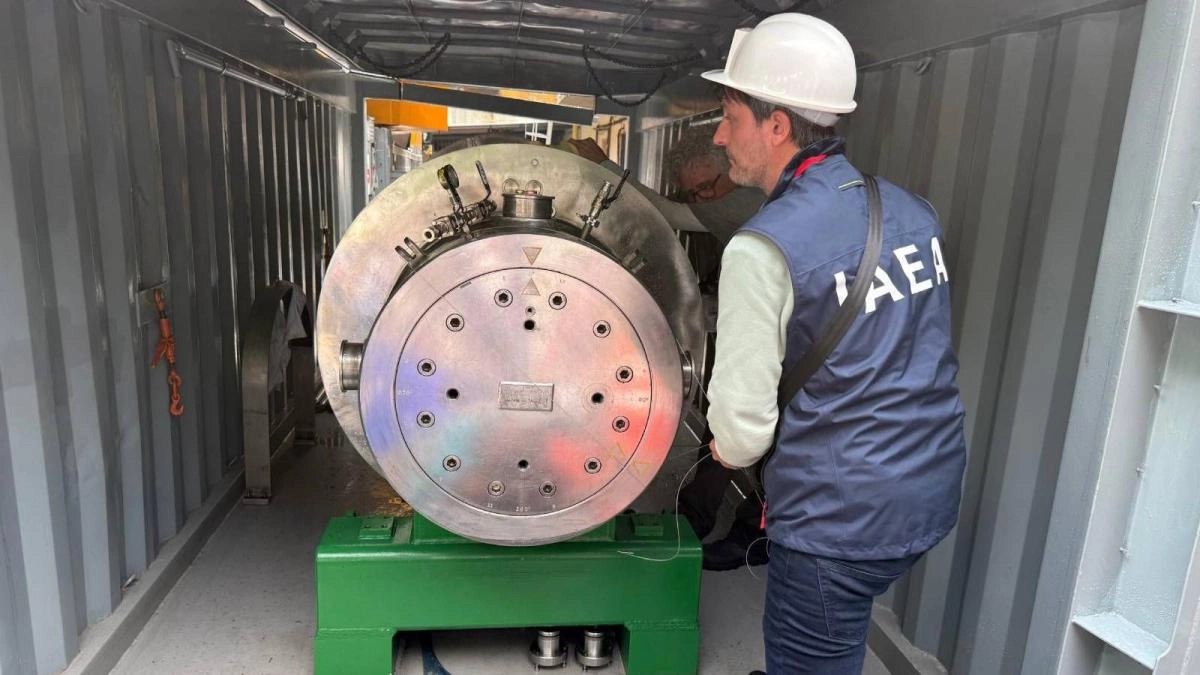
The reasons for the night and secrecy would only be known many days later: the military was escorting a vehicle that was transporting a container inside which there were about 13 kilograms of highly enriched uranium, with the aim of it being transported to the United States.
The extraction operation had the participation of the governments of Venezuela, the United States and the United Kingdom, as well as the International Atomic Energy Agency (IAEA), which - as they later revealed - worked for years to ensure that it was carried out safely.
In a statement released on May 8, the IAEA explained that it was “a carefully planned joint mission, carried out under strict security measures, as this type of nuclear material can represent a proliferation risk or security threat if it falls into the wrong hands.”
Highly enriched uranium (HEU) is considered to be uranium that has been enriched above 20%.
According to Jack Crawford, a researcher in the Nuclear Proliferation and Policy group at the Royal United Services Institute (RUSI), this type of uranium is used in nuclear reactors around the world for peaceful purposes such as research or the propulsion of nuclear submarines, but it can also be used to produce fissile material or even for bombs.
“The 13kg of highly enriched uranium that was removed [from Venezuela] is, theoretically, enough to be further refined into a small nuclear weapon, although it contained just over 20% uranium-235, and HEU is generally considered weapons grade at 90% or higher, Crawford told BBC Verify.
“Its withdrawal constitutes the latest international effort to proactively eliminate the possibility that highly enriched uranium intended for peaceful uses could be acquired by non-state actors or governments seeking to develop nuclear weapons,” he added.
For years, the Venezuelan government's ties to Iran, Russia, Cuba and North Korea have been a cause of concern for the US government and, experts told BBC Verify, for the IAEA as well.
But how did Venezuela come to have highly enriched uranium and why did it give it to the US?
Atoms for peace
The 13 kilograms of HEU that Venezuela had had been used as fuel for the RV-1, the first nuclear reactor in Latin America.
This experimental reactor was installed in the early 1960s at the Venezuelan Institute for Scientific Research (IVIC), in the context of the Atoms for Peace program, initiated by the government of US President Dwight Eisenhower in the 1950s.
On December 8, 1953, before the UN General Assembly, Eisenhower spoke about the threat posed by nuclear technology used for war purposes, which for several years had no longer been a monopoly of the United States, and about the risks of proliferation as more countries learned to produce atomic bombs.
Then, he stated that we had to go beyond seeking to reduce this threat and suggested putting this technology at the service of humanity.
"It is not enough to take this weapon from the soldiers. It must be placed in the hands of those who know how to strip it of its military coating and adapt it to the arts of peace," he said.
Then, he proposed the creation of an atomic energy agency, under the umbrella of the UN, that would be in charge of designing ways for nuclear material to “serve the peaceful purposes of humanity” and atomic energy could be applied to respond to various needs in areas such as medicine or agriculture.
The idea was that the powers capable of producing nuclear material would provide it to the UN agency, which would keep it safe and put it in the hands of researchers who would investigate the peaceful uses of that energy.
That speech by Eisenhower sowed the seed for the creation of the IAEA, but also gave rise to the Atoms for Peace initiative, through which the United States would offer training and technology to developing countries to help them in the peaceful use of atomic energy.
Less than a year after that speech to the UN, the United States reformed the Atomic Energy Act to allow the export of nuclear technology and materials to other countries, as long as they agreed not to use them for the development of weapons.
In March 1955, the Eisenhower administration went a step further and authorized the US Atomic Energy Commission to provide “free world” states with limited quantities of fissile material, as well as assistance for the construction of nuclear reactors.
A year later, the Venezuelan government acquired the RV-1 reactor from the American company, with a capacity of 3 megawatts, which was finally inaugurated on November 22, 1960.
RV-1 operated as a research reactor until 1991, when it was partially closed.
According to the Venezuelan authorities, the definitive closure occurred in 1997, when part of the fuel with which it operated was extracted and the rest remained in custody, under security conditions, until now.
The reactor was later converted into a facility for sterilizing medical instruments and other materials with gamma rays.
During the years in which it was operational, the RV-1 used nuclear fuel from the US and the United Kingdom, according to the IAEA
From the capture of Maduro to the extraction of uranium
The British government, which was also involved in the operation, told BBC Verify that Venezuelan authorities had requested the removal of the rest of the nuclear fuel in 2017 and that the United Kingdom joined the planning the following year, at the request of the IAEA.
But it was the capture on January 3 of the then president of Venezuela, Nicolás Maduro, that apparently played a determining role in finally carrying out the uranium extraction.
According to Venezuelan Foreign Minister Yván Gil in a statement on May 7, the US military operation to capture Maduro “objectively increased the level of risk and confirmed the urgency” of carrying out the operation to remove the uranium, which Venezuela had been requesting for a long time.
According to Gil, the US military operation affected the vicinity of the IVIC headquarters, reaching just about 50 meters away from the old reactor.
Thus, at the beginning of April this secret operation was launched in which the Venezuelan authorities, the US National Nuclear Security Administration (NNSA), the IAEA and the United Kingdom government participated.
According to the statement from the Venezuelan authorities, the IAEA was responsible for supervising the safeguards, executing the corresponding technical verification, institutionally accompanying the process and providing training to Venezuelan personnel.
The British authorities were responsible for the transfer of enriched uranium from Venezuela to the Savannah River nuclear power plant in Aiken (South Carolina, USA), whose facilities are currently used to process nuclear materials.
Nuclear Transport Solutions, a division of the United Kingdom's Nuclear Decommissioning Authority, provided the cargo ship Pacific Egret, on which the uranium was transported out of Venezuela, according to US authorities.
This vessel stopped transmitting its satellite location on April 11, when it was in Charleston (South Carolina). A week later, it was docked in Puerto Cabello, as BBC Verify was able to verify through high-resolution satellite images.
Images taken on May 4 show the Pacific Egret - followed by what appears to be an escort ship - during its return to the United States, a country in which it was already on May 8, as shown in images of the port of Charleston taken on that date.
“This was a meticulously coordinated effort, with strict safety measures in place at all times,” the UK Office for Nuclear Regulation stated.
In a statement, the US State Department also reported on the successful conclusion of this operation and highlighted that as of early May the NNSA had “removed or confirmed the removal of more than 7,340 kilograms of weapons-grade nuclear material.”
According to the IAEA, although most of the nuclear research reactors built in the 1960s and 1970s required highly enriched uranium to carry out their experiments, currently these research can be done with low-enriched uranium (LEU), in which the concentration of uranium-235 is below 20%.
That institution states that around the world, more than a hundred research reactors and medical isotope production facilities have been adapted to use low-enriched uranium instead of highly enriched uranium or have been closed.
This, in turn, has allowed the recovery of some 7,000 kilos of highly enriched uranium, to which that from Venezuela has now been added.