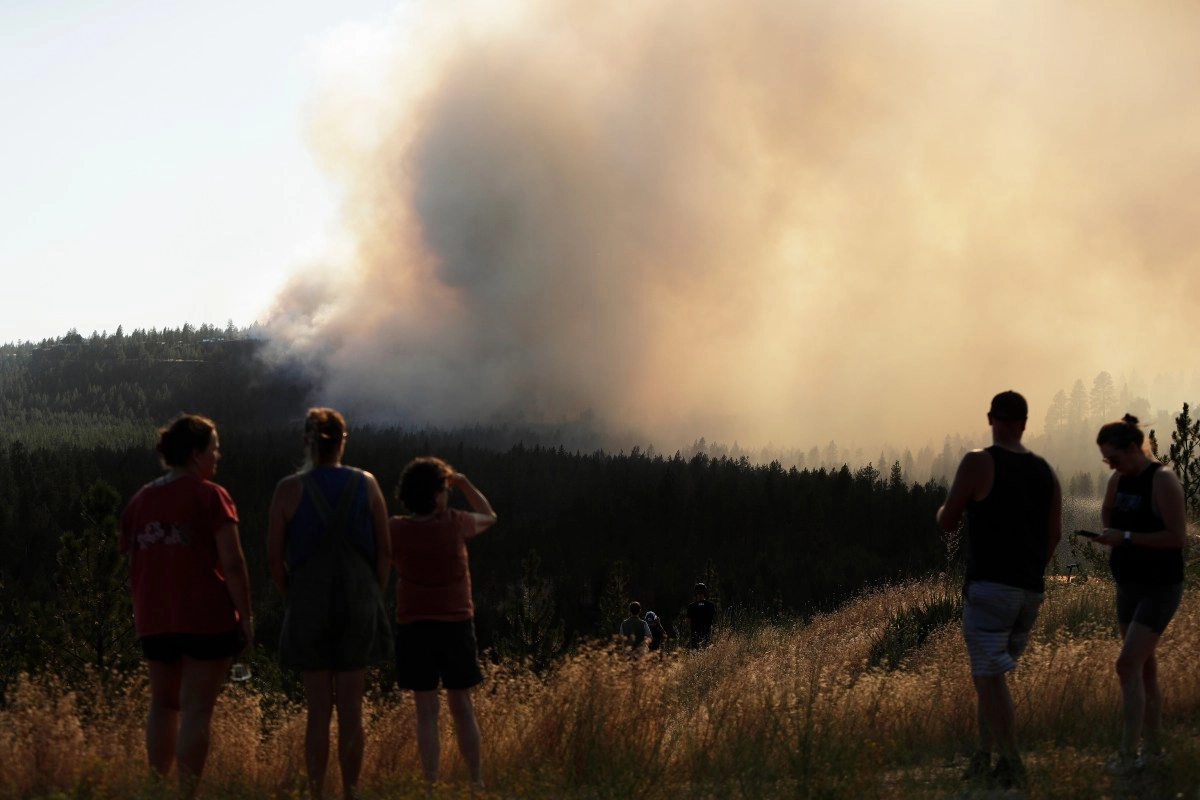

After 30 consecutive months without rain, residents of San Francisco de Conchos in the northern state of Chihuahua, Mexico, gather to pray for divine intervention.
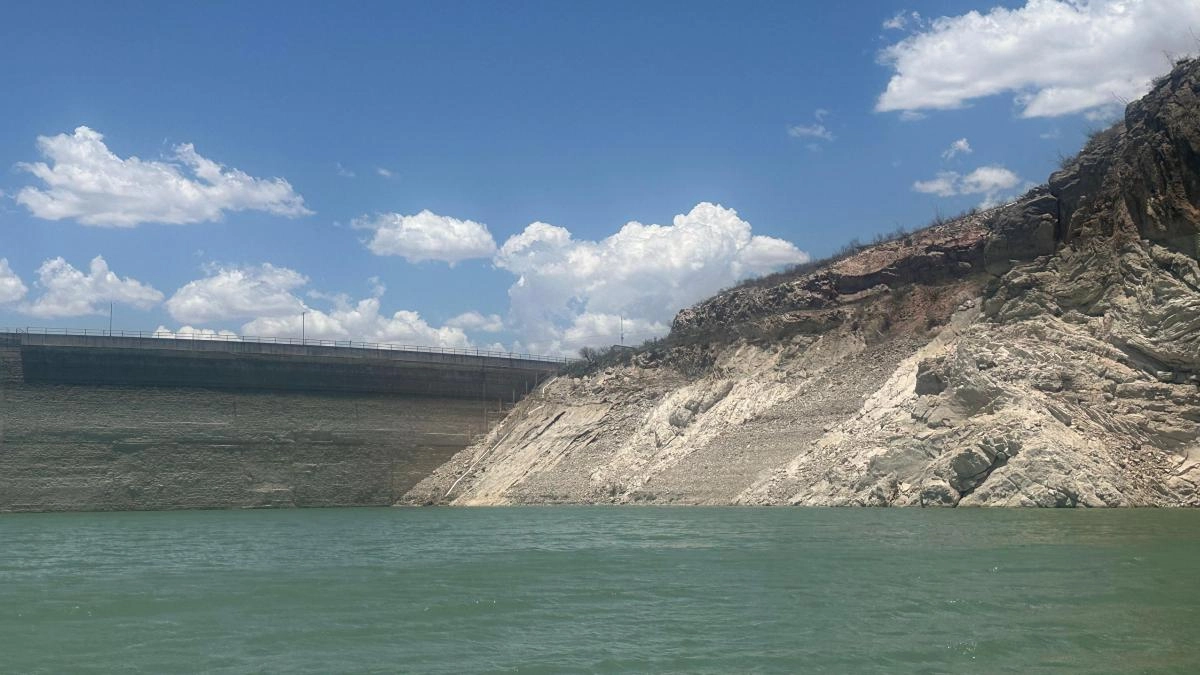
On the shores of Lake Toronto, a reservoir behind the state's most important dam, called La Boquilla, a priest leads prayers for farmers on horseback and their families, standing on rocky ground that used to be part of the lakebed before the waters dropped to the current critical levels.
Among those praying with their heads bowed is Rafael Betance, who has monitored La Boquilla voluntarily for the water authority for 35 years.
“All of this should be underwater,” he says, pointing to a parched expanse with exposed white rocks.
“The last time the dam was full and overflowed a little was in 2017,” Betance recalls. “Since then, it’s gone down year after year.”
“We’re currently 26.52 meters below high water, less than 14 percent of its total capacity.”
It’s no surprise that the local community is praying to the heavens for water. Still, few expect a respite from the devastating drought and sweltering 107°F (42°C) heat.
Now, a long-standing dispute with the state of Texas over the scarce resource threatens to turn ugly.
Under the terms of a 1944 water-sharing agreement, Mexico must send 430 million cubic meters of water a year from the Rio Grande to the U.S.
The water is sent through a system of tributary canals to shared dams owned and operated by the International Boundary and Water Commission (IBWC), which oversees and regulates water sharing between the two neighboring nations.
In return, the U.S. sends its own, much larger allotment (almost 1.85 billion cubic meters a year) from the Colorado River to supply the Mexican border cities of Tijuana and Mexicali.
Mexico is in default and has not maintained its water deliveries for much of the 21st century.
After pressure from Republican lawmakers in Texas, the Trump administration warned Mexico that it could withhold Colorado River water unless it meets its obligations under the 81-year-old treaty.
However, he did not set a firm deadline for possible implementation of such retaliation.
Mexican President Claudia Sheinbaum, meanwhile, acknowledged Mexico’s shortfall but struck a more conciliatory tone.
Since then, Mexico has initially transferred 75 million cubic meters of water to the U.S. through the shared La Amistad dam along the border, but that’s only a fraction of Mexico’s roughly 1.5 billion cubic meters of outstanding debt.
Clash between walnut and alfalfa
The controversy over cross-border water sharing can be dangerously intense: in September 2020, two Mexicans died in clashes with the National Guard at the La Boquilla floodgates as farmers tried to prevent water from being diverted.
Amid the severe drought, the prevailing view in Chihuahua is that “you can’t take what’s not there,” says local expert Rafael Betance.
But that’s not helping Brian Jones irrigate his crops.
A fourth-generation farmer in Texas’s Rio Grande Valley, he’s only been able to plant half his farm for the past three years because he doesn’t have enough irrigation water.
“We’ve been struggling against Mexico because they haven't lived up to their end of the agreement," he says. "We're only asking for what's rightfully ours under the treaty, nothing more." Jones also questions the scale of the problem in Chihuahua. He believes the state received more than enough water to share in October 2022 but released "exactly zero" to the U.S., and accused its neighbors of "hoarding water and using it to grow crops to compete" with them. Farmers on the Mexican side interpret the agreement differently. They claim it only requires them to send water north when Mexico can meet its own needs, and argue that persistent drought in Chihuahua means there's no surplus available. Beyond water shortages, there are also debates about agricultural efficiency.
Walnut and alfalfa are two of the main crops in the Conchos River Valley in Chihuahua, and both require a lot of irrigation: walnut trees need an average of 250 liters per day.
Traditionally, Mexican farmers have simply flooded their fields with water from the irrigation canal.
Driving through the valley, you immediately see walnut trees sitting in shallow pools, with the water flowing from an open pipe.
The complaint from Texas is obvious: the practice is wasteful and can be easily avoided with more responsible and sustainable farming methods.
As Jaime Ramírez walks through his walnut trees, the former mayor of San Francisco de Conchos shows me how his modern irrigation system ensures that his walnut trees receive adequate water year-round without wasting this valuable resource.
“With sprinklers, we consume about 60% less water than flooding the fields,” he says.
The system also allows the trees to be watered less frequently, which is especially useful when the Conchos River is too low to allow local irrigation.
However, Ramirez admits that some of his neighbors are not as aware. As a former local mayor, he urges understanding.
Some have not adopted the sprinkler irrigation method because of the installation costs, Ramirez says.
He has tried to show other farmers that it is more economical in the long run, saving on energy and water.
But Texas farmers must also understand that their counterparts in Chihuahua face an existential threat, Ramirez insists.
“This is a desert region and it hasn’t rained. If it doesn’t rain again this year, next year there will simply be no farming. We will have to conserve all available water for human consumption,” he warns.
An eight-decade-old treaty
Many in northern Mexico believe the 1944 water-sharing treaty is no longer valid.
Ramirez believes it may have been adequate for the conditions of eight decades ago, but it has not adapted to changing times or had properly account for population growth or the ravages of climate change.
Across the border, Texas farmer Brian Jones argues that the agreement has stood the test of time and still needs to be respected.
“This treaty was signed when my grandfather was a farmer. It’s gone through my grandfather, my father, and now me,” he says.
“Now we see that Mexico is not complying with it. It’s very outrageous to have a farm where I can only plant half the land because I don’t have irrigation water,” he adds.
Trump’s tougher stance has given a boost to local farmers, he says.
Meanwhile, the drought hasn’t just hurt agriculture in Chihuahua.
With Lake Toronto’s levels so low, Betance says the remaining water in the reservoir is warming at an unusual rate, potentially spelling disaster for the marine life that supports a once-thriving tourism industry.
The forecast for the valley hasn’t been so bleak, Betance says, since he’s been carefully charting the lake’s fluctuations.
“Praying for rain is all we have left,” he reflects.
Additional reporting by Angélica Casas
Click here for more BBC News stories.
Subscribe here to our new newsletter to receive a selection of our best content of the week every Friday.
You can also follow us on YouTube, Instagram, TikTok, X, Facebook and our new WhatsApp channel.
And remember, you can receive notifications in our app. Download the latest version and activate them.