

The hospital of farewells to which patients go to die with dignity
Brazil’s first - and so far only - palliative care center, where there is no emergency room or ICU
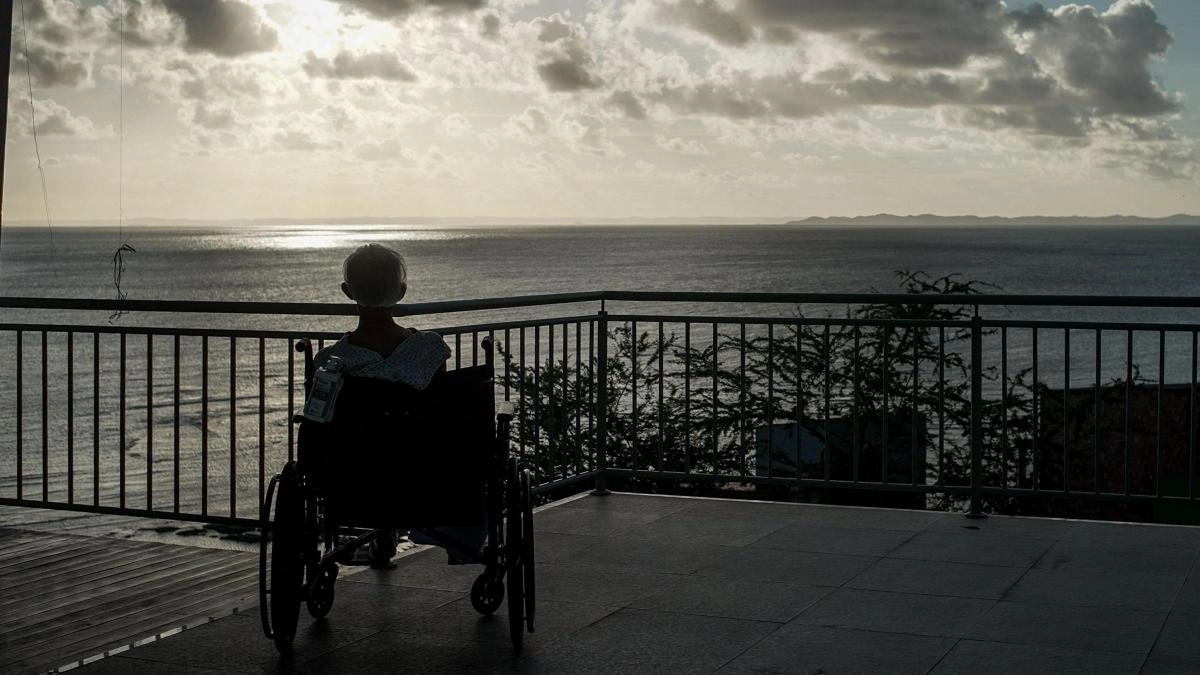

“This is where the race of the three lighthouses would start: from Humaita, it would pass by the Barra lighthouse and reach the Itapua lighthouse,” said Ayrton dos Santos Pinheiro, contemplating the sea in Salvador that opened up before his window.
It was a Monday in early June, with Clear skies in the capital of the Brazilian state of Bahia after days of heavy rain, and 90-year-old Ayrton was in one of three beds in a spacious, well-lit room at the Mont Serrat hospital.
“When they told me I was coming to this hospital, I didn’t know it was here,” he continued, speaking of the facility in Ponta de Humaitá, high above the Monte Serrat neighborhood in the Cidade Baixa (Lower City).
Memories forced Ayrton to pause his speech. Taking a deep breath, his voice breaking, he spoke in detail about his years as a racer, his family, and the birth of one of his children in that neighborhood.
Born in Pojuca, a small town in the metropolitan region of Salvador, he arrived in the capital with his family when he was about 8 years old and, to this day, he is enchanted by the city, which he has never left. “It’s beautiful,” he said.
He opened a travel agency, got married, and lived his life between sports, work, and family.
Ayrton was surprised to finally discover that the hospital was located in an area of ??the city that held so many good memories. “When I arrived here, I felt new strength,” he said.
The man occupied one of the 70 beds at Mont Serrat, which operates in a 19th-century mansion near one of Salvador’s best-known landmarks, the Señor do Bonfim church.
Previously, it was the Couto Maia infectious diseases hospital, but since the end of January, it has housed the first and, to date, only general palliative care hospital of the Brazilian Unified Health System (SUS).
In a previous initiative, the National Cancer Institute (INCA) created an exclusive unit for its patients with palliative care indications, also with support from SUS.
Palliative care focuses on improving the quality of life and symptoms of patients with serious or incurable illnesses. This approach, which also focuses on caring for family members, neither hastens nor shortens the patient's death, but rather seeks to reduce physical, psychological, and spiritual suffering.
“Here, we don't focus on death. We focus on caring while there is still life,” explained Dr. Karoline Apolonia, coordinator of the Palliative Care Center at the Bahia Department of Health.
“They asked if my father wanted to shave, what team he supports, what he likes to eat, if he likes music. So we relaxed, knowing that he is well cared for,” recounted Ayrton Junior, son of runner Ayrton.
Junior recounted that his father has prostate cancer and underwent radiation therapy to treat another skin cancer on his nose and head.
“He ran several marathons, and I have several of his trophies at home,” he recalled.
But now the priority is the present.
“We believe that what is important to me Father is present well-being, the present moment. One day at a time. He needs to be well, that's what we think, that's what his family thinks," she said.
A hospital without an ICU
Walking through the four wards of Mont Serrat is also a way of realizing that it is not a traditional hospital.
There is no resuscitation room—as that would go against one of the admission criteria—nor an Intensive Care Unit (ICU).
Karoline, who compares being admitted to an ICU to running a marathon, stated that this would be incompatible with the condition of the patients admitted.
"If I force this patient to run a marathon, I will only cause him suffering," explained the doctor.
"So, instead, we suggest you sit here and watch the sunset. Take the opportunity to say sorry, thank you, I love you, and goodbye," she added.
For a patient to receive palliative care, they must be referred by an Emergency Department (UAU) and meet certain criteria, such as having a diagnosis of a serious illness and an estimated life expectancy of six months.
The family and the patient must also have faced what Karoline calls “difficult conversations” – that is, discussing an irreversible prognosis and knowing that the ICU would not be among the options to keep them alive.
Another peculiarity of Mont Serrat is that the morgue is in the center, between the four pavilions, and not in an isolated wing. And, in the same space, divided by a sliding door, is the Saudade (Nostalgia or Longing Room).
This is where many families say goodbye and hug each other after the death of a relative,because the premise is that family members also receive care.
The room has a sofa, a television, water, coffee, and a lamp with indirect light.
On the wall in the entrance, there is a quote from Ana Claudia Quintana Arantes, one of the country's pioneering and most famous palliative care professionals: “A minute of silence. I need to hear my heart sing.”
“This hospital has been a dream come true for many years,” said Karoline, a 44-year-old doctor from Pernambuco who has lived in Salvador for 11 years.
The dream began in 2019, when the Bahia Health Secretariat’s Palliative Care Center was created, which trains medical specialists in this area throughout the state.
The center was a pioneer: in May 2024, the Ministry of Health launched the National Palliative Care Policy. Similarly, palliative care has been a mandatory subject in medical schools across the country since 2023.
In Bahia, the project took shape after an analysis of the network.
“We realized that between 20% and 30% of patients in the entire public network in Bahia were indicated for transfer to a specialized palliative care unit,” said Karoline.
“We didn't want patients to arrive here and die immediately,” explained Yanne Amorim, the hospital's medical director, “or for it to become a hospital for chronic diseases.”
That's why the estimated life expectancy of patients who arrive at Mont Serrat is six months. Some live longer and return home to continue receiving care from their families. Others live much less, so the average hospital stay is eight days.
“The patient is discharged knowing and understanding that they are still suffering from their illness,” Yanne explained.
“But they return home on the condition that they are connected to what is often sacred to them: their family,” she pointed out.
Discharged patients may continue their treatment at home, occasionally attending the Mont Serrat outpatient clinic, or they end up dying surrounded by family and friends.
BBC News Brasil visited the institution twice, once in early April and again exactly two months later. None of the patients who had been there on the first visit were still there on the second.
“My husband arrived dead”
At the beginning of April, the partner of retiree Angela Maria Barbosa Teixeira, 48, had been hospitalized for almost a month.
After being robbed and receiving several blows to the head, Donizete Santana de Oliveira, 33, discovered that the swelling in his skull was due to cancer. Angela told the story because her husband could no longer speak or move.
Despite surgery and chemotherapy, the tumor persisted. “After all the attempts, they ended up recommending palliative care,” she said. “We were sad. Who would be happy with news like that?” she continued.
At the time, Donizete was hospitalized in another public hospital. “He suffered a lot there, he was very ill, he was screaming,” she said, moved. In a word, he summed up Donizete's condition when he arrived at Mont Serrat: "Dead."
"But when we arrived here, they treated us so well that he started to get better," he said.
"Everyone, from the cleaning ladies to the psychologists, welcomed us with open arms. This doesn't happen anywhere else, which is why I say this is a little paradise," he indicated, revealing the contrasts within the SUS itself.
The entire hospital team, made up of 430 people, receives the same training.
Security guards, cleaning staff, nurses, and doctors participate in dynamics that address empathy and questions like: How would you like to be treated if you arrived here? What would you ask for during this time?
These questions are repeated daily with patients.
“They ask me what I want, what I like most, what I want to eat. I’m here like a rich lady. Where am I going to find that?” laughed Helita Maria da Silva, an 86-year-old housewife, a woman full of life who BBC News Brasil met, like Ayrton, on her second visit to the hospital, in early June.
Next to her son, production assistant João Raimundo da Silva Vitória, 54, rests in a bed while watching television.
“She’s here receiving good treatment, after we decided not to operate on her because of her advanced age,” said João, summing up in his own words the palliative care received by his mother, who suffers from liver cancer.
“They treat me like a baby,” concluded Helita, who was discharged two days later. afterward.
Donizete's partner, Angela, also expressed her gratitude for the care.
“I'm happy because when God takes him, I know that this hospital has offered him a happy ending, one without pain, without screaming, without crying,” she said.
Donizete died at the age of 33, 20 days after BBC News Brasil's first visit to the hospital, after spending two months under care at Mont Serrat.
No connection to euthanasia
The hospital, which remains the only SUS center dedicated entirely to palliative care (there are some initiatives among private hospitals), was inspired by the example of three model systems: the English, the Canadian and the Argentine, explained Dr. Karoline Apolonia.
The world's first dedicated palliative care service was created in England. Located in London, St. Christopher's was founded in 1967 by Cicely Saunders, the pioneer in palliative care.
Karoline emphasizes that palliative care has no connection with euthanasia, a common but mistaken association. “They are two different concepts,” she clarified.
According to her, palliative care advocates for orthothanasia: treatments that control symptoms for the natural process of the end of life.
Euthanasia, on the other hand, is the practice of causing, painlessly, through an injection that stops the heart, the death of someone suffering from an illness.
Although the debate on euthanasia and assisted dying (when a doctor prescribes a lethal substance so that the patient can commit suicide) is advancing in some countries, such as Canada and some states in the US, in Brazil both modalities are prohibited by law.
Karoline explains, however, that there are resources, within orthothanasia, to reduce the patient's suffering without accelerating the dying process. Palliative sedation, according to the doctor, is a sedative analgesic capable of decreasing consciousness.
“Thus, the body itself enters a state of finitude,” she asserted.
“And this is not active euthanasia, which is when a health professional, moved by compassion, performs an act whose ultimate goal is to cause the death of the person,” she noted.
“We can always reduce suffering by controlling symptoms and offering palliative sedation, which is legal,” she concluded.
“We have to organize ourselves to care for our elderly.”
Telecommunications technician Marcos Roberto Alencar da Silva, 48, was in Mont Serrat in early June to accompany his mother, Marina Alencar, 79, who suffered from dementia after being diagnosed with Alzheimer's.
“I know she's in the final stages, but she's comfortable,” he said. two days before her death.
For him, Mont Serrat is a place that provided the final care that he and his family couldn't afford in a private institution.
“I thought, 'Will a door ever open here in Salvador?' Not just for my mother, but for other families who need it too. And then that door opened,” he said.
The same door opened for retiree Antonia Carvalho de Ribeiro, 60, who was accompanying her husband, Everaldo Ferreira, 74, who was suffering from the after-effects of a stroke.
“When you talk about a palliative care hospital, you get a little scared,” she said.
“But when you arrive and find something like this, where everyone treats you with love, with respect, with a good day,It's something that is very important," she added.
The woman said she had only one wish. "That I can take him home and that we can end our days together at home," she said through tears.
Everaldo died three days after BBC News Brasil's second visit to the hospital.
"One of our manager's concerns was that if the hospital opened, we would have maximum occupancy. And today we can say that we live close to maximum occupancy every day,” Karoline asserted.
The doctor argued that the experience with Mont Serrat shows that the demand for this type of service will continue to increase.
According to the Brazilian Institute of Geography and Statistics (IBGE), between 2000 and 2023, the proportion of older people (60 years and older) in the Brazilian population almost doubled, going from 8.7% to 15.6%. And IBGE’s own projections indicate that, by 2070, almost 40% of Brazilians will be older. For this reason, for the doctor, new centers like Mont Serrat should open.
“If we don’t organize ourselves as the great system that we are, we won’t be able to care for these aging people,” she warned.
“The sea is our greatest altar”
Mont Serrat, with its mansion of 1853 and four more recent pavilions, it stands on sloping ground leading to a pier overlooking the sea.
As evening falls, you can always feel the movement of stretchers there, where the sun sets over the water, a place of contemplation for patients and their families.
When he met with the reporter, Ayrton Pinheiro, the patient who loved to run, was celebrating the existence of the place.
“Later, they’ll sit me in the wheelchair and I’ll watch the sunset,” he said, taking a deep breath and adding, “It’s wonderful.”
Now, Ayrton no longer enjoys the view, but with good reason. He returned home to continue palliative care with his family.
“There’s a companion who came here with a patient who had never seen the sea in his life,” commented Dr. Karoline Apolonia.
The doctor explained that the pier was built in place of a chapel, since, although the hospital is currently maintained by the Irmã Dulce (Sister Sweet) Social Works, a lay Catholic philanthropic organization that sponsors educational institutions and hospitals in Bahia.
“It has no relation to religion. Here, the sea is our greatest altar,” she said.
It was right there, on the oceanfront terrace, that Maria de Carvalho made a birthday wish. No cake or snacks. She just wanted water.
“Today she turns 78,” said her daughter, manicurist Bárbara dos Santos Mota, 46, through tears. After the stroke, Maria lost her vision and was paralyzed on her left side.
“My wish, on this birthday, is for her to get better,” said her daughter.
Sitting in a wheelchair, struggling to communicate, the woman was surrounded by doctors and nurses who helped her take a sip of water.