

María Montserrat Alvarado, the Mexican whom the Pope appointed as head of communications and will become the first lay w
Leo XIV's decision has surprised because the choice comes from a medium that was the subject of criticism by the late Pope Francis.
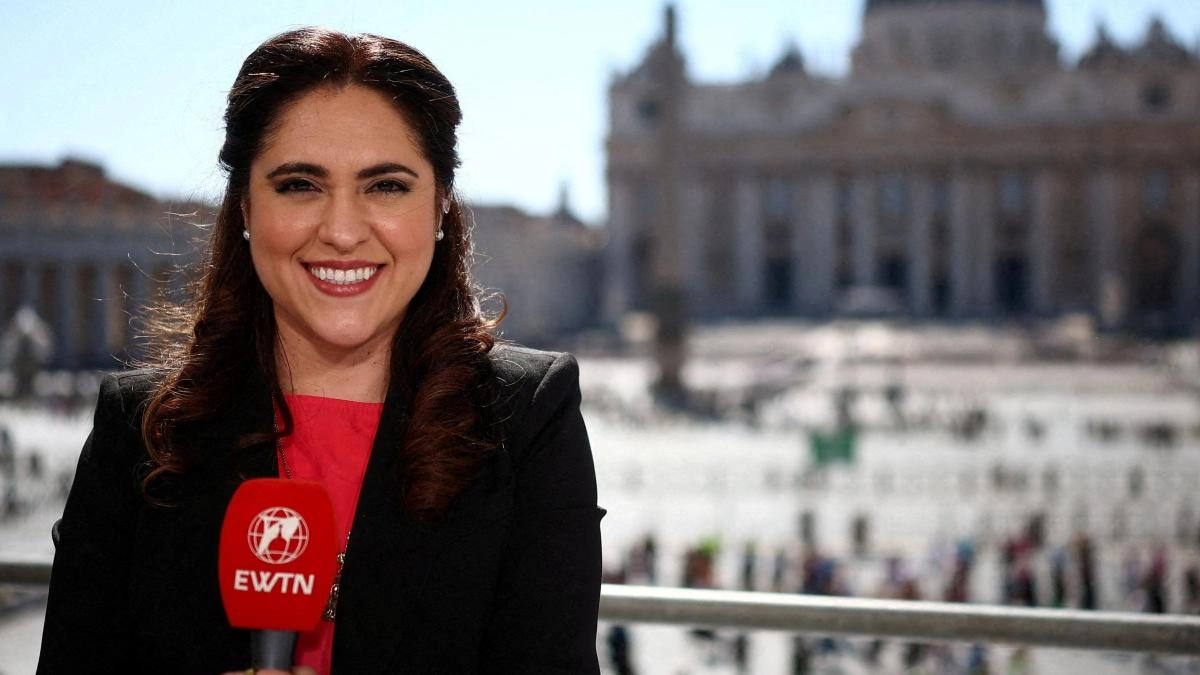

A new glass ceiling for women and lay people has been broken inside the Vatican.
Pope Leo XIV has appointed the Mexican María Montserrat Alvarado as prefect of the Dicastery for Communication, which will make her the first non-religious woman to occupy a position equivalent to that of minister within the administrative structure of the Catholic Church.
Alvarado will take up the position on November 1 and will replace the Italian journalist Paolo Ruffini, appointed in 2018 by the late Pope Francis as the first lay prefect of the Roman Curia, according to Vatican News.
“Although this appointment has been unexpected, I receive it with a sincere desire to serve the Holy Father, the Pope,” the communicator wrote.
Alvarado's appointment comes less than two months after the American pontiff appointed nun Nina Benedikta Krapić as deputy director of the Holy See Press Office, replacing Brazilian laywoman Cristiane Murray, who held this position since mid-2019.
These movements seem to confirm the importance that Leo
Just a few weeks before his death, the Argentine Pope appointed two nuns to key positions in the Vatican administration. The first was Raffaella Petrini, appointed governor of Vatican City. The second was Simona Brambilla, appointed prefect of the Dicastery for Institutes of Consecrated Life and Societies of Apostolic Life, the body in charge of supervising Catholic religious orders and congregations.
Alvarado's appointment was announced a few days before Leo XIV traveled to Spain, the first visit by a head of the Catholic Church to that country in three decades.
The chosen one
Born in Mexico City in 1986, Alvarado resides in the United States, where she studied at Florida International University and George Washington University.
Since 2023, she has served as president and chief operating officer of EWTN, the Catholic network founded in 1981 by the late nun known as Mother Angelica, which began broadcasting from a garage in Alabama and today claims to reach more than 400 million viewers worldwide.
“It is great news for the Church and for the world of communication,” Spanish Paloma García Ovejero, who in 2016 became the first woman to serve as spokesperson for the Vatican, told BBC Mundo.
“Montse has a phenomenal talent for leading teams and, above all, for spreading enthusiasm and the desire to do things well,” the current international press manager for the Mary’s Meals organization told BBC Mundo.
Professor Kim Daniels, director of the Initiative on Catholic Social Thought and Public Life at Georgetown University (USA), spoke in similar terms.
“Montse is a leader, a manager with extensive experience and vast global knowledge, which will be very useful for the Church,” added the American professor.
“I have led a global operation of a multifaceted news organization, overseeing content on multiple platforms and in seven languages,” reads Alvarado's profile on the social network LinkedIn.
In the Vatican communication apparatus they have also welcomed the election.
“We are excited by the new perspectives in communication,” a priest who works at Vatican Radio and who asked not to reveal his identity, told BBC Mundo.
Before coming to EWTN, the Mexican was executive director of the Becket Fund for Religious Liberty, a Washington-based law firm specialized in religious freedom cases.
In an article published in 2017 by the American newspaper The Wall Street Journal, the communicator Alvarado described herself as “a defender of all religions.”
Likewise, Catholic media such as the National Catholic Reporter, in the United States, have reported that Alvarado actively participates in organizations such as the Patients' Rights Action Fund - which defends vulnerable elderly people in places where assisted suicide is legal - the libertarian-oriented Acton Institute, and Benedictine College, a conservative Catholic institution in Kansas. These links have led some media to describe her as “ultraconservative.”
However, experts in communication and Church issues who have followed his career deny this adjective.
“Montse is the person who has been focused on supporting the priorities of Francis, first; and of Leo XIV, now,” said Daniels.
“He is a believer, faithful to the Church and the Pope, like 99% of Catholics.” With these words a former Vatican official described her.
“Being a believer and defending your beliefs is enough for some to call you ultra,” said an EWTN communicator.
a surprise
Alvarado's appointment surprised more than one inside and outside the Vatican. The reason? The tensions that Francisco once had with EWTN.
In 2021, the Argentine Pope complained about the media's coverage.
“There is a large Catholic television network that continually speaks ill of the Pope without any problem,” he declared at a meeting with Jesuit priests in Slovakia.
“Maybe I personally deserve these attacks and insults, because I am a sinner, but the Church does not deserve this: it is the work of the devil,” added the late pontiff.
Although Jorge Bergoglio did not expressly mention EWTN, the network considered it alluded to at the time.
“Our fidelity to Pope Francis is demonstrated by the fact that all the channels of the EWTN network have broadcast live all the important events of Francis' pontificate, so that his messages reach directly,” declared the then president of the television station, Michael Warsaw, according to the Zenit agency.
However, former collaborators of Bergoglio assured BBC Mundo that these tensions were largely overcome once Alvarado took over the reins of the medium.
“EWTN had a few years of extremist drift, but it was more due to some communicators opposed to Francisco, but Alvarado managed to redirect that,” added one of those consulted.
Alvarado joins the group of more than a dozen women who, in the last decade, have been appointed to positions of administrative importance in the Vatican. However, his appointment stands out above the rest. The reason? “The Dicastery for Communication is one of the largest organizations in the Vatican,” Daniels noted.
Vatican News, Vatican Radio, L'Osservatore Romano, Vatican Media (photo, audio and video services), the Press Office of the Holy See, the publishing house, the printing press and the Vatican Film Archive are attached to the office created in 2015 by Francis.
The election also exposes the importance that Pope Leo XIV gives to the communication issue. In one of his first speeches, after his election in May 2025, he described freedoms of expression and the press as a “precious gift.”
“The possibility of disseminating different opinions and offering diverse interpretations of facts is the concrete basis of that free exchange of ideas without which there is no freedom of thought, but rather the denial of the dignity of every human being and their right to think,” declared Robert Prevost last January.
Equality, still far away
Beyond the appointments of Alvarado and Krapić, along with the increase in women working in the Vatican – from 19% to 24% in the last 13 years, according to the most recent official data – Leo XIV has already announced that he will not modify the Church's position on the delicate issue of the ordination of women.
“It is true that women make a significant contribution to the life of the Church, but this does not justify that they should be ordained as priests,” he declared a few months ago.
The Pope has based his position not only on theological and dogmatic reasons, but also on practical considerations.
“The reality is that, culturally, not all countries are in the same place as Europe or the US. And we cannot assume that, by appointing a woman here or there for this or that, she will be respected, because there are strong cultural differences that generate problems,” he said.