

Cuba accuses the US of fabricating a “fraudulent dossier” on drones to justify military action on the island
A report indicates that the island has acquired attack drones as part of the justification for a US
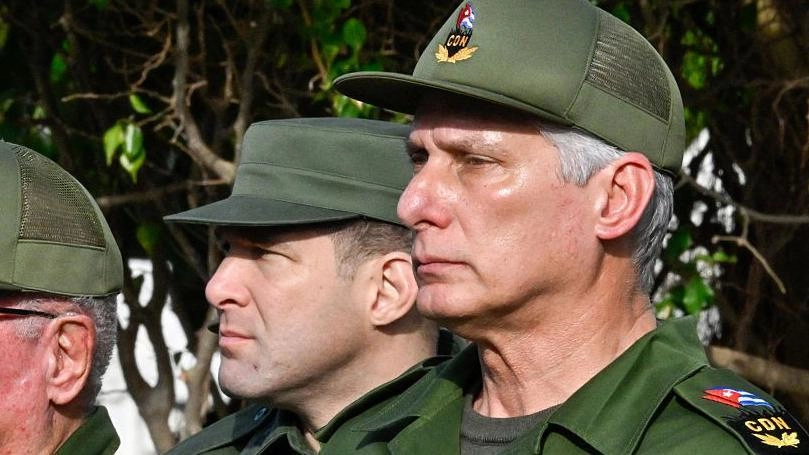

The Minister of Foreign Affairs of Cuba, Bruno Rodríguez Parrilla, pointed out that "without any legitimate excuse, the US government builds, day after day, a fraudulent file to justify the ruthless economic war against the Cuban people and the eventual military aggression."
The Cuban official's statements came after the publication of a report indicating that the island had acquired drones capable of attacking Florida.
Bruno Rodríguez indicated that “Cuba neither threatens nor desires war,” after the US news site Axios reported, citing classified intelligence, that Cuba now possessed 300 drones and was discussing attacking nearby US targets.
Cuba is suffering a fuel crisis, aggravated by a US oil blockade, while under pressure from Donald Trump's government to “make a deal”.
The US president has threatened the Cuban communist regime with an intervention similar to the one that ended in the capture of Venezuelan President Nicolás Maduro in January.
According to the Axios report, published on Sunday, Cuba would be considering using drones to attack Guantanamo Bay, the US military base on the Caribbean island, as well as naval vessels and possibly Key West in Florida.
The report quoted a US official as saying that this alleged intelligence - which he described as a possible pretext for US military intervention - also suggested that Iranian military advisers were in Havana.
Iranian drones have been central to the war in both the Middle East and Ukraine.
When condemning the United States for the construction of a “fraudulent dossier,” Rodríguez indicated on the social network
The minister added that his country "defends peace and is prepared and prepared to confront external aggression in the exercise of the right to self-defense recognized by the UN Charter."
Havana has been talking with the United States for several months to find solutions to the differences that exist between both countries.
A single Russian shipment of oil, which was allowed to reach the island, ran out earlier this month.
Cubans are suffering rolling blackouts that have affected hospitals and pumping stations, in addition to disrupting public transportation and garbage collection.
Added to the shortage of food and medicine, the situation has provoked unusual demonstrations of public dissent against the communist government.
Increases the pressure
Until recently, Cuba had survived sanctions thanks to the help of regional allies, such as the Maduro government, which is believed to have shipped around 35,000 barrels of oil a day before its capture by US forces in early January.
It appears that the Trump administration is intensifying its pressure campaign on the island.
US surveillance flights around Cuba have increased and there is a planned deployment of US forces to the region, the New York Times reported on Friday.
CIA Director John Ratcliffe had demanded that Cuba “no longer be a safe haven for adversaries in the Western Hemisphere” during a visit to Havana the previous day.
His meeting with Cuban officials came as reports emerged that the United States planned to charge Raúl Castro, who led Cuba after the resignation of his brother Fidel, for the downing of two small planes in 1996.
The Trump administration used a federal indictment against Maduro as justification for its military operation in Caracas in January, in which the Venezuelan president was captured along with his wife Cilia Flores.
Now the couple faces trial in New York on charges including drug trafficking.
In the months before that operation, Trump repeatedly accused Maduro's government of posing a threat to the United States, while a large US military force was massed in the Caribbean.
Since Maduro's capture, Trump has said that Cuba is "next."
In March, the president indicated that he will have “the honor of taking Cuba” and will be able to “do whatever he wants” with the island.
Trump has increasingly framed US policy on the region through the revival of the Monroe Doctrine of 1823, which posits that the United States should be the sole arbiter when it comes to the Western Hemisphere, renaming it the Donroe Doctrine.
His government has shown greater interest in Latin America and in left-wing leaders with whom it has ideological differences.