

Death toll rises to 44 in huge fire in Hong Kong residential skyscrapers
Huge fire in Hong Kong residential skyscraper complex leaves at least 44 dead and hundreds missing
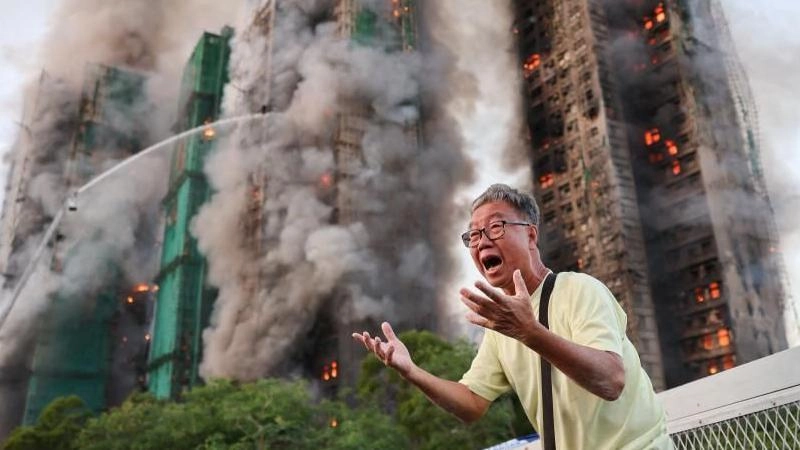

A massive fire that has engulfed several residential skyscrapers in Hong Kong's Tai Po district has left at least 44 dead and hundreds missing.
More than 700 firefighters were deployed to battle the blaze, which began Wednesday afternoon. Images showed flames and thick plumes of gray smoke billowing from the towers, which dominate the city skyline. According to preliminary information, some residents were trapped in the building, and police said 279 people remain missing. The cause of the fire, which spread rapidly through bamboo scaffolding covering the exterior of the buildings, which were being renovated, is unknown. The fire broke out in the Wang Fuk Court residential complex at 2:51 pm local time (6:51 am GMT) and was classified as a level five fire, the most severe, by the local fire department. Among the dead was firefighter Ho Wai-ho, 37. He was found unconscious at the scene of the fire about 30 minutes after contact was lost with him. The intense heat of the blaze, as well as the dangerous debris, hampered rescue efforts. “The temperature inside the affected buildings is very high, so it is quite difficult for us to get in… and up the stairs to carry out firefighting and rescue operations,” said Derek Armstrong Chan, deputy fire chief. Since the fire continued to burn well into the night, the officer said they did not know when the flames would be completely extinguished. Two directors and a consultant from a real estate firm were arrested by police for gross negligence. The complex was undergoing major renovations when the fire started. Police said they found polystyrene panels blocking the windows of one of the buildings, and it is suspected that these, along with substandard building materials, may have contributed to the rapid spread of the fire. Built in 1983, Wang Fuk Court consists of eight apartment blocks housing 1,984 apartments for approximately 4,600 residents, according to the 2021 government census. Seven of the blocks were affected by the fire. It is unclear how many people were in the apartments at the time of the fire and how many may have been trapped inside the building, but it is believed that most were evacuated.Some residents told local media that the fire alarms did not sound and that when the elevators stopped working, they had difficulty getting out. A local councilor said many of the people living in Wang Fuk Court were elderly. Reports also emerged of explosions inside the buildings, and fire hoses were having difficulty reaching the upper floors of the 31-story towers. Police also evacuated nearby buildings, and several temporary shelters were opened. Authorities declared a large evacuation zone around the fire, while roads were closed and more than 30 bus lines were diverted, according to the Hong Kong Transport Department. The fire is expected to have a profound effect on both the community and the residential complex itself. The use of bamboo scaffolding is common in Hong Kong, where it is assembled by tying poles together with nylon straps. They are lightweight and strong, and have been used as a construction tool for centuries, but Hong Kong is one of the last cities in the world still using them in modern construction. According to local media reports in March, the government's development bureau has been trying to phase out their use in favor of metal scaffolding due to safety concerns. It has been 17 years since Hong Kong faced a level five fire, when a building constructed in 1962 also caught fire. Four people died in that incident.
There were also reports of explosions inside the buildings, and fire hoses were having difficulty reaching the upper floors of the 31-story towers.
Police also evacuated nearby buildings, and several temporary shelters were opened.
Authorities declared a large evacuation zone around the fire, while roads were closed and more than 30 bus lines were diverted, according to the Hong Kong Transport Department.
The fire is expected to have a profound effect on both the community and the residential complex itself.
The use of bamboo scaffolding is common in Hong Kong, where it is assembled by tying poles together with nylon straps.
They are lightweight and strong, and have been used as a construction tool for centuries, but Hong Kong is one of the last cities in the world still using them in modern construction. According to local media reports in March, the government's development bureau has been trying to phase out their use in favor of metal scaffolding due to safety concerns. It has been 17 years since Hong Kong faced a level five fire, when a building constructed in 1962 also caught fire. Four people died in that incident.
There were also reports of explosions inside the buildings, and fire hoses were having difficulty reaching the upper floors of the 31-story towers.
Police also evacuated nearby buildings, and several temporary shelters were opened.
Authorities declared a large evacuation zone around the fire,while roads were closed and more than 30 bus lines were diverted, according to the Hong Kong Transport Department.
The fire is expected to have a profound effect on both the community and the residential complex itself.
The use of bamboo scaffolding is common in Hong Kong, where it is assembled by tying poles together with nylon straps.
They are lightweight and strong, and have been used as a construction tool for centuries, but Hong Kong is one of the last cities in the world still using them in modern construction. According to local media reports in March, the government's development bureau has been trying to phase out their use in favor of metal scaffolding due to safety concerns. It has been 17 years since Hong Kong faced a level five fire, when a building constructed in 1962 also caught fire. Four people died in that incident.