

Former DEA agent accused of laundering drug money and terrorist acts pleaded not guilty: what's next?
Former DEA agent Paul Campo and his partner Robert Sensi face four charges for conspiracy to distribute drugs, weapons, and money laundering
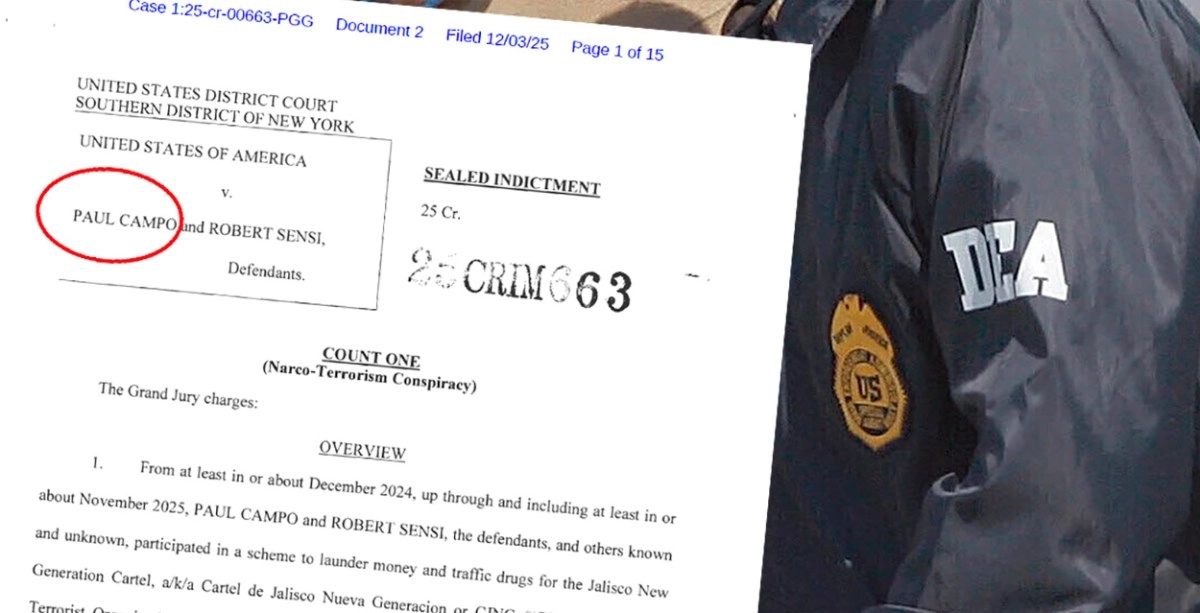

NEW YORK - This Thursday, former DEA agent Paul Campo had a hearing in the Southern District Court of New York on several charges, including laundering money for the Jalisco New Generation Cartel (CJNG); Judge Paul Gardephe ordered the prosecution to disclose information necessary for the defense. On December 5, Campo and his partner Robert Sensi—who are facing trial together—pleaded “not guilty” through documents issued by their lawyers, Arthur Aidala and Amanda Kramer, respectively. They both face four charges: 1) narco-terrorist conspiracy to import and export narcotics; 2) conspiracy to distribute narcotics; 3) conspiracy to provide material or resources to a criminal group, and 4) conspiracy to commit money laundering and fraud.
Judge Gardephe ordered the authorities, represented by Assistant District Attorney Varun Anand Gumaste, to provide the defense with information supporting the charges against their clients that could be presented as evidence at the trial, for which a start date has not yet been set.
“The Government must disclose to the defense all information 'favorable to the defendant' that is 'material to guilt or punishment' and that the Government is aware of,” the judge’s order states. “This obligation applies regardless of whether the information itself constitutes admissible evidence. The Government must promptly disclose such information to the defense.” The defense teams are preparing for trial, but the next hearing was scheduled for February 6, 2026, while it was confirmed that Campo and Sensi will remain in custody. “The information must be disclosed well in advance of the trial so that the defendants can make effective use of it at trial or at any other time the court may order,” the judge’s order adds. “The Government’s disclosure obligations are ongoing and apply to materials that come to its knowledge in the future.”
Protection of Potential Witnesses
While Judge Gardephe ordered the release of the information to the defense, he also established protections for potential witnesses, in addition to allowing the prosecution to protect victims and national security information.
“Should the Government consider that compliance with this Order could compromise the safety of witnesses, the rights of victims, national security, a sensitive law enforcement technique, or any other substantial governmental interest, it may request a modification thereof,” it states.
The judge specified that the order regarding the information applies not only to the prosecution, but also to other representatives of the “Government,” including current and former federal, state, and local prosecutors who participated in the investigation that led to the charges against Campo and Sensi.
Collusion with the CJNG
According to the grand jury indictment, former agent Campo was caught attempting to launder at least $12 million for the CJNG, but in the process they managed to launder $750,000 by investing cash in cryptocurrencies, in addition to covering the payment for 220 kilograms of cocaine. “Campo and Sensi even advised an alleged member of the CJNG on fentanyl production and exploring the procurement of weapons and explosives for the CJNG,” the indictment states. Campo worked for nearly 25 years at the DEA, first as a special agent in New York and then as deputy chief of the Office of Financial Operations. He retired in January 2016 to run a business consulting firm. The investigation allowed authorities to set a trap for Campo and Sensi at a meeting on March 10, 2025, at a restaurant in Manhattan, New York, and another on March 16, 2025, in Tampa, Florida, where Sensi resides. The alleged collaboration with the CJNG involved the production and distribution of fentanyl, moving operations from Mexico to Colombia to avoid detection in Mexico. On October 16, 2025, the alleged CJNG member met with Sensi in Manhattan, where he gave him $250,000 to convert into cryptocurrency for narcotics transactions. The investigation into the negotiations covers the period from December 2024 to November 2025.“National security, a sensitive law enforcement technique, or any other substantial governmental interest may be at stake, and a modification thereof may be requested,” it states.
The judge specified that the order regarding the information applies not only to the Prosecutor's Office, but also to other representatives of the “Government,” including current and former federal, state, and local prosecutors who participated in the investigation that led to the indictments against Campo and Sensi.
Collusion with the CJNG
According to the grand jury indictment, former agent Campo was discovered attempting to launder at least $12 million for the CJNG, but in the process, they managed to launder $750,000 by investing cash in cryptocurrencies, in addition to covering the payment for 220 kilograms of cocaine.
“Campo and Sensi even advised an alleged member of the CJNG on fentanyl production and exploring the procurement of weapons and explosives for the CJNG,” the indictment states.
Campo worked for almost 25 years at the DEA, first as a special agent in New York and then as deputy chief of the Office of Financial Operations. He retired in January 2016 to run a business consulting firm.
The investigation led to Campo and Sensi being snared at a meeting on March 10, 2025, at a restaurant in Manhattan, New York, and another on March 16, 2025, in Tampa, Florida, where Sensi resides.
The alleged collaboration with the CJNG involved the production and distribution of fentanyl, moving operations from Mexico to Colombia to avoid detection in Mexico.
On October 16, 2025, the alleged CJNG member met with Sensi in Manhattan, where he gave him $250,000 to convert into cryptocurrency for narcotics transactions.
The investigation into the negotiations covers the period from December 2024 to November 2025.