

How Iran's new regime is totally different from the previous one
Ali Khamenei's funeral is another reminder of the change Iran has undergone, but what does its new leadership want?

When US President Donald Trump signed a ceasefire deal with Iran during a dinner at the Palace of Versailles last month, many saw an irony.
His host, French President Emanuel Macron, may have wanted to ensure the Memorandum of Understanding was signed before Trump changed his mind, and possibly thought the Golden Hall of Mirrors would attract his guest.
But the choice of location inevitably invited comparisons between the one-and-a-half-page agreement and the extremely lengthy Treaty of Versailles, signed in 1919 at the end of the First World War.
The 1919 treaty reshaped Europe, but its demands for enormous reparations left Germany angry and bitter and helped set the stage for another global conflagration just 20 years later.
Could the Iran deal, different in many ways, come to be seen as equally fateful?
Nearly three weeks later, a fragile ceasefire more or less holds. But after several skirmishes in and around the Strait of Hormuz, and with none of the issues that led to the war close to being resolved, the situation in the Middle East appears as precarious as before.
Meanwhile, Iran is going through a profound process of change.
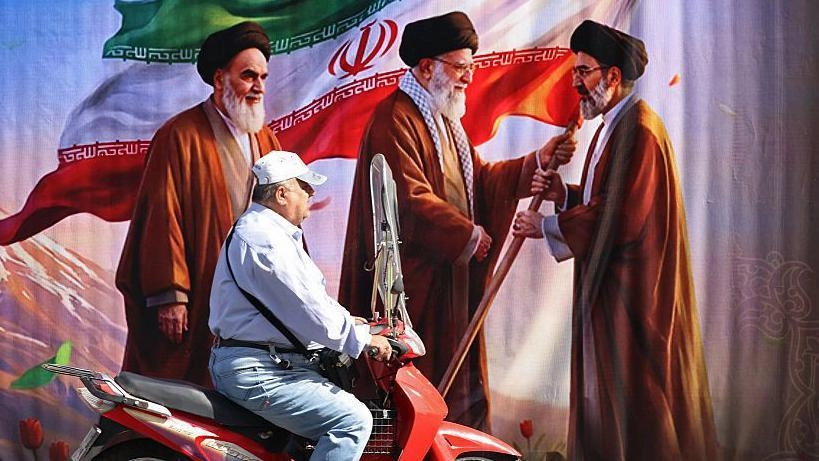
The country says goodbye to its former supreme leader, Ayatollah Ali Khamenei, who was killed more than four months ago in the devastating joint US-Israeli airstrikes that started the war and beheaded much of the regime in Tehran.
It's a pivotal moment: a great reminder that the old guard has given way to the new. And with new faces comes a new approach, with its own implications.
The United States and Israel may have sent many of the country's former leaders to an early grave, but have they been replaced by even more formidable adversaries?
Rearranging the chess board
“This war has much greater consequences and a greater scope than we have attributed to it until now,” Vali Nasr, a professor of international affairs and Middle East studies at the School of Advanced International Studies at Johns Hopkins University, told me.
“All great wars of this magnitude end up rearranging the chessboard,” he says. “This is what will happen in the Middle East.”
Already in January, Iran was rocked by popular protests that both Trump and Israeli Prime Minister Benjamin Netanyahu predicted could herald the collapse of the Islamic Republic.
The Iranian economy was already in pieces after decades of international sanctions. The country was also still badly battered after a 12-day war against the United States and Israel six months earlier.
The Iranian nuclear program—which had long served as a tool of diplomatic pressure—had not been annihilated, as Trump had presumed, but it had suffered considerable damage.
The exact whereabouts of its uranium reserves - an amount that, if further enriched, was estimated to be enough to make between 10 and 11 atomic weapons - was unknown, although much of it was believed to lie under the rubble near the Isfahan nuclear complex.
Beyond its borders, Iran's “Axis of Resistance”—a loose alliance of proxy groups and allies across the Middle East—had suffered a series of major setbacks.
In Syria, the regime of Bashar al-Assad, a close ally of Iran, is gone, swept away in a few frenetic weeks at the end of 2024.
In Lebanon, Israel eliminated prominent members of Hezbollah—a group backed by Iran—and decimated the ranks of its fighters through the use of explosive pagers and walkie-talkies.
In the Gaza Strip, another Iranian ally, Hamas, suffered a similar fate. Israel responded to the group's devastating attacks in October 2023 with a relentless offensive that leveled much of Gaza and killed tens of thousands of civilians.
Likewise, when Yemen's Iran-backed Houthi rebels launched ballistic missiles at Israel and began attacking ships in the Red Sea in response to the Gaza war, Israel, the United States and the United Kingdom carried out counterattacks, some of them targeting the group's leadership.
After so many internal and external setbacks, the consensus was that Iran was in a state of great vulnerability. The New York Times reported that Trump had received several intelligence reports indicating that Iran was weaker than at any time since the 1979 Islamic Revolution.
The idea that he could confront the United States and Israel to a stalemate seemed far-fetched.
And yet, that's what happened. The Islamic Republic still stands, thanks in part to its ability to close one of the world's most important shipping lanes—the Strait of Hormuz—and strangle the global economy.
Advantage for Tehran?
Trump likes to say he achieved regime change in Iran. Vali Nasr does not contradict this, but affirms that this has actually worked in Tehran's favor.
“A whole new generation took over,” he notes. "They have a very clear agenda. They managed the war and now they will also manage the peace."
The new leadership is not made up of the kind of people Washington often calls “fuzzy-minded apocalyptic ideologues,” Nasr says, but rather leaders of the post-revolution era, relentlessly focused on preserving the state and willing to act with greater determination than their predecessors.
At 56, the country's new supreme leader, Mojtaba Khamenei, is 30 years younger than his father, Ali Khamenei, who was believed to be in fragile health when he died at the start of the war.
Although the president, Masoud Pezeshkian, is older – he is 71 years old – the generation that led the 1979 revolution has already completely disappeared.
Two key figures – the speaker of parliament and chief negotiator, Mohammad Bagher Ghalibaf, and the commander-in-chief of the Revolutionary Guard, Ahmad Vahidi – are in their 70s.
Like the new supreme leader, both maintain close ties to the all-powerful Islamic Revolutionary Guard Corps (IRGC).
“They are children of the revolution,” says Sanam Vakil, director of the Middle East and North Africa Program at the Chatham House think tank in London.
"An 86-year-old person is no longer at the helm of the Islamic Republic. The great brake on the evolution of the system was Ali Khamenei."
For decades, the cautious Khamenei pursued a strategy sometimes called “neither war nor peace.”
His successors have been bolder: they launched attacks on US military bases in the region and, just a few weeks later, they showed themselves willing to sit down to negotiate an end to hostilities on terms that, at first glance, are far from humiliating for Tehran.
“They have proven willing to wage war much more aggressively than the previous generation,” Nasr says.
When Trump ordered the airstrike that killed former Revolutionary Guard commander Qasem Soleimani in 2020, Iran deliberately announced its intention to retaliate before launching 12 ballistic missiles at US bases in Iraq. There were no casualties among US military personnel.
This year, faced with an all-out offensive by the United States and Israel, Iran showed no such restraint and launched drone and missile attacks against multiple US bases in the region, including the Fifth Fleet headquarters in Bahrain and Al Udeid air base in Qatar.
Six American soldiers died in Kuwait. Hundreds were injured during the fighting.
Iran's willingness to attack U.S. allies in the Gulf, attack shipping traffic and close the Strait of Hormuz — a vital shipping lane — also appeared to take the White House by surprise.
For decades, Washington tried to contain Iran through its network of military installations and its growing relations with Gulf countries.
Iran's forceful response to Israeli and American attacks suggested that such a strategy was no longer working.
“Many of these countries expected US military bases on their territory to provide security, not to make them a target,” says Ali Vaez, director of the Iran project at the International Crisis Group.
“The Gulf States now question the credibility of the US security umbrella and their own deterrence strategy.”
Reports suggest that most Gulf countries are testing the waters with Iran, seeking to repair relations with their dangerous neighbor.
Citing an anonymous diplomat, the AFP news agency even reported that Saudi Arabia — which restored relations with Tehran in 2023 after decades of enmity — was preparing to hold a “reconciliation summit” that would bring together Iran and the Kingdom's neighbors in the Gulf.
However, despite their outrage at being caught in the middle of a war they did not want and tried to avoid at all costs, Vaez doubts that any are willing to sever their ties with the US military.
“They are too dependent on the United States to completely break security agreements,” he says. “They can try to diversify their options, but at the end of the day, they have nowhere else to turn.”
Without resorting to major historical parallels, Vaez describes the current situation as a “malleable moment,” full of possibilities while former adversaries contemplate a new type of relationship.
“I perceive a certain degree of realism that did not exist in the past,” he says.
But what about the Iranian people?
The new pragmatists
In January, Trump promised Iranian citizens that “help was on the way.” At the start of the war, on February 28, he was even more explicit.
“When we are done, take control of your government,” he urged them. “It will be yours for the taking.”
Until now, such promises have proven illusory. A new generation may be in charge in Tehran, but not one that has offered its people the prospect of a freer and more prosperous future.
With the regime completely focused on its own survival, Aniseh Bassiri Tabrizi, an analyst at Abu Dhabi-based Chatham House, does not expect to see a different approach to dissent.
“They will maintain a very, very strong focus on the street,” he says.
But with the hijab no longer mandatory outside state institutions, even before the war, and with alcohol discreetly available in Tehran restaurants, there are also signs that the regime may be gradually letting go of some of the old taboos.
Vali Nasr says everything is driven by necessity: to restore faith in the state.
“They made the pragmatic decision that their raison d’état (reason of state) requires them to soften on these things,” he says.
After the shock generated by its massive bloodshed in January, the regime has shown that it can at least protect the country's sovereignty.
For Iranians, the war has been deeply confusing. Horror at the regime's brutality gradually gave way to a different kind of horror as American and Israeli bombs fell on their country, killing civilians and damaging vital infrastructure.
The death of dozens of children at a Minab primary school on the first day of the war left some wondering who the real enemy was. After promising to free them, Israel and the United States seemed determined to destroy the country.
But having stood up to the combined power of the United States and Israel, can Iran's new leadership capitalize on this potentially fleeting opportunity to rebuild the regime's shattered legitimacy?
"This is kind of a 'China after Mao' moment," Vaez says, "in the sense that the system as a whole recognizes that something has to give. This new leadership understands that it needs a new social contract."
Whether they can fulfill it is an open question. More than ever, Iran is now ruled by the IRGC elite, while large numbers of well-educated young people, still grieving the loss of thousands of their friends in the bloody January crackdown, feel they have no real say in determining the country's future.
This is a turning point, with Iran balanced precariously between old certainties and future possibilities, both at home and abroad.
Despite a series of recent clashes in the Gulf, Tehran has embarked on a diplomatic process with the United States that could result in what US Vice President JD Vance has already called “a fundamentally transformed relationship.”
Faced with the tantalizing prospect of sanctions relief in exchange for nuclear concessions, the regime's ability to manage the economy could help restore its battered domestic reputation.
Since signing the Memorandum of Understanding, Iran has already benefited from waivers to US sanctions, allowing it to export crude oil and petroleum products for 60 days.
Other forms of relief could come during the 60-day negotiating period, including the unfreezing of billions of dollars in Iranian assets and, when a final deal is reached, the biggest prize: the lifting of all international sanctions.
The memo also refers to the creation of a $300 billion “reconstruction and development” plan, although it is not clear who will finance it.
Together, these economic incentives offer a powerful incentive for Iran's new leaders to reach a deal.
Sanam Vakil agrees that the region faces “a window of opportunity,” but is cautious.
“There is a scenario where they don't get a deal, where this goes on indefinitely and President Trump loses patience... and says, 'Well, it's time for round three.'”
None of the experts I spoke to believe the future is assured.
Decades of tortuous relations between Iran, its Middle Eastern neighbors and the United States have left a toxic legacy, characterized by deep suspicion and a near-total lack of trust.
There is no shortage of reasons for failure: disagreements over Iran's nuclear program, the future of the Strait of Hormuz, the war in Lebanon, as well as the entrenched positions of the most intransigent sectors on all sides.
After six turbulent months, the region has begun to change its appearance. But many things must go right for this still malleable moment to consolidate into something better.