

“Es sencillamente un acto de tirania de EE.UU. lanzar linternas sobre agua de sovereigndad extranjero”: Gust
The president of Colombia spoke to BBC correspondent Tom Bateman about the US attacks in the Caribbean
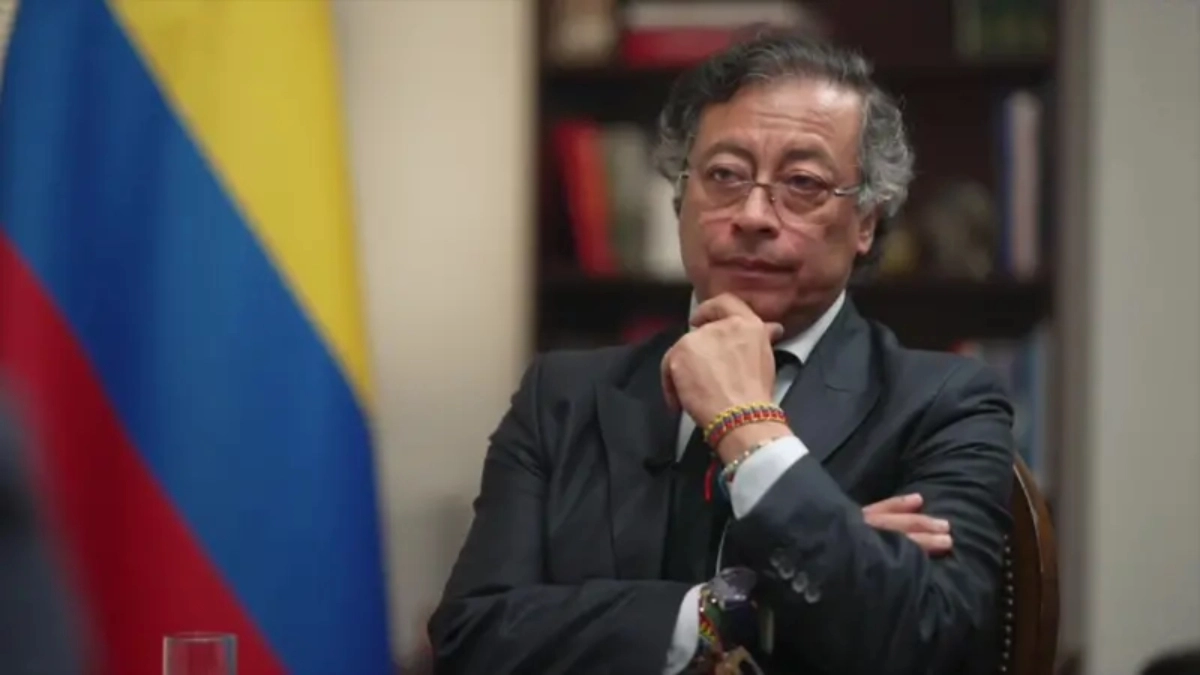

President Gustavo Petro described the recent attacks ordered by Trump against vessels allegedly carrying drugs in the Caribbean Sea as an “act of tyranny.”
In an interview with the BBC in New York, the Colombian president stated that the use of lethal force by the United States government for this purpose constitutes murder.
He added that if it is confirmed that Colombian citizens were among those killed in the attacks, criminal proceedings will be initiated against the senior US officials who ordered them.
Since August, the US has deployed a military fleet in the Caribbean Sea as part of its anti-narcotics strategy, and in the last three weeks it has carried out attacks in international waters that left at least 17 dead.
Trump frames these military actions within the fight against foreign terrorist organizations, but United Nations experts have defined them as extrajudicial executions.
Petro is one of the few world leaders who has dared to publicly confront the US president.
Since Trump took office, the relationship The relationship between the two governments has been tense for several times. Recently, the US decertified Colombia as a partner in the fight against drugs.
In a conversation with BBC correspondent Tom Bateman, Petro discussed the attacks in the Caribbean, the US relationship with Colombia, and the fight against drug trafficking.
The following is a version of the interview edited for length and clarity.
I'd like to start with last week's US airstrikes on a speedboat in the Caribbean, which President Trump said were aimed at illegal drug trafficking. You've suggested that the crew may have been Colombian civilians.Has it been confirmed?
There is a universal principle of international law, which is the proportionality of force. It takes into account the degrees of force of each of the rivals and whether it has been used in an excessive manner.
If you use a nuclear bomb against an army of rifles, you would violate international law.
Colombia, with the United States, with Europe, with other Latin American countries, has carried out immense operations, with at least 100 or 200 tons of cocaine seized in speedboats. We have extensive experience, in collaboration with the same United States agencies and others, in marine cocaine seizures.
No one has ever died. There is no need to kill.
And it is not necessary, because you simply block, as in a street, the speedboat with other faster ones. For years and years, we have managed to carry out operations without deaths.
Why launch a missile if you could have simply stopped it and captured its members?
That is what I call an assassination because 1. It breaks the principle of proportionality of force: a missile is much more than a gun 2. The operation can be carried out very cleanly without anyone dying, and that is a first in any State action and 3. [By stopping the boat] you capture the people, you know what is inside the package they are carrying and if they are migrants or young drug workers.
In general, neither the peasant who grows coca leaves, nor the people who transform it into cocaine, nor those who transport it are the real drug traffickers.
The real drug trafficker has a multinational business organization, and he organizes, with his team, the global transportation of the drugs, the way in which those drugs are converted into money and how that money is laundered.
That means they're not on boats, they're not in fields, they're not in laboratories, but they live in luxury cities, because the amount of money they manage to obtain allows them the greatest luxuries in the world.
President Trump argues that he has the right to use war powers in this case because of the magnitude of what is being inflicted, in terms of drug trafficking, on American communities. And that's why he says he's taking these actions as a deterrent. Yesterday he said that this will stop drug trafficking in the Caribbean Sea. Isn't he right?
No, not at all, because he's unaware of the reality of drug trafficking.
The growth in demand for cocaine in the United States stopped a long time ago due to a much more harmful consumption, which is fentanyl.
Fentanyl doesn't come from the land, from the fields, from vegetables. Fentanyl is a chemical and therefore,It can only be done in a relatively complex industrial apparatus, not in the coca leaf fields of Colombia.
That means that a high percentage — of both the supply and demand — of fentanyl in the United States is self-produced and self-consumed, it doesn't need boats, it doesn't need airplanes, really. It's done right here, right here in New York.
So Trump's idea that there's a drug invasion, on the cocaine side, is false because consumption hasn't increased for a long time in the United States.
And, secondly, fentanyl consumption doesn't cause an invasion of foreign merchants, but rather it occurs in the United States itself.
So, how would you characterize President Trump's behavior and his decision to use military force against vessels like this in his country's region?
It's an assault on reason, first and foremost, and that's the most dangerous thing.
Trump is part of irrationalist currents of thought. They deny the capacity of science. There's what you said about the climate crisis. They deny the dialogue that science produces.
And unreason always leads to violence.
Launching missiles into waters that are foreign sovereignty for the United States is simply an act of tyranny.
What is happening there is tyranny. You cannot know if those young people are migrants or employees of a drug-trafficking mafia. And in neither circumstance does Mr. Trump have the right to launch a missile at them when they are defenseless.
Yesterday you asked that President Trump be criminally prosecuted for this matter. Why do you say that?
I said that if it is confirmed that among those young people [who died in the US attacks] there were Colombians, it is mandatory for the Colombian justice system to open a criminal investigation for murder.
And those who would be named in that process are the officials who are responsible for the murder.
Regardless of what they had there [on the boat], international law, the law of nations, was violated.
It is evident that Americans will see this as an extremely provocative statement. Given your relationship with President Trump over the past nine months, are you concerned that adopting this approach of resistance to the US government could isolate your country?
I think it is President Trump who is isolating himself.
I spoke with President Biden four times, we were relatively friendly, we agreed on some issues, I warned him about the issue of Palestine.
There was a relatively civil and respectful relationship between the two of us. I have no animosity towards the US.
But Trump came in insulting me. He had already insulted me during one of his presidential campaigns when he called me a terrorist. I have received nothing but insults from him.
I have told his envoys: let's talk face to face. But it has to be face to face.
They cannot think that we, the people who are children of Bolivar, kneel. We are not subjects. We cut off the king's head. We are republicans. And, therefore, here we speak as equals.
I think the gentleman has not understood that. And he mentally believes that we are subjects, perhaps because many Latin American leaders feel that way: sepoys, subjects, they are afraid to speak as equals. Not me.
Do you think this strategy of arguing publicly with Trump is working?
I want to make our positions clear. And to make a position clear to the world, it must be made public. There's no other way.
The United States withdrew Colombia's certification as a partner in the fight against drugs. There's always the risk of sanctions. You receive billions of dollars in security aid from the United States. Aren't you putting that at risk, and therefore endangering the well-being of the Colombian people?
We haven't received billions of dollars.
First of all, what the United States calls aid is a transfer of money from the United States budget to its own NGOs, to its civil organizations. That doesn't reach Colombia's national budget.
If it reaches the Colombian Army, it's to buy weapons from the United States. It's a business.
So that's not the biggest problem. It's never been about billions of dollars either.
What we do have at hand is a destabilization of Colombian sovereignty over its own army, for example, over its police, over Immigration, over the Attorney General's Office, because the institutions are becoming disjointed.
So, sections of the institution, depending on what they do, can be co-opted by the United States and functionally separated from the rest of the institution.
That happened to me with Immigration. Once I entered one of their offices in Bogota and found it covered in American flags. And it's Colombian immigration.
Or the operation that I myself publicly denounced, because I discovered it through my personal investigation, surrounding Pegasus.
Pegasus is an Israeli software that, if it enters your cell phone, can listen to all your conversations, etc. In Colombia, a court order is required for that. The software entered without a court order. The money, approximately $14 million, was provided by the CIA. And it was a CIA operation without consulting the civilian government.
That's illegal.This destroys Colombia's national sovereignty. I don't know if the targets were drug traffickers or not; only the CIA knows that.
But, in my opinion, this is not an operation between states that respect each other.
How would you describe your progress in terms of coca crops and negotiations with guerrilla groups in Colombia?
There are no guerrillas in Colombia at this time. There are armed organizations serving drug trafficking that, because it involves cocaine, need control over specific crop areas and routes.
This control is armed and illegal. But it has nothing to do with political objectives of seizing power, as was the case during the Cold War. The ideological element is not at the heart of the violence in Colombia, but rather greed and business.
Coca leaf crops have been variable and have increased in correlation with the demand for cocaine.
They began to grow starting in 2013, in a new cycle that correlates with the growth of the cocaine market in Europe.
During Duque's government (2018 to 2022), the sharpest trend is observed, a 43% annual growth in crops.
In my years [of government], which are now 3, there has been a decline in the growth rate: 13% in 2022, 9% in 2023, and 3.4% this year. That is to say, we are going to stagnate crops and hopefully return them to a decline.
Why, if under Duque's government they grew at 43% per year and we have reduced that growth to 3%, do they decertify me and not Duque?
Because the issue is not in the numbers. It's in the politics.
But I add one more fact. We must not only count the area of ??crops, which is easy with a satellite, but also the productivity by zone.
And this is where the big error of the last United Nations report lies.
The United Nations took the productivity rate from high-productivity zones and applied it to all zones, including those of wilting. In other words, it overestimated the amount of potential cocaine.
They accepted this as a mistake. But the numbers from the 2023 study haven't changed, which was the only excuse US officials used to say we weren't good partners in the fight against cocaine.
In other words, our decertification is due to the carelessness of a junior UN researcher. To not doing the study properly.
You promised to negotiate with the armed groups, to resolve this problem. And what we've seen is an upsurge in violence. According to the International Crisis Group, the ELN has executed civilians this year, and negotiations have failed. In other words, no progress has been made.Hasn't your strategy failed?
The failure isn't in negotiating.
When an insurgent group has a political vocation, there is political negotiation. Colombia has had decades of political negotiations; some failed, others successful.
With crime, there is no political negotiation. There is legal negotiation. This second is what we have talked about in Colombia.
Why is there no longer any possibility of political negotiations? Because we don't have an armed insurgency, we have armed gangs. With relative capacity, not as much as the insurgency had.
That's why Colombia's homicide rate today is the lowest since 1993 and a quarter of what it was at that time, when Pablo Escobar was at the height of his power and about to die.
So, today's circumstances are those of a socio-legal negotiation, as we have called it.
My officials may have made mistakes, I confess, in confusing one negotiation with another. With drug traffickers, there is no political negotiation. They negotiate their legal terms of surrender, years [of sentence], even extradition.
We have said: we can negotiate that in exchange for eradicating the illicit economy.
Only a few armed groups have said they are willing to voluntarily replace their crops. They are marginalized groups, it's the truth.
What the United States government was asking for was the forced eradication of crops.
Forced eradication was most successful in 2020, under Duque. It reached 130,000 hectares eradicated.
Why did the satellite show that [that year] the planted area was only reduced by 9,000 hectares? Because forced eradication failed.
The farmers, or the drug traffickers, immediately planted elsewhere.
When it is the same farmer who pulls out the plant of his own free will, he does not plant it again. They plant their legal crops, and I have to help make them profitable, because they grow in very excluded areas of the national territory.
The peasants begin to eradicate because the armed gangs, who are not the owners of drug trafficking but are there for hire taking care of those coca plants, have decided to negotiate a legal solution.
And then an effect of transformation of the territory occurs.
That's what we have: socio-legal negotiations in which we seek to eliminate the illicit economy in the least violent way possible, without affecting the peasantry and achieving the submission of people to legal processes with legal benefits, but that have nothing to do with politics.
This same thing that I do they do here [in the US]. Here they don't have the problem of the peasant farmer,but yes, of the kingpin that I myself have extradited.
I have the following awards: during my administration, the largest number of tons of cocaine in world history has been seized. We are approaching 1,000 tons a year.
The president who has seized the most tons in world history has been decertified.
And we have achieved the largest number of extraditions for drug trafficking to Europe and the United States, around 700.