

Take what you want while you can: the fierce dispute over sovereignty in the South China Sea
For years, China has transformed reefs into dry land to bolster its claims. Now, other countries have begun to imitate that strategy
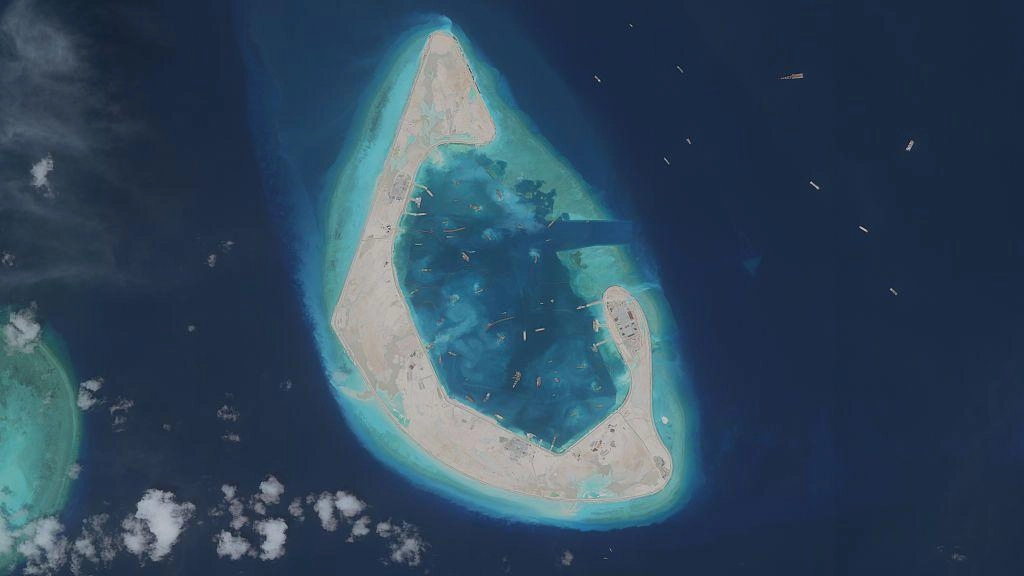

A new focus of tension emerges in the South China Sea.
Antelope Reef, a small teardrop-shaped formation at its northwestern end, has gone from being almost completely submerged to becoming land.
Millions of tonnes of sand have been dredged from the seabed in an operation that reflects the growing territorial dispute in the region.
What was once just a turquoise dot on the map is now a crescent of bright white sand covering about 6 square kilometers, with a few buildings scattered at one end.
In the lagoon formed by this crescent, dozens of boats can be seen, probably cutter suction dredgers, a type of machinery of which China has the largest fleet in the world.
Some can extract up to 6,000 cubic meters of material per hour, enough to fill two Olympic-size swimming pools.
The speed of this dredging operation is extraordinary and could constitute a world record.
But China is not the only country that carries out this type of intervention.
After years of watching Beijing create new tracts of land to bolster its ambitious territorial claims, Vietnam has also begun rebuilding some of the reefs it controls in the South China Sea.
To a lesser extent, other countries with territorial claims in the area, such as the Philippines, are following the same path.
A dredge war
Antelope Reef is located in the Paracel Islands, which together with the Spratlys constitute disputed territory claimed by China, Taiwan, Vietnam, the Philippines, Malaysia and Brunei.
Most of these islands are, like Antelope Reef until recently, submerged reefs that historically have not had human settlements.
China took control of the Paracels in 1974, after a confrontation with South Vietnam.
More recently, Beijing dredged three reefs in the Spratlys — Mischief, Fiery Cross and Subi — transforming them into islands large enough to house airports and military bases.
At the same time, it has claimed almost the entire South China Sea as sovereign territory within the controversial “nine-dashed line” it has drawn on the map.
Today, numerous Chinese coast guard and maritime militia vessels patrol within that line, overcoming attempts by other countries to challenge their dominance.
In recent years there have been several clashes with the much smaller Philippine coast guard in areas claimed by both countries.
The rectilinear edge of one of the newly created beaches on Antelope Reef suggests that China could be building another military-use airstrip there, similar to those at Mischief, Fiery Cross and Subi.
However, China already has a well-established runway on nearby Woody Island, and building another in an area close to its large military bases in Hainan may prove unnecessary.
Rather than an operational necessity, this construction could be interpreted as a message directed to Vietnam.
Vietnam and China have a long history of friction in the South China Sea, or East Sea, as Hanoi calls it.
However, in recent years, Vietnamese communist authorities have moderated their anti-Hina rhetoric and have worked to strengthen ties with Beijing.
To Lam, the newly elected president, made his first state visit to China this year, where both countries addressed their differences over the Paracel and Spratly islands in unusually conciliatory terms.
Vietnam has formally protested against Chinese construction on Antelope Reef, although it has done so in diplomatic and content terms.
However, on the ground, in the disputed reefs, Vietnam has also stepped up its dredging activities, using suction vessels similar to those used by China.
“If you can't beat them, join them.”
Over the past three years, Vietnam has been dredging sand around at least 20 reefs and, according to the Washington-based Asia Maritime Transparency Initiative (AMTI), created 11 new ports.
In total, it now controls more than 11 square kilometers of reclaimed land, about half the area controlled by China.
In addition, it has begun to build military infrastructure, such as navigation beacons.
Vietnam's approach seems to be that if you can't beat China, you have to keep up with it.
“The Vietnamese have been less likely to lead the public relations battle in their disputes with China,” says AMTI director Greg Poling.
"They prefer to let the Filipinos fill that role. But at sea, Vietnam has shown a greater willingness to confront Beijing. As a result of this, China has largely retreated from attempts to, for example, block Vietnamese oil and gas exploration."
This is, according to some analysts, one of the reasons why China is accelerating its work on Antelope Reef.
“Vietnam has taken advantage of China's focus on the Philippines... The land reclamation in Antelope could be interpreted as China's response, a reminder of who's boss in the area,” says Ray Powell, director of SeaLight, a Stanford University-based project that monitors the South China Sea.
Where does this leave the rest of the countries that claim the Spratlys?
For the past three decades, the Association of Southeast Asian Nations (ASEAN) has attempted to negotiate a code of conduct with China and its four member states that also have grievances.
In 2002, both sides agreed to a much weaker, but non-binding declaration, which China has largely ignored.
Each year at the annual Asean summit, leaders promise to move toward an enforceable code of conduct.
However, at the end of each year, progress remains limited.
Frustrated by the lack of progress, the Philippines took China's actions to the Permanent Court of Arbitration in The Hague in 2013.
The court ruled decisively in favor of Manila, concluding that China's claims within the “nine-dashed line” lacked historical basis and that its activities – such as the transformation of reefs into islands – violated international law and the Philippines' rights to its exclusive economic zone on its western coast.
China has ignored that ruling, prompting the Philippines to change strategy and attempt to pressure Beijing by sending its clearly outnumbered coast guard to challenge the Chinese fleet.
This has led to multiple confrontations, although without altering the power imbalance.
The Philippines has also strengthened its military cooperation with the US and sought new alliances with countries such as Japan and Australia.
Washington, for its part, has offered him firm diplomatic support, US$500 million in military aid and new equipment.
Together with its allies, the US periodically conducts freedom of navigation operations in the South China Sea, with the aim of reaffirming that these are international maritime routes, despite Chinese claims.
However, these operations are mainly symbolic and have a limited impact on the balance of power.
Now, the Philippines is also reinforcing the enclaves it controls in the South China Sea.
It is expanding the landing strip on Pagasa Island, also known as Thitu, building a coast guard base and reinforcing the BRP Sierra Madre, a landing ship that ran aground on Second Thomas Reef in 1999 and is now in notable disrepair.
He maintains a detachment of soldiers on board, despite constant harassment from Chinese vessels.
“Most complaining countries have recognized that they will never achieve the legally binding document that the code of conduct was intended to be,” says Greg Poling.
"China is just continuing to do what it wants in the sea, eroding its sovereignty. So what we will probably see in the end is a non-binding agreement. But that could open up diplomatic space for Vietnam, the Philippines, Malaysia and other countries to negotiate more effectively among themselves, without necessarily going through Asean."
This now appears to be the new reality in the South China Sea.
Each country acts on its own, trying to make the most of what it already controls, accepting that China will continue to be the largest and most assertive player in the region.