

The incredible journey of the young man who rowed alone across the Pacific from Peru for 15 months
Tom Robinson holds the Guinness World Record for the youngest person to row the Pacific. On his journey he faced fear and uncertainty
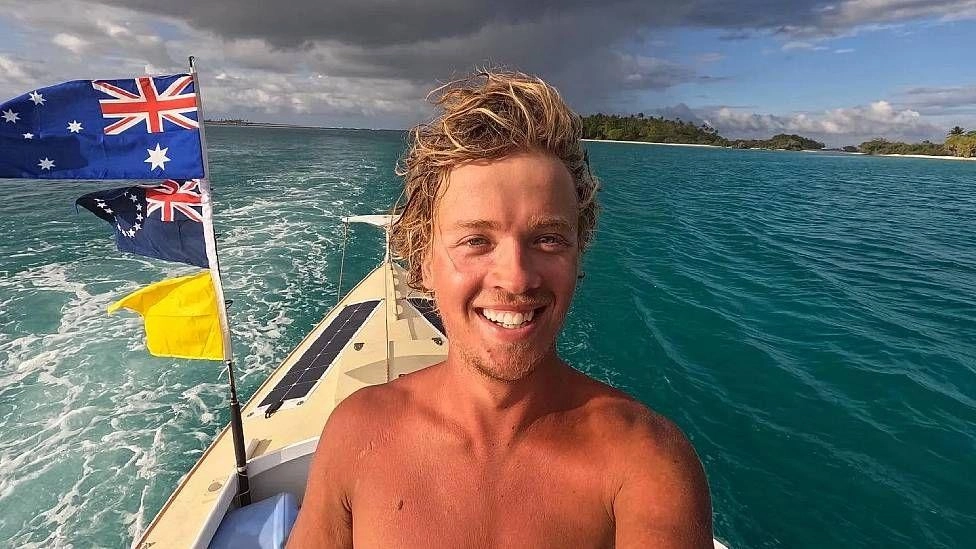

In the early morning of October 6, 2023, Tom Robinson, 24 years old, found himself alone in the middle of the Pacific Ocean clinging to the overturned hull of his boat, shivering from the cold and completely naked.
He didn't know at the time if anyone would try to rescue him.
The young Australian had left Peru months before on a wooden boat that he had designed and built himself.
His goal was to make the dream he had harbored since he was 14 come true: to become the youngest person to row the Pacific Ocean.
During the journey he explored not only a vast ocean, but his priorities and his ability to overcome fear and uncertainty.
“There was a brief moment when I thought it was all over and that this trip would cost me my life,” Robinson told the BBC.
"And that thought was really distressing. But very soon I changed my perspective...and I started setting small goals for myself."
On the journey, the young man also experienced days of “total peace” and the affection of communities on Pacific islands that welcomed him “with open arms.”
Tom Robinson reflected on the lessons of his journey in conversation with Outlook, a BBC World Service radio programme.
The interview was conducted by journalist Mobeen Azhar.
How did your dream of crossing the Pacific come about?
I grew up on the banks of the Brisbane River, so my entire childhood revolved around that river meandering through the city.
Every day after school, I paddled on the river, fished, lived a very Huckleberry Finn-style childhood and from there arose my passion for boats and the sea.
Every night he read books about sailors, explorers and adventurers. And one morning I woke up very early, looked in the mirror and said to myself: “Tom, you are going to be the youngest person to row the Pacific Ocean, and you are going to build yourself a boat for the crossing.”
From that day on, starting when I was 14, every day I thought about that trip and that adventure.
You also wanted to build the ship yourself to cross the Pacific. Why was this so important?
I think I wanted the biggest challenge possible. I chose the Pacific for several reasons, but one of them was that it is the largest ocean, and crossing the South Pacific is basically the longest ocean rowing crossing you can undertake.
So building the boat became a fundamental part of the trip. That ship was really a part of me. It was my drawings that made it come true. It was my hands that built it.
Ultimately, the whole trip was about expressing myself to the fullest, and building the boat was part of that.
And you named your boat Maiwar, which means “Brisbane River” in the Aboriginal language…
Yes. The design was based on the 18th century whaling ships that went out to the Pacific to hunt whales.
I remember reading a book one night, looking at the plans for those boats, and thinking, “That's just the kind of boat I need for this trip.”
The sea and waves haven't changed in 250 years, so I didn't think the boat had to change either.
How did you mentally prepare for the trip?
I don't know how one can prepare for something like that.
I took certain steps to ensure that when I left Brisbane I wouldn't become homesick.
Obviously my friends and family will always be there. But I tried to cut ties and relationships, just to know that during the trip I could be completely at peace with myself and the world around me, and I wouldn't think that I should be somewhere else for someone else.
You had a girlfriend at the time, right?
Yes. And I suppose that is one of the great tragedies of the trip: that the journey had to take priority over everything else.
I said to myself, “This rowing trip is going to be the most important thing in my life for the next two years or however long it lasts.” And I had to make decisions.
Yes. It was a very difficult conversation, obviously. But we both knew it was going to happen. People asked me, “Will your friends and family come to visit you on the islands along the way?”
And I said, "Absolutely not. The trip begins when I leave Brisbane airport on a plane to Lima and ends when I return to Brisbane."
Any contact with my previous life and my previous world would disrupt how the entire trip would feel. I was totally committed.
I wanted that experience to be definitive, true, pure, and that was the best way to achieve it.
Tell me about the day of departure.
It was July 2, 2022. I will never forget it. It was a strange and surreal day. I went to the local market and bought my bread with pork rinds for breakfast and said goodbye to the market ladies. Then I went to the yacht club and a lot of people started arriving.
He had been in Lima for two months and had made friends, but the entire community came on this special day to say goodbye to the young Australian who was leaving.
There were television cameras everywhere. I looked into the distance and saw a naval music band arriving.
I assumed they were coming to some other event after I left. But the manager of the yacht club winked at me, and the band began playing traditional Peruvian naval songs.
The musicians got into a boat and played music. So I got into my boat, untied the rope, sat down, grabbed both oars, and took the first stroke.
I realized that this was going to be the first of millions. What a feeling!
There were boats around me, the band playing. I was totally focused and started paddling hard. The boat was very heavy, loaded with all the food and water for the trip.
Little by little, the boats began to return to port and there was only one left to accompany me, that of my good friend Gonzalo Rivago, who helped me a lot.
Finally he turned around and it was just me and the sea lions left. That's when I knew the adventure had begun.
During the first 75 days of the trip everything was great happiness.
It's everything you dream of: being on your own boat in the middle of the Pacific, fishing for dinner, living off the ocean.
I left Peru with the intention of making a stop in the Marquesas archipelago, which is part of French Polynesia. It is the first archipelago west of South America, about 3,000 or 4,000 miles (about 6,800 kilometers) from South America.
I was on track to reach those islands in about 100 days. Everything was going very well.
Suddenly, a very strong breeze emerged from the southeast and for days and days that strong wind blew. No matter how hard I tried, I kept drifting further and further north, away from the islands.
I pulled out a huge nautical chart of the Pacific. I scanned it again and again looking for the nearest inhabited island.
It was important to find an inhabited island, because I knew that whichever one it was, I would be stuck there for the next four months during the cyclone season.
Finally I found a small island, Penrhyn, also called Tongareva, which was just a dot on the map.
And suddenly, just like that, the whole trip changed. My goal was that little dot. I had no idea what the people would be like, or what the place would be like, but I kept paddling.
I rowed like crazy, basically, 14 hours a day just to survive, to make sure I got to this island.
Finally, after rowing almost 5,000 nautical miles, on day 160 you were able to see land and a boat full of people approaching…
I felt indescribable joy and euphoria. They were very happy to see me.
They towed me across the lagoon to a small town called Omoka, the largest on the island, with 140 inhabitants and houses made of brick and tin.
They told me: “Tom, you can go ashore now.” I looked at my feet and realized that this was going to be the first step I would take in over 150 days.
The boat is so small you can't walk on it, so I took a huge jump to get off and my feet landed on the hard coral floor.
I felt the warmth of the earth beneath me and it was an extraordinary sensation. I tried to stand up, but I felt very dizzy and walked like a drunken sailor.
Some big, burly men from the village surrounded me and helped me stay upright. And one of the village elders came up to me and said, "Tom, welcome to our island of Penrhyn. It's a pleasure to have you here. You're the first international ship to arrive in three years."
He added: "But there is something I must inform you. You came here as Tom Robinson, but now you have a new name. You are now Mahuta Hoi Ho Asanga, which in our language means 'the warrior who has rowed from afar'. So welcome to Penrhyn, Mahuta."
A wave of emotion came over me; I couldn't believe that after so much time at sea I had arrived at this little paradise.
These people welcomed me with open arms. They instantly welcomed me into their homes and into their lives.
When I left it was difficult. They are people very connected with their emotions, kind and selfless. The truth is that I have friends and family there for life.
You faced many challenges, but after more than 260 days at sea the toughest challenge was yet to come…
I had traveled about 7,000 nautical miles and believed I was about 50 days away from reaching land and fulfilling my childhood dream.
I had been paddling all day quite comfortably. I decided to hang up the oars a little early and go into my cabin.
The thing to understand about these ocean rowing boats is that they are designed to be unstable upside down, meaning that if a wave capsizes them, they right themselves.
And the reason they are unstable upside down is because they have a lot of air trapped inside the cabin when the hatch is closed.
But in the Pacific near the equator it is very hot and there are times when you are trying to sleep and you are suffocating.
So this time I had the hatch open, and that was the big mistake.
I was lying on my bunk, thinking about dinner. Suddenly I heard a tremendous roar and, without time to react, I felt that the entire boat was shaken by a huge wave and was left upside down.
I held my breath as the cabin flooded in an instant. There was no time to think. It was a total shock. By then, the sun had already set and it was getting dark.
I had no choice but to swim through the half-open hatch and then climb out and grab the side of the overturned boat.
I suddenly realized that the worst possible scenario had become reality. I tried to right the boat. I tied a rope to the side and tried to straighten it again, but it was too heavy and got stuck.
I realized that the emergency transponder was inside the boat.
So I had to swim back under the boat to the cockpit, grab the emergency beacon, hold on to it, and swim back under the boat to the side.
I tied it to my wrist with a rope and then climbed onto the overturned hull and tied myself up. I knew that trying to right the boat and resolve the situation was going to be impossible during the night.
It was too dark and the sea was rough, the swell was increasing. I ran the risk of hitting my head, becoming unconscious, and it all being over.
I sat on the overturned hull, completely naked, shivering with cold. There was a brief moment when I thought it was all over and that this trip would cost me my life.
It was a truly shocking thought. But I quickly reacted and realized that it was just a setback.
What were you thinking in those moments?
Many things went through my head during those 14 hours. At first everything was pessimism and hopelessness. I thought my life had come to an end, not just the trip, but my entire life.
And that thought was really distressing. But very soon I changed my perspective and started to see the positive side, if there was one.
The whole trip had been about overcoming difficulties. So I figured if I'd gotten through all that, there was no reason I couldn't survive the night.
I started setting small goals for myself. The main goal, the great goal, was to endure the night and see the dawn.
I knew the moon would rise at some point, and I decided it would be the most beautiful moonrise I had ever seen. And I started planning how to get out of that situation.
The next day the sun would rise. He might find some food on the boat, and then he would flood certain sections of the boat to right it and move on.
I had this emergency locator beacon with me, this transponder that beeped and flashed. But I had no idea if anyone was looking for me or if help was coming.
The waves crashed over the boat and almost carried me away.
And then, as I looked east like I did all night, that pitch darkness turned to a faint dark purple and then it got lighter and lighter and I had a strong feeling that everything was going to be okay.
I had just gotten through the hardest night of my life and the hardest experience of my life, and I thought things were going to get a lot better after that.
I felt great excitement, and shortly after the sun rose over the horizon, I saw a large black dot on the horizon and realized it was a ship, and for the first time I knew the journey was over.
I know you thought it was a freighter at first.
I couldn't help but laugh. And only then did I realize my own nakedness. And as the ship approached there were literally hundreds of people on the decks with large lenses on their cameras and binoculars.
The captain did an incredible job maneuvering the ship until I, in my rowboat, ended up against the side of the ship as these large waves went up and down the hull. A very scary situation.
They lowered a rope ladder down the side of the ship and I had no choice but to take a leap of faith and leave my rowboat and jump onto the ladder.
I gathered the strength to climb the rope ladder and when I was on the ship I saw a group of people in a hallway, crew, staff and others. Everyone was staring at me, I was staring at them and the whole situation was absolutely surreal.
Although you couldn't finish the trip you had crossed enough ocean to receive the Guinness record for the youngest person to row the Pacific. You achieved your dream, what was it like to be back?
The next 12 months after I returned were the hardest part of my life.
It was totally impossible for me to resume the rhythm of life. I had done something so important that I had always wanted to do and I was left with a huge void.
Sometimes you wonder if the whole trip was worth it because the return trip is very difficult. But really I just had to accept it, like when I rowed, day by day.
Have you regained your sense of purpose since you returned?
Yes, I went back to work. I'm building boats again. I have a small business. But there is always something that eats away at me and I wonder: “When will I be able to return to the sea?”
As for the Tom who went on this journey and the Tom we talked to today, how would you say you're different?
I had so much time to think, reflect and wonder about life and the decisions I had made.
Arriving at the islands and seeing those people living in a totally different way, so happy and at peace, made me question my daily decisions and my way of living.
It was a very, very good experience to reach inside oneself.
I experienced moments of maximum euphoria. Sometimes they call it nirvana. And I had a moment, around day 120, where I felt an inner glow radiating throughout the world. There were two or three days in which I was totally at peace, more than ever. It was simply extraordinary.
I'll probably never feel it again. But having that with me and knowing that it is possible is a beautiful thing.
You can listen to the original interview with Tom Robinson in English here. And read more about the journey on their site.