

The building in Gaza that still stands and helps tell the story of Israel's offensive
The Skeik Building, on a quiet street in western Gaza City, has seen many families pass through since the war began.
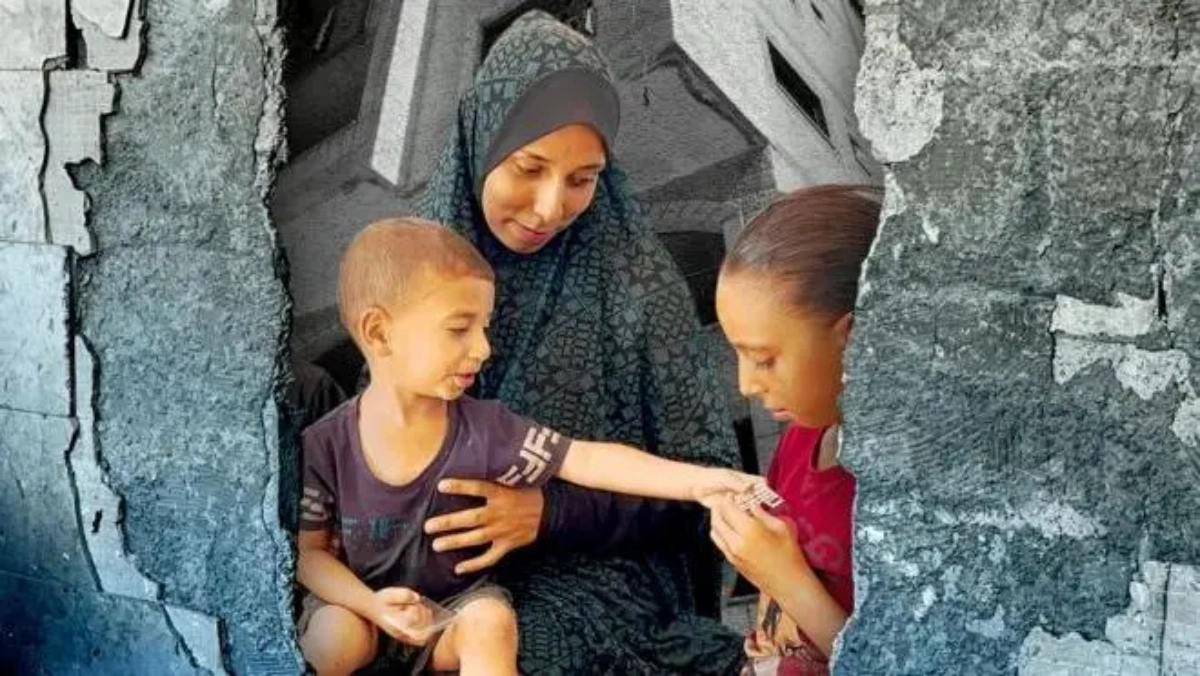

The Skeik Building, on a quiet alley off Omar al-Mukhtar Street in western Gaza City, was a familiar sight to residents of the Strip.
The tree-lined street that ran alongside it was once a favorite haunt for couples as couples, eager to avoid the socially conservative gaze of Gazans.
But the street, nicknamed “Lovers’ Lane,” and the six-story building that overlooks it, are now surrounded by rubble.
Few residents remain who remember the old days. Those hiding here now did not flee Gaza's disapproval, but Israeli tanks, now withdrawn with the entry into force of the ceasefire agreed between Israel and Hamas.
The war has left this once glitzy neighborhood in ruins.
The elegant shops and restaurants that stretch down to the beach are now riddled with shrapnel and bullet holes, and the park, with its French-pruned trees, is buried under gray rubble.
The Skeik building still stands, but its walls are pocked with shrapnel, and a large artillery hole pierced an upper floor.
The faces of those who lived here before have been replaced by the ever-changing number of displaced people.
Two years after the start of the Gaza war, this building offers a snapshot of how the conflict has eroded ties to home and community among Gazans, and the impact this has had.
The former tenants of the Skeik Building left long ago. Above the boarded-up warehouses on the ground floor, eight of the building's ten apartments have been converted into temporary homes for families displaced by the war.
Hadeel Daban – 4th floor
Hadeel Daban, 26, lives on the 4th floor with her husband and three young children: Judi, 9; Murad, 6; and Mohammad, 2.
The family arrived here two months ago, paying 1,000 shekels ($305) a month to camp out in the empty rooms.
“The people who lived here before us left because it was dangerous,” Hadeel says. “Shrapnel hits the walls, but it’s still better than a tent.”
The family’s few belongings are neatly packed in piles of bags along the walls.
Torn sheets cover the holes where the windows used to be. It’s the twelfth place the family has moved to.
“When I load our belongings into a cart, I put my children on top and tell them to play with the items, like the kitchen utensils,” Hadeel tells me.
“I tell them we’re going to live a different life, a little far from the one we had.”
The family home is less than a mile away, in the al-Tuffah neighborhood of Gaza City. They fled during the first week of the war after a relative's apartment above theirs was attacked.
They returned a few months later. But on March 15, 2024, an attack on the adjacent building killed Hadeel's mother-in-law, injured her three children, and buried her husband alive.
“We spent hours searching for him and found him under the rubble,” she explains.
Her husband, Izz el Din, was unconscious. He was taken to al-Shifa Hospital, where, Hadeel says, she was informed that her husband had a skull fracture and was in a coma. Three days later, he was still receiving treatment when Israel closed the hospital and began a two-week military operation there to eradicate Hamas command posts, she reported. Only when Israeli forces finally withdrew was Hadeel reunited with her husband, frail but alive. Hadeel tells us she still needs regular medical checkups. “I used to take him to a neurologist [in Gaza City], but six weeks ago all the doctors moved to the south,” she notes. A home is not just a shelter or belongings. And the three families we spoke to in the Skeik building have moved several times. “None of my neighbors are my neighbors, because new people arrive every month,” Hadeel explains. “I don’t even know where my original neighbors are; some went south, others died or were injured. There are no neighbors anymore.”
The day we met Hadeel, Gaza City was emptying again, as hundreds of thousands of people headed for safer areas further south.
The Israeli army, advancing on the city, had given a “final warning” to leave. But the families we spoke to planned to stay.
As Hadeel spoke with our cameraman, a series of explosions echoed through the apartment.
Through the windows, huge gray clouds loomed in the middle distance.
None of her young children flinched.
The Skeik building was built in 2008, in the wake of Gaza City’s mid-1990s construction boom.
Its prime location, next to the American International School and a block from the Palestinian Parliament, both now in ruins, put it in the path of Israeli tanks during the first months of the war.
Al-Shifa Hospital is two blocks north. Within weeks of the invasion, the Israeli military moved in to capture the hospital complex, claiming it was being used as a Hamas base.
Troops approached from several directions, including the streets surrounding Omar al-Mukhtar Street.
Near the back of the Skeik building, a large rectangular hole has opened in the wall.
Inside, graffiti reads in Hebrew “The Last Samurai,” a reference to a Hollywood film about a 19th-century Japanese warrior overpowered by modern weapons.
Muna Shabet – Fifth Floor
We asked the Israeli military if their forces had ever used the building or fought there. We received no reply.
But the building’s owner, Shaker Skeik, informed us that the block was used as an observation post by Israeli troops during operations.
Israel claimed to have attacked several compounds used by Palestinian snipers in the area in March.
Ground forces remained in Gaza City for the first few months of the war, launching a second assault on al-Shifa Hospital in March 2024, while Hadeel’s husband was receiving treatment inside.
With such a rapid turnover of residents, no one in the building now remembers what happened in those first months of the war.
In the apartment above Hadeel’s, Muna Amin Shabet, 59, plays with her grandchildren beneath large bullet holes in the wall.
“Two days ago, bullets hit here, inside the building,” she explains. “I grabbed the children and ran with them over there, where it was safer. We sat there praying to God that everything would be okay. The children were terrified.”
Muna is also from the al-Tuffah neighborhood. She has lived here since August with her husband, three of her children, and her grandchildren. They don’t pay rent.
The family lost everything, Muna says, when their home was destroyed weeks after the war.
“They razed the entire al-Tuffah area; not a single house was left,” she says.
“We are starting our lives over again, collecting spoonful by spoonful,dish by dish. When famine hit, we ground pigeon feed and lived on wild vegetables,” she tells us.
“After two years of war, I say I’m not alive, I’m one of the dead.”
Wastewater
Another resident, from the northern town of Beit Lahia, tells us her area is now a “wasteland” after the Israeli army razed it to the ground.
“There are no houses left, not even signs that there was once a neighborhood here,” she says.
The UN says 90% of residential buildings in Gaza have been damaged or destroyed. Entire neighborhoods, with their shared history, family ties, and social support, were demolished.
But the idea of ??home is harder to destroy than bricks and mortar.
When our cameraman visits Muna’s apartment, two of her granddaughters are drawing a picture idyllic picture of a house, like something out of a fairy tale: small and neat, with a sloping red-tiled roof.
The sun peeks over the horizon, the sky is pink and blue, there are trees and plants.
It is nothing like where they live.
And the widespread destruction of homes and communities often forced families to separate in order to survive.
Of Muna's five children, two have moved south, another has gone to live with his in-laws. The others, she says, have come and gone.
Even she and her husband spent months apart before moving into the Skeik building, while Muna took shelter with relatives.
The extended family that once surrounded her and constituted her world is disintegrating.
“We are scattered. The separation is the hardest thing,” she notes. “Our lives have been taken from us. I have lost my health.” Our home is gone, and the people dearest to our hearts are gone; we have nothing left.”
Shawkat al Ansari – first floor
It’s a feeling Shawkat al Ansari knows well.
Originally from the now-destroyed Beit Lahia, he tells us that his mother and sister sleep on the streets in southern Gaza, while Shawkat lives with his wife and seven children on the first floor of the Skeik building.
Four months ago, his brother disappeared.
“He went to get flour from one of our in-laws’ house in Shejaiya [on the northern edge of Gaza City]. We still don’t know what happened to him. We searched everywhere for him, but we couldn't find him."
The constant movement of people on the move in search of food, safety, or shelter has made it difficult to keep families together.
"We used to be fine," Shawkat recalls. "Now my brother has disappeared, and we're all stranded in different places."
One by one,The anchors that held people in place—home, community, family—have been loosened by the constant uprooting of Gaza’s population and the destruction of its neighborhoods and streets.
Now, sitting in the empty concrete rooms of the Skeik building, Shawkat also sees his future slipping away.
His children did well in school before the war, he says, but now they are forgetting how to read and count.
The constant movement is freezing their lives.
Days later, we receive a call from Hadeel. She and several other families in the Skeik building are on the move again.
She tells us that Israeli forces dropped smoke bombs all over the area to indicate they were about to move in.
“We didn’t see the tanks last night,” she says, “but if we don’t leave now, we’ll find them tomorrow.”
Hadeel was gathering her things when we spoke; planned to reunite with his brother nearby before attempting to head south together.
“We will stay on the streets and live in a tent,” he says. “Whatever we do, nothing will rebuild what is inside us. My children are no longer my children. There is more suffering than innocence in their eyes now.”
Across Gaza, the buildings that remain have become transit centers for families, reunited and then separated by the war.
If the ceasefire holds and negotiations progress to cement an end to the war, peace could bring them a respite from so much moving, and rebuilding could offer them a different future.
But their old lives are behind them. This war has erased the path to the past.
*With additional reporting by Aamir Peerzada and colleagues in Gaza. Design by the BBC Visual Journalism team.