

The complaint against Bukele by the husband of Ruth Lopez, the lawyer who has been imprisoned in El Salvador for months
Lawyer Louis Benavides asks for a fair and public trial for his wife, who he maintains is innocent and whom he has not been able to visit in jail since July

Since July 5, her family has heard nothing from her.
Accused of “embezzlement” or misappropriation of state funds, human rights lawyer Ruth Lopez was arrested on the night of May 18, under circumstances described by her husband, Louis Benavides, as “unusual.”
Shortly after the arrest, the Attorney General's Office (FGR) changed the charge to illicit enrichment.
The proceedings have been declared secret at the request of the FGR, headed by Attorney General Rodolfo Delgado, who was re-elected to the position in 2024 by the Legislative Assembly controlled by the ruling party and whose opponents and critics consider close to President Nayib Bukele.
The accused's family states that she has not been allowed any visits since July. Not even her lawyers can see her. Her conditions have been denounced by various international organizations.
BBC Mundo interviewed Louis Benavides, who was in London receiving the 2025 Magnitsky Award on behalf of his wife. The award was given to her for her work defending victims of injustice and her fight against corruption.
The award is named after the Russian lawyer Sergei Magnitsky, who died in prison in 2009 after accusing Russian officials of multimillion-dollar tax fraud.
Lopez, who as head of the Anti-Corruption and Justice Unit of the human rights organization Cristosal led several investigations into the Bukele government, was also recognized by the BBC in 2024 as one of the 100 most influential and inspiring women.
In its original indictment, the Prosecutor's Office goes back to the time when Lopez was “a trusted advisor and right-hand woman of Eugenio Chicas during his two terms on the Supreme Electoral Tribunal.”
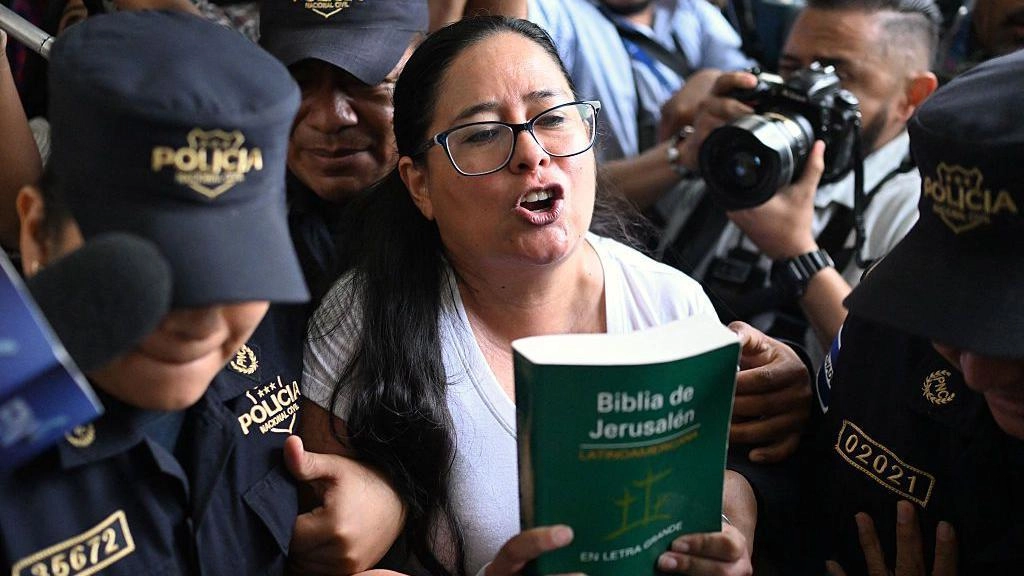
Chicas, who was also arrested in February accused of illicit enrichment,She presided over the Supreme Electoral Tribunal (TSE) and later served as Secretary of Communications for the Presidency of the Republic during the administration of Salvador Sanchez Ceren (FMNL, 2014-2019). “According to the investigations and information gathered during the raids carried out in the case of Eugenio Chicas, Lopez's active participation in the events with which she is charged has been identified,” the Attorney General's Office (FGR) stated in a post on social media. She maintains that she is a political prisoner. “All the charges against me stem from my legal work, from my denunciation of corruption in this government,” he shouted on June 4 as he left his initial hearing, when he was ordered to pretrial detention. "They won't silence me; I want a public trial! Grant me a public trial, the people deserve to know. He who has nothing to hide has nothing to fear," he added. In an interview with BBC Mundo, Benavides, a lawyer, political scientist, and recent activist demanding a fair and public trial for his wife, gives a detailed account of what has happened since the police knocked on his door that Sunday in May near midnight. He also criticizes the Bukele government, alleging that it seeks to silence activists and human rights defenders like his wife, and calls the state of emergency in his country since March 2022 “unconstitutional.” It has been 178 days since Ruth was arrested. How is she? Have you and the lawyers been able to communicate with her regularly?
After she was arrested on May 18 of this year, Ruth was held incommunicado for more than 72 hours.
We thought something serious had happened to her. Fortunately, that wasn't the case.
Then they took her to a facility of the National Civil Police, the traffic police, where she was held until July 4.
Up until that point, we were able to see her daily. We had contact with her.
But when they moved her to a prison known as the Izalco Penitentiary Farm, starting on July 4, we haven't had any communication with her.
We, her family, and her lawyers have all been completely cut off from communication.
Ruth hasn't been allowed any visitors for months.
What is the latest information you have regarding your wife's legal situation? Have your lawyers been able to have full access to the court file?
Yes, they have had full access, but the case has been declared confidential.
This creates complications because we don't have free access to the file as is normally the case.
They can't make copies of the file, record it, or take it out of the building.
To review it, the lawyers have to go to the courthouse, and this has done preparing the defense much more difficult.
How have they treated her in jail since her arrest in May?
When we were in contact with her, she hadn't been tortured. At least that much we were sure of.
I couldn't tell you right now. The authorities seem to be keeping an eye on her medication. Every time the medication she receives regularly is about to run out, they let me know so I can bring it.
When I went to bring it to her at the transit facility on July 4th, they made me wait because they were supposedly busy with other detainees.
After an hour, they told me that Ruth wasn't there anymore, that she had been moved.
She was arrested for alleged embezzlement, but later the charge was changed to illicit enrichment. What do you have to say about this?
First, I must say that the accusations are completely false.
Ruth is innocent, but the regime felt it had to silence her because her voice made them uncomfortable. She was a highly credible voice, both nationally and internationally.
She made strong and well-founded accusations, which bothered a regime concerned about her image.
They looked for a way to accuse her of something.
They started with embezzlement, but realized that this accusation was not sustainable because it implied that the accused person had access to and handled money.
But that didn't happen in any of the positions she held while in government.
Perhaps upon realizing this, they changed the accusation to illicit enrichment, a broader concept.
How does your legal team intend to counter these accusations of illicit enrichment?
By establishing the origins of her money, which are legal.
The money comes from what we have worked for as a family, from what we have earned to survive.
We intend to tell the truth as it is.
Do you have faith that this strategy will work?
I would like to think that it will work, but I believe the main reason Ruth is detained is because they want to silence her and because of her work as an activist.
Ruth's case has also greatly benefited the regime, because after the arrest of Ruth and the lawyer Enrique Anaya Barraza, which occurred a week later, there has been a large exodus of journalists and activists who immediately went into exile out of fear.
So, I honestly don't know if we will ever have true justice.
You say that Ruth was arrested for her work as an activist. Which investigations specifically motivated her arrest, in your opinion?
There were several cases. Ruth was the head of anti-corruption and justice at Cristosal, an organization dedicated to the defense of human rights.That's why she began investigating alleged cases of government corruption.
One of them was a case she investigated and documented the handling of money that families give to prisons for inmates to use.
The investigations revealed that these prison stores, as they are known, manage the money they receive from the public and the state in a very opaque way.
Ruth also investigated contracts awarded by the Ministry of Health during the COVID-19 pandemic and discovered some strange hiring practices.
People who had never been involved in selling medical supplies were suddenly awarded multi-million dollar contracts.
What is your interpretation of the situation and the exodus from the country of journalists, activists, and organizations like Cristosal?
The Salvadoran regime is trying to silence dissenting voices because it is very concerned about its image abroad.
It wants to project the image of a cool government that has brought security and is creating development.
The ultimate goal is to attract foreign investment, and to achieve this, they try to silence the reality of the country.
And what is the reality of the country?
In El Salvador, we are witnessing the consolidation of a dictatorship under a single individual who pulls the strings of all institutions and who, on many occasions, does not give direct directives.
But it is clear that all institutions end up doing what he expects them to do or what he says.
Along these lines, Cristosal and other organizations accuse Bukele of destroying institutions and the rule of law, and point out that authoritarianism has increased in the country. "You know what? I don't care if they call me a dictator. I'd rather be called a dictator than see Salvadorans being killed in the streets," Bukele said in June, in a speech marking the first anniversary of his second term. The ruling party of President Bukele began its term in 2021 with an overwhelming majority in the Legislative Assembly, and in its first session, he dismissed the justices of the Constitutional Chamber of the Supreme Court and the Attorney General. They imposed the Constitutional Chamber and the Attorney General they wanted. Those first actions were already unconstitutional. They intended to curtail those institutions, and it seems they succeeded. Bukele was re-elected president in 2024 with 85% of the vote and enjoys enormous popularity. What is the reason for this, in your opinion?
It boils down to the fact that he managed to get the gangs off the streets in El Salvador.
Gangs have caused a lot of pain to Salvadoran families.
The fact that a Salvadoran can move freely anywhere in his country is something no one imagined could happen, and he achieved it.
But now there are doubts about that achievement. There are investigations that suggest his government made pacts with the gangs, which have allowed for a decrease in violence and fewer homicides.
As a citizen, one doesn't know what to think.
What will happen to Cristosal's work now that the organization has left the country?
To continue its work, Cristosal and many organizations in El Salvador have had to move their headquarters to other places.
Cristosal moved to Guatemala and from there will try to continue its human rights work in El Salvador.
The problem is that it's very difficult.
It's already difficult to find people in El Salvador who want to dedicate themselves to continuing this work because they're afraid of exposing themselves and being attacked.
Ruth remains in pretrial detention awaiting trial. What are the next steps in the legal process? Does she have a trial date, or does her legal team receive notifications?
The legal team receives notifications. The case, as I mentioned, is completely confidential.
The case is at the initial hearing, where the charges against her have been presented and the investigation process has begun.
I couldn't tell you what stage the investigation is at or if it has progressed.
Currently, any legal process in El Salvador moves very slowly.
The Inter-American Commission on Human Rights issued precautionary measures in September after recognizing "the serious and urgent situation" in which Ruth finds herself. He requested that the government of El Salvador adopt measures to ensure that his detention conditions meet international standards, end his incommunicado detention, guarantee regular contact with his family, among other things. Has the ruling had any consequences?
No. The corresponding requests have been made, and so far we have not received a positive response.
We are still waiting for some initial implementation of the ruling. But for the moment, nothing.
Have you had any contact with the government?
We haven't had any contact with the government, and it's not that we want to. The reality is that we have tried to be as institutional as possible.
We have tried to let the lawyers handle the case.
What other support do you have?
Cristosal continues to support us. It helps us generate empathy and raise awareness of the case internationally and even diplomatically.
This is important because it helps put pressure on the authorities while we wait for Ruth's conditions to improve.
The awards and recognitions also serve as support for her work.
And perhaps they can help ensure that nothing serious happens to her while she is detained.
What do you remember about the day the National Civil Police arrested you?
The police arrived that Sunday, almost at midnight, and told us that supposedly the vehicle owned by Ruth had been involved in a traffic accident.
It seemed strange to me. We hadn't gone out that day and hadn't been in any accident.
They told me they wanted to speak with the owner. So I went inside the house, told Ruth, and she told me to bring her the documents and we went outside.
Outside, we explained what we had done that day. They checked Ruth's documents, and one of the officers immediately told her that she had an administrative arrest warrant from the Attorney General's Office and that she would be detained right then and there. The officer, embarrassed very, added that he was only following an order. We asked the officers to let her change her clothes because we were in our pajamas. They wouldn't let her. It was unusual treatment and harmful to the dignity of any human being. It was then that she something said that has been very significant for people who are fighting against this. She asked them to have some decency, that this would end someday, and that what they were doing was wrong.
Did you expect something like this to happen?
We expected it before the BBC included her in their list of the 100 most influential women in the world.
Before that, there was always fear; we always felt persecuted by the police.
Sometimes, the police would suddenly show up near the house, follow her while she was doing her job, when she went to file complaints, or when she attended conferences. There were almost always police officers taking her picture.
The BBC's recognition gave us the confidence that it would be difficult for them to mess with her.
But Ruth's figure became so strong that they felt they had to do something about her. I think they felt that if they didn't do it then, it would be more complicated later.
How have these last few months been for you and your family?
Do you still live in El Salvador?
It sounds strange, but the first few months were perhaps the most critical, because they were months of great uncertainty. We didn't know what could happen to us.
But little by little, the anxiety and fear subsided. The atmosphere has stabilized, although that doesn't mean we are completely at ease living in El Salvador.
We are still there waiting for Ruth's release. We are on alert for any eventuality.
In El Salvador, many detainees die inside prisons without even having a trial.
Families are always very worried about what might happen to their relatives who are detained, often unjustly.
What impact has the state of emergency approved by the Assembly in 2022 at Bukele's request and extended since then had?
It has been in place since March 2022, even though the Constitution only allows it to last 30 days, with the possibility of extending it once. But the regime has extended it 44 times.
It is an unconstitutional practice. It involves the suspension of basic constitutional rights and guarantees. Pretrial detention no longer lasts 72 hours, but can last up to 15 days without you knowing why you are being detained and without access to lawyers or representatives. They are not required to read you your rights or the reason for your arrest. They can take you away because someone gives the order, period.
At first, there was a positive side, because many gang members ended up arrested.
But later the regime began to handle this in a vicious way.
By authorizing anonymous denunciations of gang members or people suspected of being gang members, a series of harmful practices emerged.
They started arresting innocent people who had nothing to do with any gang.
That degenerated the situation much further, and now in El Salvador there is a great fear of speaking out against the government, of being an activist, or even using social media.
People no longer express themselves as they used to. They have managed to terrorize the population, silence them, and eliminate their freedom of expression.
Aren't you afraid of reprisals for making these kinds of accusations?
Of course we are afraid of being arrested.
That's why, generally speaking, I don't work as an activist, and although my wife is detained, I always try to maintain a low profile with the media.
What message would you like to send to the international community, to Salvadorans, and to the government regarding Ruth's situation?
We want a fair trial. Ruth wants it to be public so that we can prove her innocence.
Another thing I ask is that they realize what is happening in the country at an institutional level. The democratic decline is undeniable.
What impact has the state of emergency approved by the Assembly in 2022 at Bukele's request and extended since then had?
It has been in place since March 2022, even though the Constitution only allows it to last 30 days, with the possibility of extending it once. But the regime has extended it 44 times.
It is an unconstitutional practice. It involves the suspension of basic constitutional rights and guarantees. Pretrial detention no longer lasts 72 hours, but can last up to 15 days without you knowing why you are being detained and without access to lawyers or representatives. They are not required to read you your rights or the reason for your arrest. They can take you away because someone gives the order, period.
At first, there was a positive side, because many gang members ended up arrested.
But later the regime began to handle this in a vicious way.
By authorizing anonymous denunciations of gang members or people suspected of being gang members, a series of harmful practices emerged.
They started arresting innocent people who had nothing to do with any gang.
That degenerated the situation much further, and now in El Salvador there is a great fear of speaking out against the government, of being an activist, or even using social media.
People no longer express themselves as they used to. They have managed to terrorize the population, silence them, and eliminate their freedom of expression.
Aren't you afraid of reprisals for making these kinds of accusations?
Of course we are afraid of being arrested.
That's why, generally speaking, I don't work as an activist, and although my wife is detained, I always try to maintain a low profile with the media.
What message would you like to send to the international community, to Salvadorans, and to the government regarding Ruth's situation?
We want a fair trial. Ruth wants it to be public so that we can prove her innocence.
Another thing I ask is that they realize what is happening in the country at an institutional level. The democratic decline is undeniable.
What impact has the state of emergency approved by the Assembly in 2022 at Bukele's request and extended since then had?
It has been in place since March 2022, even though the Constitution only allows it to last 30 days, with the possibility of extending it once. But the regime has extended it 44 times.
It is an unconstitutional practice. It involves the suspension of basic constitutional rights and guarantees. Pretrial detention no longer lasts 72 hours, but can last up to 15 days without you knowing why you are being detained and without access to lawyers or representatives. They are not required to read you your rights or the reason for your arrest. They can take you away because someone gives the order, period.
At first, there was a positive side, because many gang members ended up arrested.
But later the regime began to handle this in a vicious way.
By authorizing anonymous denunciations of gang members or people suspected of being gang members, a series of harmful practices emerged.
They started arresting innocent people who had nothing to do with any gang.
That degenerated the situation much further, and now in El Salvador there is a great fear of speaking out against the government, of being an activist, or even using social media.
People no longer express themselves as they used to. They have managed to terrorize the population, silence them, and eliminate their freedom of expression.
Aren't you afraid of reprisals for making these kinds of accusations?
Of course we are afraid of being arrested.
That's why, generally speaking, I don't work as an activist, and although my wife is detained, I always try to maintain a low profile with the media.
What message would you like to send to the international community, to Salvadorans, and to the government regarding Ruth's situation?
We want a fair trial. Ruth wants it to be public so that we can prove her innocence.
Another thing I ask is that they realize what is happening in the country at an institutional level. The democratic decline is undeniable.
It is an unconstitutional practice. It involves the suspension of basic constitutional rights and guarantees. Pretrial detention no longer lasts 72 hours, but can last up to 15 days without you knowing why you are being detained and without access to lawyers or representatives. They are not required to read you your rights or the reason for your arrest. They can take you away because someone gives the order, period.
At first, there was a positive side, because many gang members ended up arrested.
But later the regime began to handle this in a vicious way.
By authorizing anonymous denunciations of gang members or people suspected of being gang members, a series of harmful practices emerged.
They started arresting innocent people who had nothing to do with any gang.
That degenerated the situation much further, and now in El Salvador there is a great fear of speaking out against the government, of being an activist, or even using social media.
People no longer express themselves as they used to. They have managed to terrorize the population, silence them, and eliminate their freedom of expression.
Aren't you afraid of reprisals for making these kinds of accusations?
Of course we are afraid of being arrested.
That's why, generally speaking, I don't work as an activist, and although my wife is detained, I always try to maintain a low profile with the media.
What message would you like to send to the international community, to Salvadorans, and to the government regarding Ruth's situation?
We want a fair trial. Ruth wants it to be public so that we can prove her innocence.
Another thing I ask is that they realize what is happening in the country at an institutional level. The democratic decline is undeniable.
It is an unconstitutional practice. It involves the suspension of basic constitutional rights and guarantees. Pretrial detention no longer lasts 72 hours, but can last up to 15 days without you knowing why you are being detained and without access to lawyers or representatives. They are not required to read you your rights or the reason for your arrest. They can take you away because someone gives the order, period.
At first, there was a positive side, because many gang members ended up arrested.
But later the regime began to handle this in a vicious way.
By authorizing anonymous denunciations of gang members or people suspected of being gang members, a series of harmful practices emerged.
They started arresting innocent people who had nothing to do with any gang.
That degenerated the situation much further, and now in El Salvador there is a great fear of speaking out against the government, of being an activist, or even using social media.
People no longer express themselves as they used to. They have managed to terrorize the population, silence them, and eliminate their freedom of expression.
Aren't you afraid of reprisals for making these kinds of accusations?
Of course we are afraid of being arrested.
That's why, generally speaking, I don't work as an activist, and although my wife is detained, I always try to maintain a low profile with the media.
What message would you like to send to the international community, to Salvadorans, and to the government regarding Ruth's situation?
We want a fair trial. Ruth wants it to be public so that we can prove her innocence.
Another thing I ask is that they realize what is happening in the country at an institutional level. The democratic decline is undeniable.
But later the regime began to handle this in a vicious way.
By authorizing anonymous denunciations of gang members or people suspected of being gang members, a series of harmful practices emerged.
They started arresting innocent people who had nothing to do with any gang.
That degenerated the situation much further, and now in El Salvador there is a great fear of speaking out against the government, of being an activist, or even using social media.
People no longer express themselves as they used to. They have managed to terrorize the population, silence them, and eliminate their freedom of expression.
Aren't you afraid of reprisals for making these kinds of accusations?
Of course we are afraid of being arrested.
That's why, generally speaking, I don't work as an activist, and although my wife is detained, I always try to maintain a low profile with the media.
What message would you like to send to the international community, to Salvadorans, and to the government regarding Ruth's situation?
We want a fair trial. Ruth wants it to be public so that we can prove her innocence.
Another thing I ask is that they realize what is happening in the country at an institutional level. The democratic decline is undeniable.
But later the regime began to handle this in a vicious way.
By authorizing anonymous denunciations of gang members or people suspected of being gang members, a series of harmful practices emerged.
They started arresting innocent people who had nothing to do with any gang.
That degenerated the situation much further, and now in El Salvador there is a great fear of speaking out against the government, of being an activist, or even using social media.
People no longer express themselves as they used to. They have managed to terrorize the population, silence them, and eliminate their freedom of expression.
Aren't you afraid of reprisals for making these kinds of accusations?
Of course we are afraid of being arrested.
That's why, generally speaking, I don't work as an activist, and although my wife is detained, I always try to maintain a low profile with the media.
What message would you like to send to the international community, to Salvadorans, and to the government regarding Ruth's situation?
We want a fair trial. Ruth wants it to be public so that we can prove her innocence.
Another thing I ask is that they realize what is happening in the country at an institutional level. The democratic decline is undeniable.
What message would you like to send to the international community, to Salvadorans, and to the government regarding Ruth's situation?
We want a fair trial. Ruth wants it to be public so that we can prove her innocence.
Another thing I ask is that they realize what is happening in the country at an institutional level. The democratic decline is undeniable.
What message would you like to send to the international community, to Salvadorans, and to the government regarding Ruth's situation?
We want a fair trial. Ruth wants it to be public so that we can prove her innocence.
Another thing I ask is that they realize what is happening in the country at an institutional level. The democratic decline is undeniable.