

The death of a protester complicates Jeri's first days as president of Peru
Neither the fall of the former president, Dina Boluarte, nor the arrival of the current president, Jose Jeri, seems to calm the troubled waters of the country
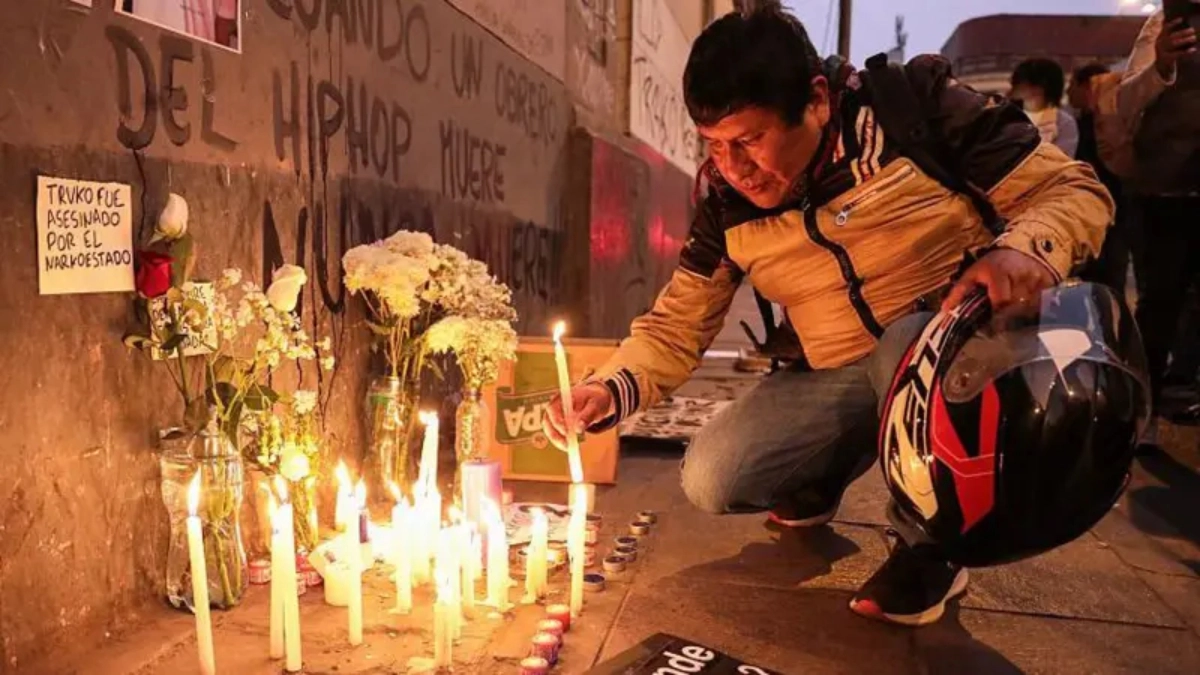

The discontent in Peru does not stop. And in the streets, thousands of protesters have continued to protest for a month.
Neither the fall of the previous president, Dina Boluarte, nor the arrival just a week ago of the current president, Jose Jeri, seemed to calm the troubled waters of the country.
In the last few hours, the protests turned violent.
On Wednesday, hip hop singer Eduardo Ruiz, 32, died after being shot during a demonstration in which he was participating with thousands of young people, according to the Attorney General's Office.
The general commander of the Peruvian National Police, Oscar Arriola, reported this Thursday that it was a non-commissioned officer who fired the shot and is under arrest.
More than 100 people have been injured in recent days, including police officers and journalists, and several of the groups promoting the protests assure that they will remain in the streets until Jeri is removed from the presidency.
Without resignation
The new president said he would not resign and clarified: “My responsibility is to maintain the stability of the country, that is my responsibility and my commitment.”
At the same time, he said he would ask Parliament for powers to combat crime.
But the death of a protester has been reminiscent of what happened in 2020 with Manuel Merino, who had to resign after the deaths of two protesters just five days after being sworn in as president.
The authorities appear to be acting differently this time, perhaps aware that overwhelming popular unrest could force Jeri's presidency to also be very short-lived.
The alleged perpetrator of the shot that ended the life of Eduardo Ruiz was arrested within hours, and General Oscar Arriola, commander-in-chief of the Peruvian National Police, offered his condolences to the family, promised an “exhaustive” investigation, and announced that the generals responsible for the police operation in downtown Lima on Wednesday had been relieved.
The question is whether Jeri will be satisfied with acting differently than Merino did in 2020.
“Although his survival instinct pushes him to distance himself from an unpopular regime, Jeri must not forget that his origins are the same,” wrote columnist Jose Carlos Requena in El Comercio, referring to the fact that the forces that brought Jeri to the presidency in Congress appear to be the same ones that supported Boluarte.
Despite protests by students and other groups in the streets, the president has so far survived the movements of his rivals, who are not willing to give him any respite.
Congress refused to admit two motions of censure against the board of directors of Parliament.
The approval of a motion of this type would imply the departure of Jeri from the Presidency, which he exercises in his capacity as president of Congress. If he ceases to be president, he will also cease to be president of the Republic.
But the president has so far managed to avoid that danger.
The last vote ended with 63 votes against and only 20 in favor, which reveals a still relatively solid position in Congress.
Although precedents like Boluarte's show that this can change in a matter of hours in Peru.
This very Friday, Congresswoman Sigrid Bazan of the Popular Democratic Bloc filed a constitutional complaint against Jeri; his prime minister, Ernesto Alvarez; and his Interior Minister, Vicente Tiburcio, for their alleged responsibility in the death of the protester.
Few are betting that this will be the last attempt against Jeri and his government.
Jeri is the seventh president of Peru in less than a decade and took office on October 10.
“A war on crime”
Although the protests began with Boluarte in the presidency to demand better pensions and salaries for young people. people, the demands later expanded and today they are a melting pot of the main problems facing Peruvians: crime, corruption and decades of disillusionment with their government.
“The evil that afflicts us at this moment is crime. The enemy is in the streets,” said Jeri in his first words as president before the Congress of the Republic, who promised upon taking office “a war on crime.”
The president has tried to project an image of firmness in the face of the crime in his first days in office.
A few hours after taking office, he participated in a police operation to seize cell phones in a prison on the outskirts of Lima.
This Thursday, his prime minister announced that a state of emergency would be declared throughout metropolitan Lima.
Increasingly violent crime is one of the main concerns in Peru,with a large part of the population and analysts blaming political leaders for inaction, if not complicity, in the face of criminal gangs.
Announcing the possibility of establishing a state of emergency in Lima, Ernesto Alvarez said that “it cannot be a gaseous measure that does not lead to anything special” and, although he did not rule out imposing other measures, such as a curfew, he noted that “it would have to be demonstrated, by the specialist who proposes it, what its real effectiveness is, considering that crime no longer responds to the nighttime.”
Boluarte's governments have already resorted to states of emergency and the deployment of the Armed Forces in large areas of the country to contain organized crime.
Critics point out that it is a measure for show and does not seem to have offered tangible results in the medium term.
In the first Peru than in the same period in 2024, according to the Death Information System (Sinadef).
Last August alone, there were 209 homicides. And Human Rights Watch has warned that Peru is one of the countries in the region where violent deaths are increasing the most.
But the crime that increased most alarmingly during Boluarte's presidency was extortion, which seems to have skyrocketed.
According to a report by the Observatory of Organized Crime and Violence, a crime analysis organization, in 2024 the number of reports was more than double those registered in 2018.
According to police data, 75 reports of extortion are filed every day in Peru, and experts point out that the problem is probably greater, since victims often avoid reporting it for fear of reprisals from those who extort them.
Small businesses and transporters are the hardest hit. The Crime and Violence Observatory estimates that around 180 urban transport drivers have been killed this year for refusing to pay fares, a figure that has led the sector to organize successive strikes and protests to demand answers from the government.
Various factors, such as the rise of illegal mining, facilitation of crime by those in power, inadequate and populist responses by leaders and a depleted and suspect police force, are behind this increase in crime.
Generational discontent
The Peruvian protests come amid a wave of demonstrations taking place around the world, driven by generational discontent against governments and youth anger.
Nepal, The Philippines and Morocco are some examples of countries where protests have erupted, with demonstrators identifying as Generation Z, meaning those born between the late 1990s and 2010.
In Lima's main square, David Tafur, a 27-year-old electrician,said he decided to join the demonstration after learning about it on TikTok.
"We are fighting for the same thing: against the corrupt, who are also murderers here," he told the AP, referring to the violent 2022 protests and government repression in which 50 people died.
Omar Coronel, an expert on social movements at the Pontifical Catholic University of Peru, told BBC Mundo that "those leading the protests are mainly young people who are now entering the labor market and discovering the limitations and difficulties they will encounter there. the pirate skull flag from One Piece, a Japanese cartoon series in which the protagonists fight against a kind of world dictatorship,” explains Coronel.
Alvarez has not yet commented on the matter, but previously stated that Generation Z in Peru is a “gang that wants to take democracy by storm” and does not represent “young people who study and work.”
Jeri's Past
Some episodes in Jeri's personal career have also contributed to the rejection she arouses some among sectors.
The focus is that now president, he was investigated after being accused of rape by a woman. The Prosecutor's Office dismissed the case in August, although authorities continue to investigate another man who was with Jeri on the day of the alleged rape.
During the protest, more than 20 women shouted "The rapist is Jeri!" or "Jeri is a violin!", a colloquial Peruvian expression where "violin" means rapist.
The protesters threw firecrackers at the police, who responded with tear gas and pellets.