

The glacier that “bleeds” in Antarctica has intrigued scientists for more than a century
For more than a century, an Antarctic glacier has bled without apparent explanation
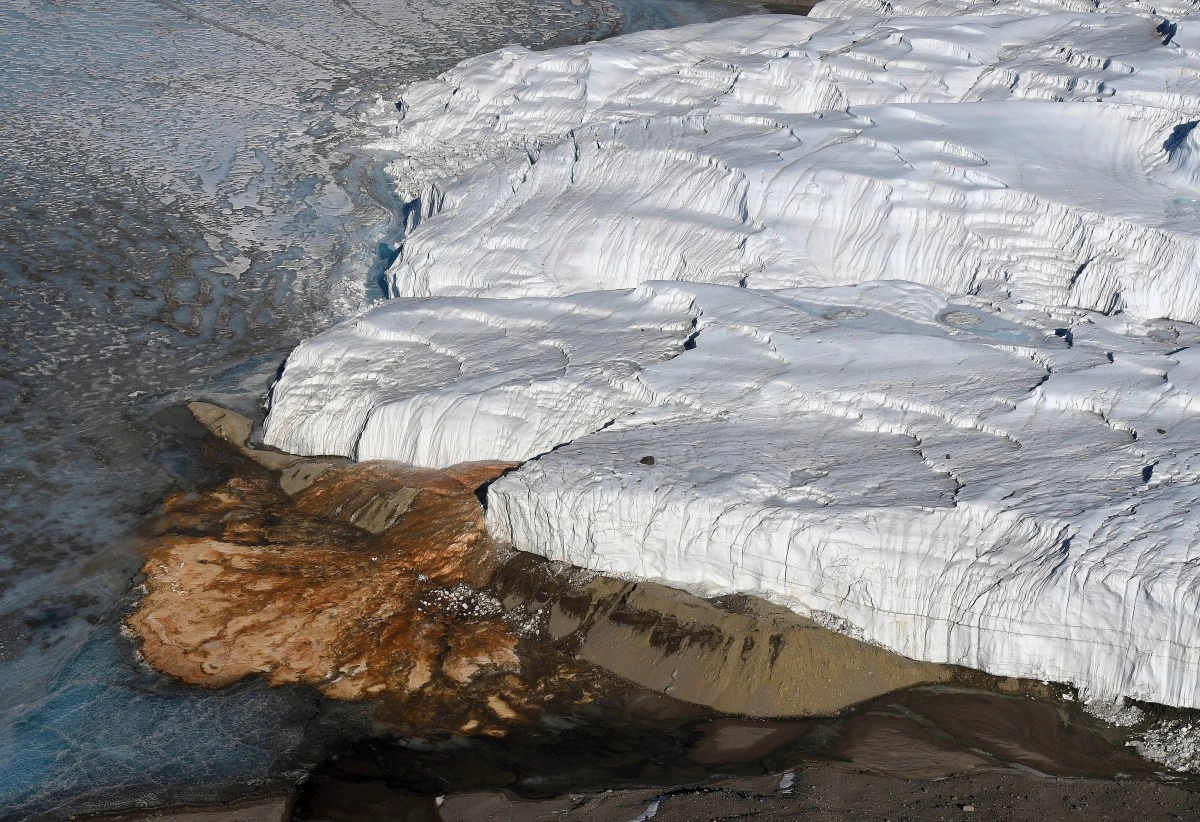

If the Earth were a living being, perhaps it would bleed. And judging by what is happening in a remote corner of Antarctica, it might even seem like it already does. There, in the middle of a landscape of ice and silence, an impossible wound dyes the white surface of the continent red. Of course, it's not blood. But the image is so disturbing that it has been puzzling scientists for more than a century, ever since Australian geologist Thomas Griffith Taylor stumbled upon it in 1911 during the Terra Nova expedition.
The show takes place in the McMurdo Dry Valleys, in eastern Antarctica, specifically on the Taylor Glacier. Intermittently, a jet of red water emerges from the depths of the ice and pours over it a crimson color that seems straight out of a horror novel.
The scene earned the place the name Blood Falls. And it's not difficult to understand why. Taylor himself believed he had solved the mystery by attributing that color to the presence of reddish algae. It was a reasonable explanation. But it was also completely wrong.
Neither blood nor algae
What flows from the glacier is an extraordinarily iron-rich brine that remained trapped under the ice for a time that is difficult to imagine: between 1.5 and 2 million years, according to different estimates. At some point in the distant past, a pocket of seawater was isolated by the advance of the glacier and remained there, locked in an ice prison.
During this geological captivity, the water became increasingly saline until it no longer behaved like running water. Its high salinity allowed it to continue flowing even near twenty degrees below zero. And when it finally reaches the surface and comes into contact with oxygen, the iron it carries rusts – like a nail abandoned to the elements – and stains the ice that dark and disturbing red that has fueled the mystery for more than a century.
A network hidden under the ice
For decades, the great mystery was how this brine managed to escape from an ice prison located hundreds of meters deep. A first answer came in 2017, when a team from the University of Alaska Fairbanks used radar to peer inside the glacier and discovered a hidden network of pressurized channels that extended at least 300 meters below the surface. The glacier, in reality, was crossed by a kind of invisible circulatory system.
The discovery also helped explain another enigma: how can liquid water flow in such a frigid environment? The culprit would be the salt itself, which lowers the freezing point, and a little physics trick. Where the brine does freeze, it releases heat; and that heat is enough to keep other sections of the duct open.
As glaciologist Erin Pettit summarized then in a statement from the University of Alaska Fairbanks, it is counterintuitive that water can heat ice as it freezes, but that is exactly what happens. Thanks to this mechanism, Taylor became the coldest glacier on the planet in which water is known to flow persistently.
The trigger for “bleeds”
But the last piece of the puzzle was still missing: what pulls the trigger of each “bleed”? The answer came almost by accident.
In September 2018, a team led by geoscientist Peter Doran, from Louisiana State University, had in operation – without having planned for this purpose – a GPS station on the glacier, a camera that photographed the waterfalls every day, and a temperature sensor in Lake Bonney, located below. By one of those rare coincidences that science is so grateful for, the three instruments recorded a complete episode of discharge at the same time.
In the following weeks, the surface of the glacier dropped about 15 millimeters and its advance slowed down by about 10%, according to researchers. At the same time, the lake registered a cold water anomaly and the camera began to capture new red spots spreading day after day starting on September 19.
The conclusion, published this year in the journal Antarctic Science, is that the brine trapped under the ice behaves like a pressure cooker. As the glacier compresses the subglacial channels, the liquid ends up finding escape routes through cracks and emerges in brief pulses towards the surface.
Each of those pulses leaves a mark. The surface of the glacier descends slightly, its advance slows down, and then everything begins again in silence. The pressure under the glacier builds up again, as if the glacier is holding its breath before the next release. In other words, the leak itself acts as a hydraulic brake that temporarily slows the movement of the ice.
An ecosystem that has never seen the sun
But Blood Falls holds a secret even stranger than its color. According to Science Alert, in that pocket of water trapped under the ice, isolated from the outside for more than a million years, a community of bacteria survives that feeds on sulfate because it simply has nothing else at hand. They have never received sunlight or been in contact with oxygen. They were already there long before our species appeared.
It took years for microbiologist Jill Mikucki, now at the University of Tennessee, to get a sample of water clean enough to study. When he finally did, he found something unexpected: a surprisingly thriving microbial ecosystem.
Since then, Blood Falls has become a natural laboratory for astrobiology, a window to the icy, oxygen-depleted worlds that could exist in other corners of the Solar System.
After more than a century of questions, the glacier that seems to bleed has revealed many of its secrets. But the story is far from over. Scientists now want to know if these “bleeds” will change over time and if the Blood Falls can become an early sign of the transformations that the Taylor Glacier and, perhaps, Antarctica itself are undergoing. What they don't yet know is how this strange system will respond to a warming planet.