

The Vatican excommunicates the rebellious bishops of the Lefebvrian group and warns their thousands of followers of the
Six bishops of the Priestly Society of Saint Pius X were excommunicated by the Vatican for participating in a schismatic act for the Catholic Church
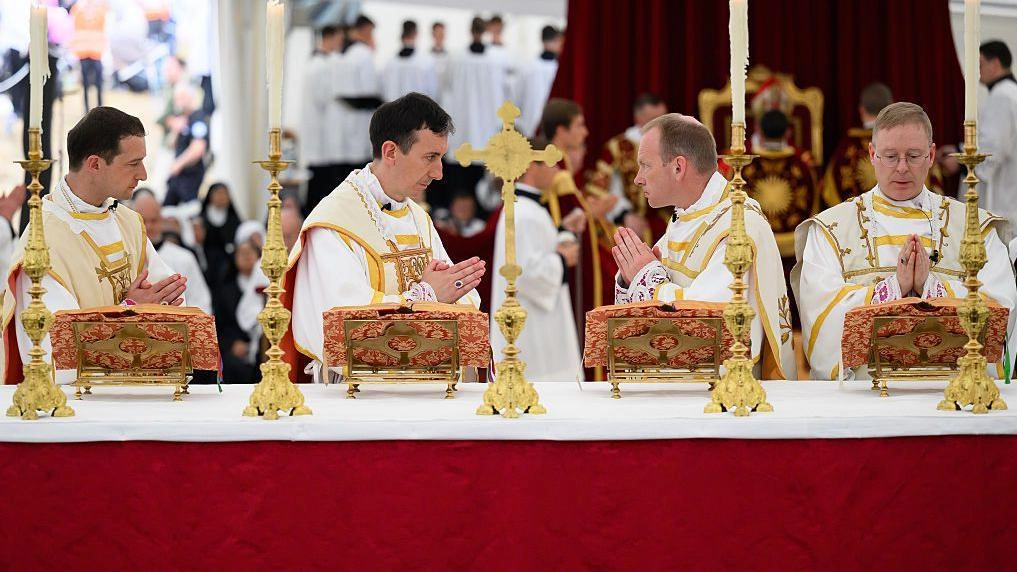

The Vatican announced this Thursday the excommunication of several leaders of a Swiss Catholic fraternity who participated in an "act of a schismatic nature" in the consecration of bishops without the consent of Pope Leo XIV.
The decree also declares the ipso facto excommunication of Catholic faithful who “formally” participate in the Priestly Fraternity of Saint Pius
The SSPX, based in Switzerland, has around half a million faithful who would be at risk of being formally expelled from the Catholic Church.
Excommunication is one of the most severe punishments that the Church can impose, as it effectively expels the offender from the religion and excludes him from Catholic life.
The Dicastery for the Doctrine of the Faith, the Vatican's highest doctrinal oversight authority, said in a statement that Bishop Alfonso de Galarreta was excommunicated "for having committed an act of a schismatic nature through the episcopal consecration of four priests, without a pontifical mandate and against the will of the supreme pontiff."
Along with Galarreta, the co-participating bishop Bernard Fellay was also excommunicated, as well as the priests who were consecrated by the SSPX: the Swiss Pascal Schreiber, the American Michael Goldade and the French Michel Poinsinet de Sivry and Marc Hanappier.
“Clergymen and lay faithful are warned not to join the schism of the Priestly Fraternity of Saint Pius
The Vatican later clarified that not all members would be automatically excommunicated, but those who “habitually participate” in SSPX celebrations and “formally share its doctrinal positions” would be excommunicated.
The announced consecration of the bishops, produced on Wednesday, had been seen as a schism in the Catholic Church - a term that indicates a serious and formal break - due to the challenge it posed to the authority of Leo XIV.
The SSPX - which has a presence in several countries around the world - is known for rejecting the Second Vatican Council, a historic meeting of bishops in the Vatican in the 1960s that promoted a series of reforms for the global Church and sought to repair its relations with Jews and other Christian denominations.
The Council also allowed the Mass, until then celebrated only in Latin, to be celebrated in local languages.
The Fraternity rejected that change, citing a desire to preserve the sense of mystery and formality of the Latin rite.
Faithful at risk of excommunication
In an additional explanatory note issued by the Vatican, the Church said that in the past there were “multiple attempts” to reintegrate members of the fraternity started by Archbishop Marcel Lefebvre “into full communion with the Catholic Church.”
However, such efforts were “unsuccessful.”
“This situation has been aggravated by recent episcopal consecrations celebrated without papal mandate, against the will of the Holy Father and in open violation of canon law,” the note adds.
“Consequently, this Dicastery, in the faithful exercise of the functions entrusted to it, considers it necessary to point out that this act constituted the crime of schism, with canonical consequences for the sacred ministers and the lay faithful involved,” he adds.
According to canon law, this “disobedience” implies rejection of the direction of Rome in the life of the Catholic Church, so the automatic consequence is excommunication.
And those lay people (Catholic faithful without a religious order) who “formally adhere” to the SSPX also fall into immediate excommunication, so it is estimated that in this case more than half a million followers of such fraternity would enter.
This implies “freely and consciously sharing” the acts of the Lefebvrians that are considered schismatic, such as the consecration of the four bishops, but also participating in “the Lefebvrian ecclesial acts.”
“The holy people of God are warned that the sacred ministers of the Priestly Fraternity of Saint Pius X administer the sacraments illicitly and that the sacrament of penance administered by them and the marriage assisted by them are invalid,” the Vatican adds.
Therefore, to avoid ipso facto excommunication, the Vatican asks the faithful not to participate in the fraternity.
Massimo Faggioli, an expert on the papacy, told Reuters that Leo XIV believed very strongly in the reforms of the Council, which Catholics often refer to as “Vatican II.”
“He has no regrets or doubts about the fact that this is the Church of Vatican II,” said Faggioli, a professor at Villanova University, outside Philadelphia. “He has shown that he does not want to compromise on that.”
Excommunication implies that a baptized believer is “out of communion” with the Church, so they cannot receive the sacraments, for example, confess or marry within the Roman Catholic Church.