

70 missiles and 500 drones: the “most massive” Russian attack against Kyiv leaves dozens dead and injured
The mayor of the Ukrainian capital declares a day of mourning after the new wave of bombings by the Kremlin
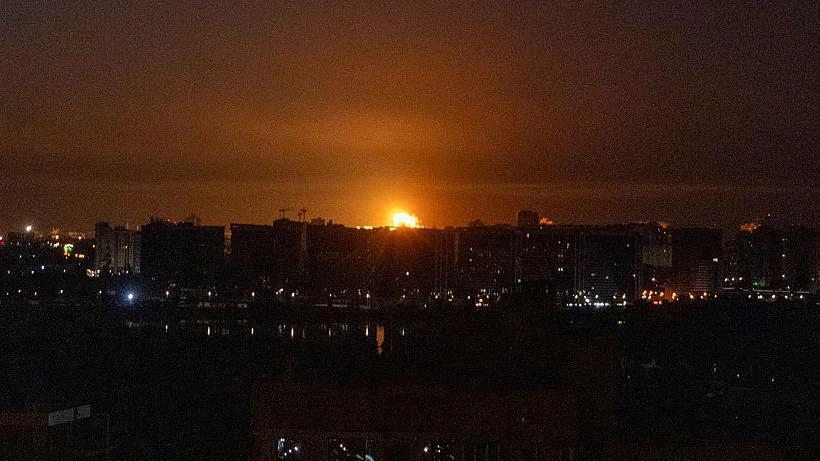

Russian forces launched a barrage of drones and missiles at Kyiv overnight, killing at least 18 people. An offensive that the city's mayor described as the “most massive attack” against the Ukrainian capital.
Vitali Klitchko declared Friday a day of mourning and noted that around 90 people were injured. He also indicated that an ambulance station was among the places hit by the projectiles.
Although previous attacks left more victims or involved the use of more weapons, this latest wave affected points located in a very large area of Kyiv.
Several neighborhoods were evacuated as the attacks shook buildings across the city.
The bombings occurred just hours after Ukrainian President Volodymyr Zelensky warned that Russia was preparing a new attack.
Russia said its forces hit what it called military facilities in retaliation for recent attacks on Russian civilian infrastructure.
Kremlin spokesman Dmitri Peskov told reporters on Thursday that “Russia will continue to increase pressure on the Kyiv regime to achieve the set goals.”
Ukraine accused Moscow of attacking civilian areas and argued that it would be wrong to equate the actions of the "aggressor with those of a country that defends itself."
Among the “significant number” of victims were children, according to Tymur Tkachenko, head of Kyiv's military administration.
“The enemy is again deliberately attacking residential areas and killing civilians,” he declared early Thursday.
For its part, the Russian Defense Ministry claimed to have attacked energy facilities in response to recent Ukrainian attacks.
Among the targets hit was a high-rise apartment building in the southeast of Kyiv, whose structure was partially destroyed by the impact.
In a video posted on Telegram, Klitschko noted that rescue teams are trying to locate, among other people, a 15-year-old girl and her family.
“This is not retaliation”
On the city's left bank, in the Darnitskyi district, southeast of Kyiv, two missiles directly hit a residential area, causing extensive destruction.
A projectile left a huge crater next to a childcare center; The surrounding buildings were devastated by fire and their metal balconies twisted.
The second missile fell a few meters away and hit the edge of a nine-story apartment block. The structure collapsed, breaking away from the façade and becoming a pile of concrete rubble.
A resident told the BBC that several people were missing and were possibly taking refuge in the basement.
In the morning you could see destroyed cars, broken windows and a thick layer of gray ash that covered everything, including people.
Rescuers were trying to make their way through the rubble to reach the victims, while relatives watched the scene through tears.
Svitlana, a neighbor of the impacted building, told the BBC that she had taken refuge in the hallway during the aerial alert and heard the explosions.
“I didn't feel afraid because I've been through this before,” he said with a shrug. She then revealed that she had been seriously injured in another Russian attack on another town, in which her mother died. Two years later, his son died in combat fighting for Ukraine.
Oleksiy, his face covered in cuts and blood, told the BBC that he had gone out to smoke after hearing the first missile; Then the second fell and was hit by flying glass.
“This is not Russian retaliation for the Ukrainian attacks,” he said, rejecting Moscow's explanation for its latest offensive.
"They started this war. This is a residential area. And they deliberately attacked it," he denounced.
The attack on Kyiv lasted more than 11 hours and came in several waves, beginning with a drone raid on the city's historic center that caused a fire in a downtown hotel.
At 01:00 in the morning, dozens of ballistic and cruise missiles were launched. After a brief pause, Moscow fired another dozen Kh-101 cruise missiles at 03:00, followed by a wave of drones that attacked the capital until dawn.
Residents of Kyiv, who have been living through four and a half years of war, say they have noticed a change in the dynamics of Russian attacks on the capital in the last two months.
Although the attacks may occur less frequently—although they still occur every few days—they now last longer and appear more powerful and extensive.
Ukrainian military experts called the offensive one of the most difficult attacks for the country's air defenses to deal with in recent months.
Bohdan Dolintsev, an aviation expert, told Ukrainian media that the Russian tactic of using various types of weapons at the same time interval, combined with the erosion of Ukrainian defenses, poses an exceptionally complex challenge for Ukraine's air defense systems.
The Ukrainian Air Force reported that Russia launched 74 missiles and 496 drones overnight, primarily targeting the capital.
Although air defenses managed to repel most of the projectiles and unmanned aircraft, 25 ballistic missiles and 12 drones hit 33 locations.
Zelensky urged the United States to license Patriot air defense missiles, saying these supplies were “an absolute and critical priority.”
For his part, Foreign Minister Andriy Sybiha called on Ukraine's partners to send more air defense systems, stating that the country needed "not just words of condemnation, but concrete actions to stop Russian terror."
Through the X social network, the head of Ukrainian diplomacy denounced that Russia had attacked residential buildings and civil infrastructure, and urged international partners to toughen sanctions against Moscow.
For her part, the Ukrainian ambassador to the United States, Olha Stefanishyna, denounced that it was “another horrible night for the inhabitants of the city, who were forced to spend it in shelters.”
“Fires and destruction of civil infrastructure and residential buildings in several districts of the city,” he added in his X account.
The Russian Ministry of Defense declared having carried out a “massive attack” against Ukraine's defense industry and military infrastructure, hitting facilities in and around Kyiv.
Russian military authorities also claimed that they hit military airfields in Dnipropetrovsk, Poltava, Cherkasy and Chernihiv.
Likewise, they presented their actions as a response to what they described as “terrorist attacks launched by the Kyiv regime against civilian infrastructure” in Russian territory.
For his part, the Ukrainian Foreign Minister described it as “immoral” to present the Russian attacks as a response to the long-range offensives launched by Kyiv against Russia.
“In this war there is an aggressor and a country that defends itself,” he declared.
The attack marks the first large-scale missile and drone offensive launched by Russia against Ukraine in more than two weeks.
In addition to attacks on military bases in central and eastern Ukraine, the Russian Defense Ministry claimed to have hit Ukrainian energy infrastructure in response to recent attacks on Russian power plants, from Moscow to the Black Sea area, Russian press reported.
Ukrainian bombings in Russia prompted a rare admission by Russian President Vladimir Putin that his country was facing a fuel shortage.
On Wednesday, Zelensky cut short his visit to Dublin after receiving new intelligence suggesting Moscow was planning to attack Ukraine.
“I urge our people to take extreme precautions, to protect themselves, their children and, of course, their families,” he declared.
The president added that President Putin "has been preparing this massive attack against Ukraine for some time."
For their part, Russian troops have recently advanced towards the city of Kostiantynivka, one of Ukraine's last strategic strongholds in the east of the country. If Moscow manages to gain control, the city could become a gateway to the rest of the Donbas region.
However, Ukrainian commanders claim to have regained more territory than they have lost so far this year, as well as disrupting crucial Moscow supply lines between the Russian border and occupied Crimea.
The ground war has been virtually at a standstill for months, with troops on both sides largely entrenched in their positions.
Russia controls about a fifth of Ukrainian territory, much of which was occupied during the first months of the large-scale invasion launched in February 2022.