

They find the remains of the Pan Am plane whose accident more than 70 years ago marked a before and after in air safety
After the 1952 tragedy, airlines are obliged to explain to passengers where life jackets are located in case of emergency

"Dear passengers, welcome to this flight to (...). Before taking off, we ask for your full attention while we review the safety instructions."
Who has not heard this message when they are on a plane, about to start a vacation, embark on a work trip or simply return home?
However, the instructions that begin with the reminder to fasten the seat belt and not recline the seats during the takeoff and landing phases, and continue with the request to locate the emergency exits, as well as the location of the life jackets and how to use them in the event of a ditching, did not always exist.
The instructions came into force after a fatal plane crash that occurred in 1952 on the island of Puerto Rico, a tragedy that claimed the lives of 52 people and that has once again made headlines more than seven decades later, after a group of explorers and scientists located the remains of the crashed aircraft at the bottom of the Atlantic Ocean.
The discovery of the DC-4, property of the defunct US airline Pan Am, occurred on June 2, around 7:00 p.m., reported the Air/Sea Heritage Foundation.
The organization, together with the exploration companies Deep Sea Vision (DSV) and Eco Minerals, as well as the American network Discovery Channel, participated in the search that allowed the aircraft to be located.
The Good Friday Tragedy
The crash of Flight 526A remains one of the worst air disasters in the history of Puerto Rico.
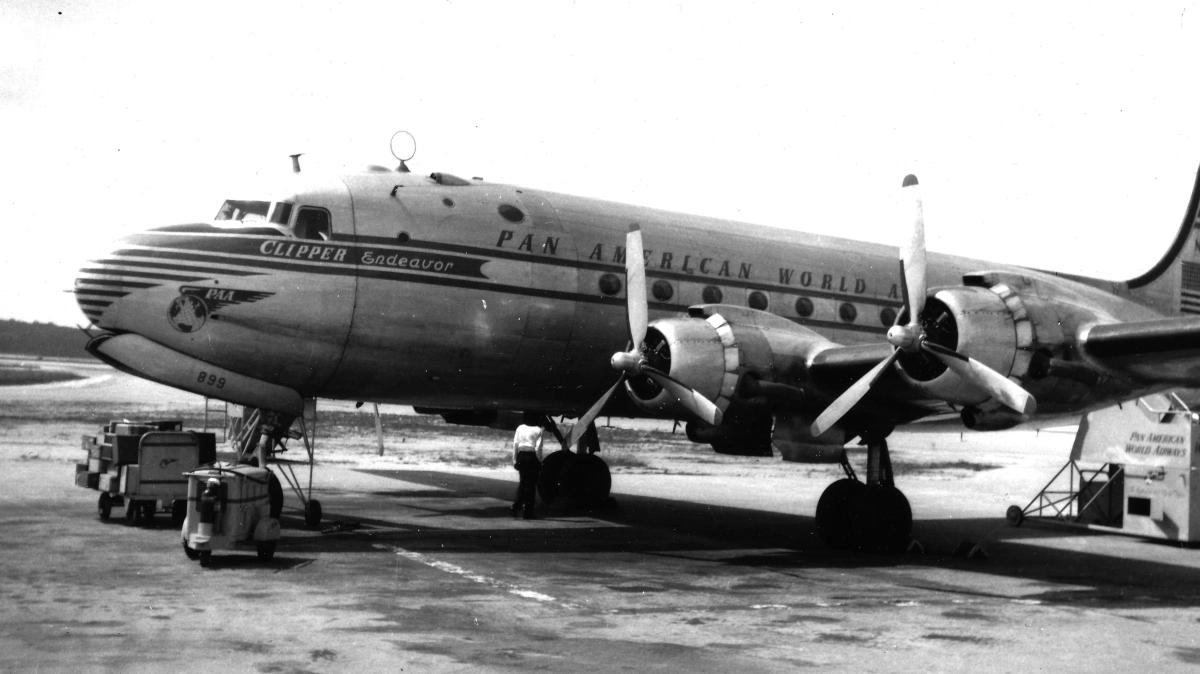
On April 11, 1952, a Good Friday, 64 passengers—including six children—and five crew members boarded the Clipper Endeavor, a four-propeller-engine DC-4 comparable in size to a modern Boeing 737.
The plane left the Isla Grande airport in San Juan, heading to New York, to what is now John F. Kennedy Airport. Hours later, that day would be recorded in the island's memory as the “Good Friday Tragedy.”
The device took off at 12:11 in the afternoon, but just a few minutes later engine number 3 began to fail and then number 4 followed.
Faced with continued loss of altitude, Captain John C. Burn abandoned his initial plan to return to the airport.
According to the report prepared by the accident investigators, to which BBC Mundo had access, the pilot decided to move towards the coast to avoid a possible emergency landing in a populated area or on a coral reef.
Finally, Burn opted to make a splashdown.
The commander had extensive experience in transoceanic flights and was familiar with maneuvers over water, as Pan Am had used seaplanes for years on its international routes during the previous decades, according to an article published by the Pan Am Historical Foundation.
Despite the enormous risk involved in the maneuver and the fact that the tail of the aircraft detached after the impact, all occupants initially survived.
A perfect storm
However, the joy was short-lived. With the fuselage fractured, water began to rapidly flood the cabin and, less than three minutes after impact, the plane sank, taking 52 people with it.
Only 39 bodies were recovered.
What happened? The investigation by the United States Civil Aeronautics Board, predecessor of the current Federal Aviation Administration (FAA), concluded that the accident was caused by mechanical failures in the engines that were not corrected in time.
On a previous flight another captain reported some problems.
However, investigators concluded that the tragedy was aggravated by other factors, including the language barrier, the lack of clear instructions for passengers and the absence of proper evacuation procedures.
“Each passenger had a life jacket located in a pocket located on the back of each seat,” states the report dated September 1952.
“Above each pocket there was a sign in English and Spanish indicating its location,” adds the 13-page document.
However, testimonies from survivors revealed that “before landing, no crew member informed the passengers about where the vests were or how they should be used.”
“As a result, considerable confusion occurred,” concluded the investigators, who admitted that the lack of instructions left many passengers unsure of what to do to save their lives.
As if that were not enough, only one of the three inflatable life rafts was able to deploy correctly. The first officer, two flight attendants and three passengers managed to board it.
Meanwhile, the captain and ten other survivors remained floating in the sea for about an hour until they were rescued by US Coast Guard units.
Investigators also determined that the fact that the rafts were stored in a compartment behind the cockpit made them difficult to access at a critical time and may have contributed to the high number of victims.
“If more rafts had been accessible, additional lives could have been saved,” the report states.
“The Board concluded that more lives probably could have been saved if passengers had received prior instructions on the location and use of life jackets,” the report states.
Based on these findings, the agency recommended that vests and rafts be stored in easily accessible locations and that they could be quickly deployed during an evacuation.
Likewise, he proposed that on long-haul flights over water, airlines would be obliged to verbally inform passengers about the location of life jackets, the correct way to use them, the location of emergency exits and the location of rafts.
“This explanation should include a practical demonstration on how to properly put on a vest,” the report proposed.
The recommendations were accepted by the US authorities and incorporated into civil aviation legislation in 1965 and over time they ended up becoming safety standards adopted by a large part of the global airline industry.
“This incident became a catalyst and helped drive improvements in safety, such as the use of better flotation equipment and pre-flight briefings,” explained John Cox, pilot and aviation safety expert, according to the London newspaper The Guardian.
“The investigation into the Pan Am accident that occurred in Puerto Rico in 1952 highlighted a series of issues that can be related to the safety measures that are common in civil aviation today,” the United Kingdom Civil Aviation Authority (CAA) explained to BBC Mundo.
“Currently, passengers routinely receive safety instructions prior to departure covering emergency equipment, procedures and emergency exits, including instructions on the use of life jackets where applicable,” they noted.
A complex task
Why did it take more than seven decades to find the plane? There are several reasons.
“The Clipper Endeavor was lost in 1952, so there are no radar records or GPS data that would allow us to accurately determine the location of the accident,” Russ Matthews, president of the Air/Sea Heritage Foundation, explained to BBC Mundo.
“Thanks to the testimonies of survivors and eyewitnesses, we had a fairly clear idea of the general area, although this information was no more than a well-founded estimate,” he added, while pointing to the enormous depth at which his remains lie as another factor.
What remains of the DC-4 is located about 600 meters under the waters of the Atlantic Ocean.
However, technological advances in recent years have made it possible to overcome obstacles that for years made it impossible to locate the aircraft.
The company Deep Sea Vision, specialized in underwater exploration and mining, has developed aquatic drones equipped with sophisticated sensors capable of scanning vast expanses of the seabed at depths of up to 6,000 meters and remaining submerged for four consecutive days.
“This marked a before and after in the search, and the results speak for themselves,” said Matthews.
The definitive identification of the DC-4 was achieved thanks to a photographic study of the crash site.
The images obtained clearly showed the iconic winged Pan Am logo and the name of the aircraft, still legible on a fuselage that, although damaged, remains largely intact and fairly well preserved.
The discovery could offer new hope to the families of victims of other plane crashes, such as that of Malaysia Airlines flight MH370, which disappeared more than 12 years ago with 239 people on board.
Download the new BBC World Service app. Choose BBC News Mundo and receive news alerts, documentaries and analysis, all in one place. Important: The new app is not available in the United Kingdom or the United States.