

Ziesel, the miniature robot capable of firing anti-tank missiles
The Ziesel is a small German unmanned robot capable of launching multiple SPIKE LR missiles against tanks at more than 5 km
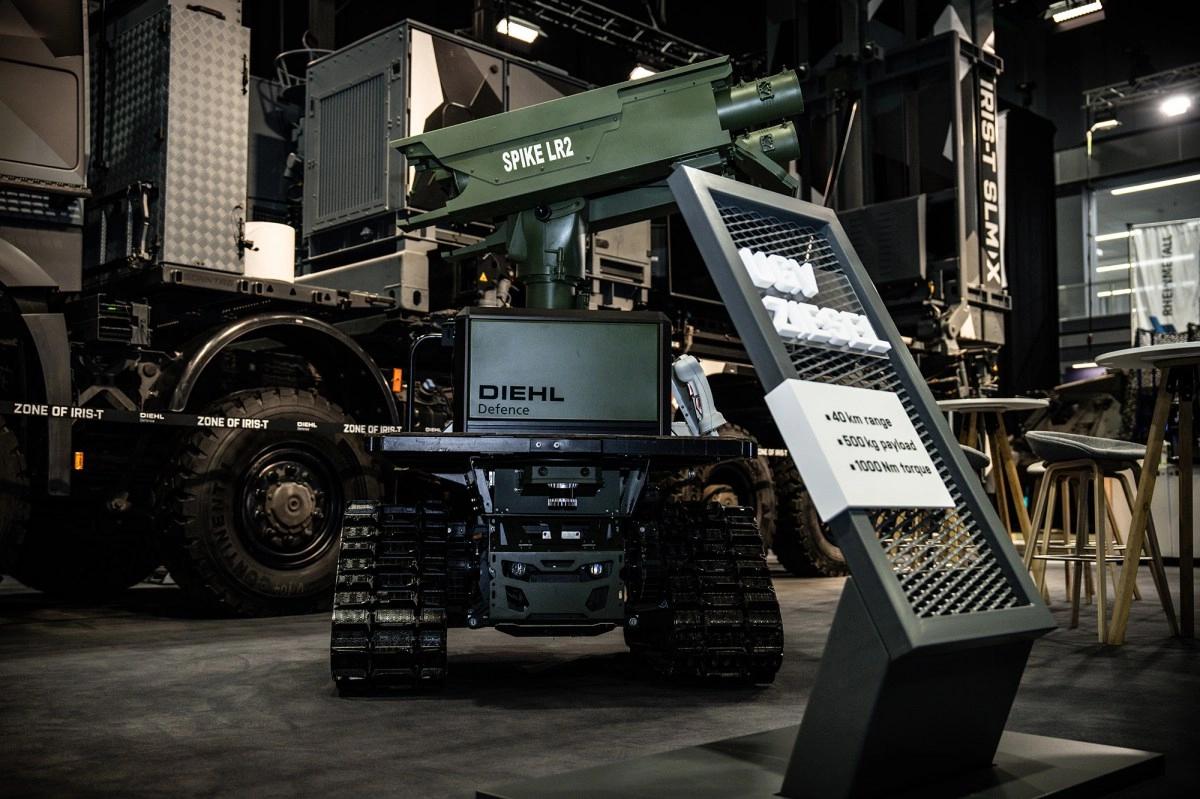

We are not talking about science fiction or a laboratory prototype. The Ziesel, the small unmanned land vehicle from the German company Diehl Defence, has just passed live fire tests by firing anti-tank missiles from several kilometers away, and we are facing one of the most disruptive robotic systems in the recent history of land weapons.
A small robot capable of causing millions of dollars in damage
The first thing that strikes you about the Ziesel is its size — and that's not a flaw, but part of its purpose.
The platform measures just 1.6 meters long by 1.3 meters wide, weighs 380 kilos empty and can transport more than 500 kilos of payload. A small footprint that allows you to move through urban areas, forests and uneven terrain where a conventional vehicle simply does not fit.
Its drive is electric, which gives it an immediate tactical advantage — it emits very little noise and generates a reduced thermal signature, making it more difficult to detect. The maximum speed is 20 km/h, and it can climb slopes of up to 60 degrees.
What makes it especially relevant is the PLATON autonomy kit, which allows you to navigate and execute missions with a high degree of independence in complex tactical environments.
17 missiles fired, zero structural failures
In May 2026, Diehl Defense, together with RAFAEL Advanced Defense Systems and EuroSpike GmbH, completed a five-day test campaign in which the Ziesel fired 17 SPIKE LR missiles with complete success.
What engineers wanted to check wasn't just whether the missile fired correctly — it was whether the platform could withstand the structural stress of repeated launches. The answer was yes.
The result makes the Ziesel the first ground-based unmanned system from which a modern guided missile is successfully fired. That's a real milestone. Previously, guided anti-tank missiles required manned platforms or specialized helicopters; They can now be mounted on a robot the size of an ATV.
The SPIKE LR has a range of up to 5.5 km, can operate in “fire and forget” mode, and also allows the operator to update the target during flight. Its penetration capacity exceeds 700 mm of laminated homogeneous armor.
Close to deployment, with Germany and Ukraine watching
What this means is that we are looking at a technology that is no longer experimental — it is on the verge of becoming a real asset on the battlefield.
Several armed forces, including those of Germany and Ukraine, are already evaluating the Ziesel for different operational missions. Diehl Defense has new demonstrations planned for military representatives from different countries in the coming months.
The historical comparison is inevitable. It took almost a decade for armed aerial drones to go from concept to mass deployment. Armed UGVs appear to be compressing that process. The Ziesel debuted with a SPIKE launcher at the Enforce Tac 2026 event in Nuremberg, and just three months later it already had 17 live missile shots on it.
What we see here is a new class of weapon — an autonomous ground system with true anti-tank capability, keeping the human operator out of the enemy's reach.
What is the Ziesel robot and what is it for? The Ziesel is an unmanned ground vehicle (UGV) developed by the German company Diehl Defense. It is designed for logistical support, medical evacuation and reconnaissance missions, and in its combat version it can mount a SPIKE LR missile launcher to attack armored vehicles more than 5 km away.
How many SPIKE LR missiles can the Ziesel fire?During testing in May 2026, the Ziesel successfully fired a total of 17 SPIKE LR missiles in five days without suffering significant mechanical damage. The system can perform multiple consecutive launches thanks to its reinforced structure and loading platform design.
When will the armed Ziesel robot enter service? There is no official deployment date yet, but the system is being actively evaluated by the armed forces of Germany and Ukraine. Diehl Defense has new demonstrations planned for military representatives, suggesting that the operational deployment phase could be near.
Autonomous armed robots have been the subject of ethical and strategic debate for years — the Ziesel demonstrates that this debate is no longer theoretical. Do you think that these types of systems should have international restrictions similar to those of anti-personnel mines? Tell us what you think.