

Elections in Peru: Keiko Fujimori and Roberto Sánchez maintain a close dispute vote by vote for the presidency
More than 27 million Peruvians were called to the polls to elect the ninth president that the country will have in a decade
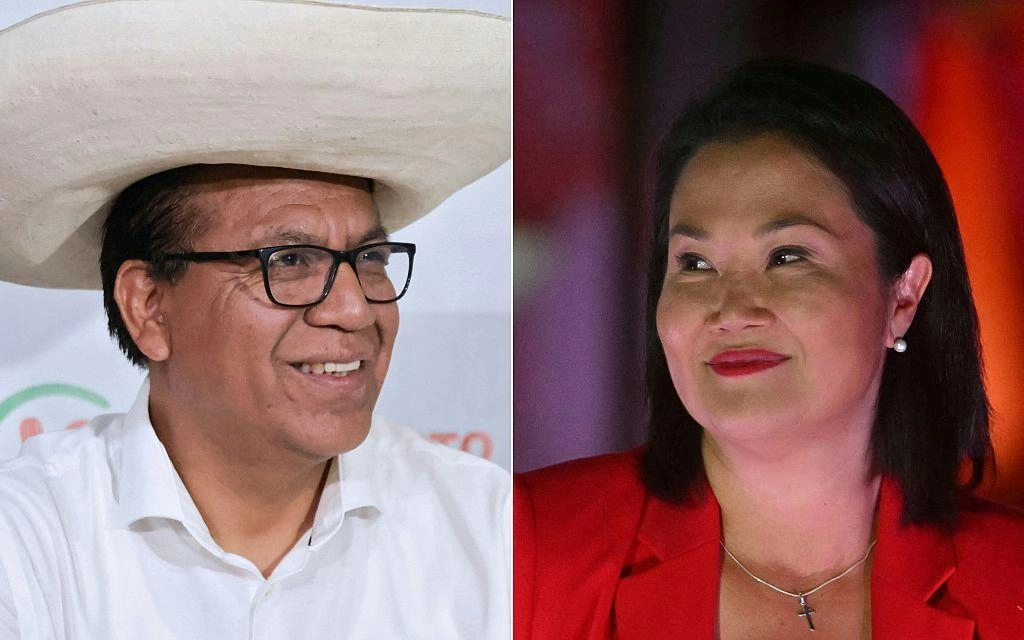

The vote count for the second round of the presidential elections in Peru is advancing after a day in which more than 27 million citizens were called to the polls to elect the ninth president that the country will have in a decade.
Voters had to choose between two candidates who represent the extremes of the ideological spectrum: the right-wing Keiko Fujimori, 51 years old and from the Fuerza Popular formation, and the leftist Roberto Sánchez, 57 years old and representative of Together for Peru.
With 93% of the minutes scrutinized, data from the National Office of Electoral Processes of Peru show that Fujimori has a tight lead with 50.08% of the votes, compared to Sánchez's 49.92%. As the votes were counted in rural areas, the Together for Peru candidate has reduced the difference.
On the other hand, the rapid scrutiny made public on Sunday night by the company Ipsos and the NGO Transparencia shows a technical tie between Sánchez and Fujimori: the former would obtain 50.3% of the votes compared to 49.7% for his rival.
This quick count, based on a sample of more than 1,000 polling stations throughout the country, has historically been a reliable indicator of the final outcome of elections in Peru.
The exit polls made public after the closing of the voting centers also predicted a technical tie. The one from Ipsos gave 50.7% of the votes to Fujimori compared to 49.3% for Sánchez, while the one from Datum placed the conservative candidate with 50.53% compared to 49.47% for her rival.
This Sunday's elections are being followed closely after the logistical problems and allegations of fraud in the first round on April 12, the results of which took a month to be known.
Given the closeness of the results, it is anticipated that the vote count will last for several days and even weeks.
In fact, this Saturday the National Election Jury (JNE) reported that the final results of this second round will not be known until mid-July, shortly before the transfer of command in the country.
The JNE spokesperson, Grecia Rentería, explained that the certification of 100% figures will be delayed due to the introduction of the new mandatory vote recount process in cases of contested tables or with observations.
“Serenity and respect for democracy”
After knowing the results of the quick count, Roberto Sánchez spoke to his followers from a balcony in Plaza San Martín, in the historic center of Lima, ensuring that "on this blessed night, we are going to put an end to the mafia pact that has taken over our government."
"We want to convey serenity and respect for democracy. Today, the quick count shows an important advantage that reaffirms the will of the people. As corresponds to those of us who believe in democracy, this is the time to defend the vote and electoral transparency. I call on our representatives and social movements to respect the results and the voice of the citizens," he assured.
For his part, Fujimori spoke to the press in a hotel in Lima, pointing out that "so far there is no winner in this race."
"For this reason, it will be long days until we know it. Each of the minutes needs to be counted," he said.
"Do not lose hope. We are going to wait with great faith and we will respect the final results," he assured, asking the international community to remain attentive to the development of the vote count.
Urban vote versus rural vote
This is the fourth time that Keiko Fujimori, daughter of the controversial former president Alberto Fujimori, whose legacy she claims, is running for presidential elections, after having previously lost to Ollanta Humala (2011), Pedro Pablo Kuczynski (2016) and Pedro Castillo (2021).
Sánchez, for his part, presents himself as the political heir of former president Pedro Castillo, for whom he was Minister of Foreign Trade and Tourism.
Castillo was sentenced last year to 11 and a half years in prison for the crimes of rebellion and conspiracy, after unsuccessfully trying to dissolve Congress and concentrate powers when he was at the head of the Executive in 2022.
One of the determining factors in this election will be the participation in the different regions of the country.
“It is not convenient for Keiko Fujimori that there is abstentionism in Lima, its main urban bastion, while Roberto Sánchez is not interested in abstentionism in the rural world and in the south of the country, where he is very popular,” political scientist Alonso Cárdenas, professor of Political Science at the Antonio Ruiz de Montoya University, in Lima, Peru, explained to BBC Mundo.
In this sense, electoral mobilization in urban versus rural areas can be decisive.
Another determining element, according to Cárdenas, is the historical rejection of both candidates, which functions as a political force in itself.
In the case of Fujimori, the so-called anti-Fujimorism activates memories of the authoritarianism and corruption of the Alberto Fujimori era; In the case of Sánchez, his association with Pedro Castillo's management weighs, which "is remembered as a very disorderly management, plagued by corruption and improvisation."
Two contrasting visions
Insecurity and crime have been two of the priority issues for voters in this second round of elections.
Added to the increase in homicides are the nearly 30,000 episodes of extortion reported in Peru 2025, many of which affected small businesses or workers in the transportation sector.
Fujimori has based his campaign on a series of tough-on-crime policies, declaring “war” on extortionists and promising to deploy the army against organized crime, take control of prisons and collaborate with financial institutions to block money from criminality.
It is precisely this approach that makes many voters fear a return to the era of Alberto Fujimori - president between 1990 and 2000 - whose heavy-handed policy led to his imprisonment for human rights violations.
Fujimori's supporters contrast his free-market approach and his promise to attract more American investment with Sánchez's proposals: reviewing mining contracts, increasing certain corporate taxes, raising the minimum wage and giving the state greater control over natural resources - ideas that have unsettled financial markets.
Sánchez argues that the wealth derived from Peru's natural resources does not reach ordinary people or the communities—often rural—where much of the mining activity is concentrated.
In any case, in the days before the second round the leftist candidate qualified his speech, presenting a new government plan that is more moderate and different from that of the April 12 elections, and ensuring that he will respect the autonomy of the central bank and the legal framework that facilitates investments, defending macroeconomic stability as a necessary condition to attract investments.
Sánchez has also promised to free former left-wing president Pedro Castillo.
On Friday, a judge ruled that Sánchez could be tried for alleged undeclared campaign funds from regional elections held between 2018 and 2020. He denies the allegations and is expected to appeal the decision.
Keiko Fujimori also had her own scandal: a case of money laundering within the framework of the Odebrecht case. After going to jail, the Constitutional Court ended up shelving the process. The ruling allowed her to become a candidate again just in time for these elections.
More instability?
Beyond who wins at the polls, another great unknown is the governability of the country, in a context in which the Peruvian Congress has become a key actor in political stability, with the ability to condition the action of the Executive.
In recent years, the combination of a fragmented party system and the absence of solid majorities has unleashed persistent instability.
The impeachment of presidents and the constant confrontations between powers have reinforced the perception that governability depends less on the electoral result and more on the president's ability to build alliances in a highly volatile Congress.
No party has a majority in the Peruvian Congress, although Fujimori's party has the largest minority bloc.
Many Peruvians are exhausted by this instability.
Last year, protests broke out led by Generation Z, whose young people argued that the State was failing to combat crime, corruption and inequality.
Those under 30 represent about a quarter of the Peruvian electorate, and many of those who protested do not believe that either candidate can achieve real change.