

‘Exhaustion is real,’ say ICE surveillance volunteers in Southern California
One year after the increase in raids, the teams that warn about the presence of La Migra in their neighborhoods claim to be physically and mentally tired
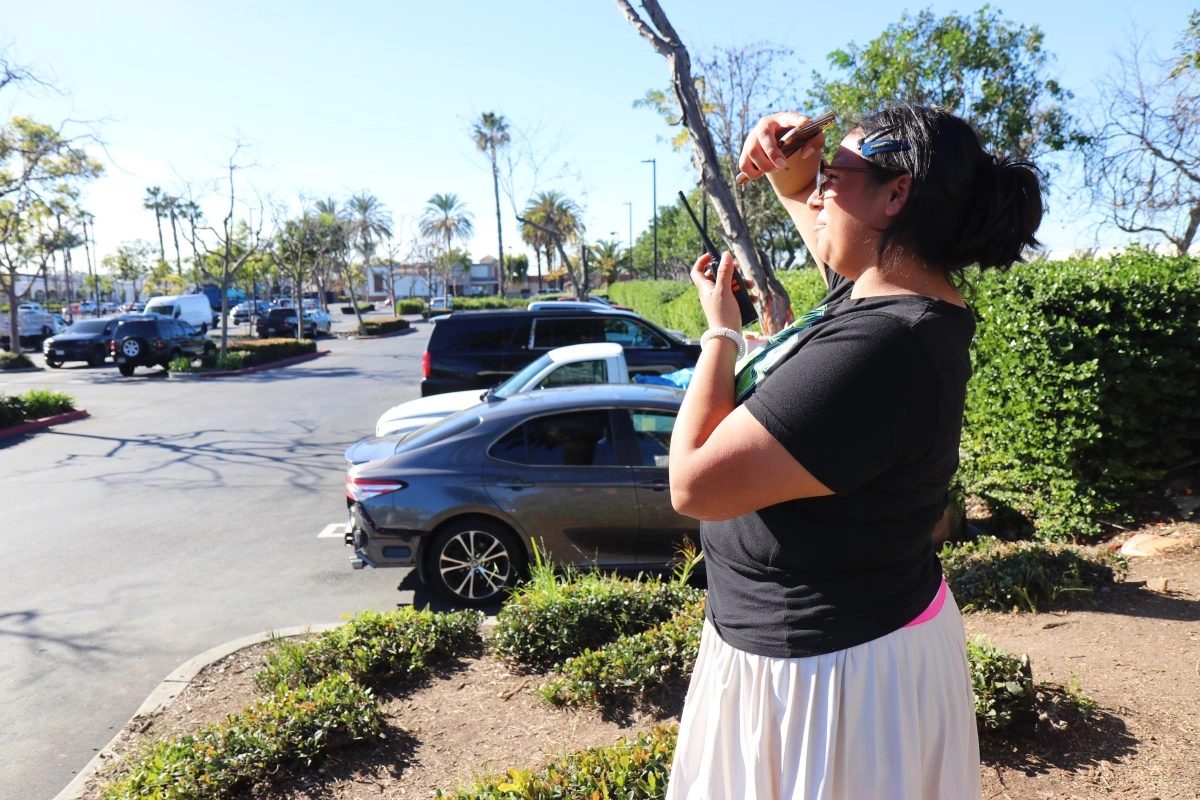

“I think at the height of the stress, we were all getting sick from stress: common colds, body aches and pains… I just couldn't sleep,” says Elaine, a full-time working mother who also serves as a volunteer operator for the Orange County Rapid Response Network (OCRNN), a coalition of civil rights attorneys, nonprofit organizations and community members who advocate for undocumented immigrants.
“For me, the most important thing is to sleep and I have a constant feeling of nausea, as if everything disgusts me and nothing suits me,” he explains.
In south Orange County, Elaine says many of the people who have volunteered to patrol and protect their communities are just like her: regular people, mothers, fathers, students and even seniors. Many of them have full-time jobs and put in extra hours protecting their neighborhoods from cruel immigration raids.
Elaine's mornings usually begin with her and others patrolling the streets of South Orange County neighborhoods, making sure the path to school is clear and safe for parents to take their children, including her own son.
Once the children have arrived at school, she goes to work as an OCRRN operator. Without revealing too many details, Elaine said she has been able to dedicate her time to volunteering because she works from home, which gives her the flexibility and time to patrol the neighborhoods around her residence.
For many community watchdogs and patrollers who report the presence of ICE, this is the first time they have confronted the immigration system or come face to face with masked and armed agents, and many are learning how to conduct their patrols safely in community training sessions organized by groups such as OCRRN.
But not even those with years of experience facing ICE were spared the psychological consequences that these new raids brought to their lives.
Sandra de Anda has been organizing actions in Santa Ana for more than a decade. As director of legal policy and strategy at OCRRN, she thought she had seen it all, but nothing could have prepared her for the enormous workload, exhaustion, sleepless nights, and anxiety-filled days they would have to endure when the first ICE raids began a year ago, in June 2025.
Chronicles from the front line
One Friday afternoon, during a visit to De Anda's house, he was observed preparing to end his work day. He was scheduled to attend a sound bath meditation session, organized for local ICE surveillance teams and community members affected by the immigration raids.
But, as is the case most afternoons, he is fielding calls to the OCRRN hotline until the last minute. These days, your work week is very different than it was just a few months ago; Nowadays, he has some breathing room to take in what happened to him during the day.
Before 2025, the OCRRN received 100 calls in an entire year. By 2025, that number skyrocketed to more than 10,000 calls, with some days seeing an average of 3 calls per minute.
“Most of our time is spent verifying that what was seen was actually immigration police, helping families whose loved ones have been detained or putting people in touch with the right help,” he said as he walked down the hall where he lives.
"If someone saw (ICE) preparing somewhere, we would go in person, do a live stream on Instagram and yell at them (the agents) to leave, and on several occasions we managed to get them to leave without the situation escalating. But I know that's not the case for all activists; some people have had guns pointed at them."
Like many activists, De Anda has witnessed arrests, heard personal testimonies from those who have been detained, and as someone who works closely with people's cases, often witnesses the many facets of family separations.
And over the past year, these community advocates have worked tirelessly with the sole purpose of protecting the most vulnerable, often putting their own personal care and mental health on the back burner.
But as the one-year anniversary of the ICE raids approaches, many of these organizers are feeling the weight of the work they've been doing, which in some cases manifests itself in the form of body pain, dissociation, depression and anxiety.
According to the National Library of Medicine, research has shown that prolonged exposure to immigration control policies and measures contributes to cumulative trauma and can foster generational cycles of mental health disorders.
OCRRN has been actively helping the most vulnerable people in Orange County for a decade. But for the past 12 months, De Anda and his team, along with others across Orange County, have been working tirelessly to protect their neighbors.
“We are fighting misinformation while trying to protect the community, not only from control measures, but also from people who take advantage of the situation, such as lawyers who are not really fighting for them, while trying to maintain sanity,” De Anda said.
Some patrol their neighborhoods, others coordinate or protect local Home Depot stores, and others respond to and document any encounters with immigration agents on the streets and in courthouses. But the daily raids, the separation of families and the violence they witness have left many organizers exhausted by the emotional toll of their work.
“At the height of the raids, everyone in the community suffered and continues to suffer trauma and trauma reactivation over and over again, which has put the community into survival mode,” said Jennifer León Salinas, a Los Angeles therapist who works with the undocumented population and specializes in immigration-related trauma, post-traumatic stress disorder (PTSD) and other conditions.
According to her, the community as a whole has been suffering trauma since the raids began. From the most vulnerable—who live in fear daily and have had to rethink how to navigate their daily lives—to those charged with protecting them, very few in this group have emerged unscathed.
In recent months, the very public and aggressive immigration raids that began in Southern California in June 2025 have slowed, but even in this “truce” the number is still almost double what it was in February 2024.
According to a report from the Transactional Records Access Clearinghouse (TRAC), the average daily number of people deported in 2025 would have decreased by 10.9% compared to 2024, however the average daily number of people held in immigration detention centers has increased significantly.
While deportations may be declining, more and more people are being held in prolonged and often indefinite detention. And the community and first responders continue to witness violent kidnappings.
De Anda describes this period not so much as a slowdown, but as a change in tactics; He says raids are now simply more dispersed and targeted.
According to community observers and immigration rapid response services, this brief respite has given them new time and space to assimilate, for the first time, what they have witnessed since it all began. Many describe the process as a rollercoaster of emotions, something they are still trying to understand.
“Today I feel more centered, I think because since January, more or less, I have prioritized my mental health,” said De Anda, who attends weekly therapy sessions to help her assimilate some of the experiences she has had, such as seeing masked plainclothes officers for the first time in Orange County, or witnessing one of the first arrests of an asylum seeker while attending a court hearing. "But it's been a very interesting period of dealing with your feelings, because if you really stop and think about everything that's happening right now, it's really horrible, but if you let that feeling take over, you feel paralyzed, and you can't stay stuck there."
The immigrant rights and community advocate said that at the height of the raids, she and others were easily working 12 hours with little to no breaks or days off.
“I guess I'm coming out of the exhaustion I felt from January to April; it was like emotional whiplash,” De Anda said. "I had a feeling that maybe I wasn't doing enough. That's something I've felt these past few months: 'Have I done enough to help my community?'
Research from the National Institutes of Health highlights that prolonged exposure to immigration control policies contributes to cumulative trauma, fostering intergenerational cycles of mental health disorders and legal precariousness. Additionally, data recently provided to NPR by Zocalo Health, a Los Angeles primary care organization, documents a sharp increase in anxiety, depression and thoughts of suicide among its patients.
“What I've heard a lot is that they feel a lot of anger and a lot of exhaustion because this fight against immigration is not new; it has been going on for years and it has been very demanding on the body and mind of the advocates who do this work,” said Salinas, the Los Angeles therapist.
He explains that his clients report everything from nightmares and difficulty sleeping to symptoms of exhaustion, such as excessive fatigue and inability to concentrate. These symptoms are compounded by an overwhelming demand for help.
“That's why we hear many advocates say that they need more people in this fight because they can't do it alone, it's too much,” he added.
'Exhaustion is real'
Since Trump's presidency began on January 20, 2025, ICE has made 384,490 arrests, including 14,302 in the Los Angeles area, which encompasses neighboring counties such as Orange, Riverside, San Bernardino, Ventura, Santa Barbara and San Luis Obispo.
For De Anda, who initially responded to sightings, confronted officers seen stationed in different locations and often stood guard to protect local car washes and people attending his court hearings, the job eventually took its toll. He says that in those first months, it was impossible for him to stop working because the calls came so frequently.
"The exhaustion is real. Right now I am recovering because I can go back to work the usual 9 to 5 schedule and my weekends are no longer invaded by Border Patrol raids," he said. "But honestly, I felt physically exhausted; my whole body was tired, I had body aches every day, I felt like I was disconnecting. Every day I saw myself staring at the screen and completely disconnecting."
She said one experience in particular has haunted her. "Before we saw the massive raids on the streets, they started in the cuts. I've never seen anything like that," De Anda said.
"It was the first time in Orange County that we saw masked officers inside the courthouse. These arrests were carried out against asylum seekers; they took entire families to Dilly, Texas. Just thinking about what I saw makes my hair stand on end. I talk to my therapist a lot about the court," he added.
In search of balance
The same feeling is felt in a local center called “Lucha Santa Ana”, located in the Home Depot store in Santa Ana, and created to patrol, protect and defend the day laborers who usually go there in search of work.
Celeste, who is part of the group that patrols the store's parking lot, said they too have felt the exhaustion and emotional toll caused by the raids.
His group not only protects local day laborers but also provides them with resources such as food, drink and other essential items. Over the past year, many of the volunteers, like Celeste, who prefers not to reveal her last name, have formed bonds with the people they protect.
“At first it was intense; I don't think many of us had time to feel anything because it was like we were on alert 24/7 non-stop,” Celeste said while patrolling the perimeter of the Home Depot. “I think the most difficult thing is when we can't avoid an arrest, because that guilt follows you.”
Celeste is one of several volunteers at the local center. She has created a bond with many of the day laborers, who praise her every time we ask about her.
“She is an angel; thanks to her and everyone else, we don't feel alone,” a day laborer said in Spanish on one of the many times we visited. "We don't feel like shadows that no one pays attention to or cares about. They make us feel like we're worth protecting."
Equipped with her walkie-talkie, which she uses to communicate with other security guards stationed in the parking lot, at each entrance and exit of the stores, Celeste begins her shift. The guards usually arrive early in the morning and do not leave until most of the day laborers have left. On some occasions, they offer to take workers home so they can arrive safely.
In January of this year, Celeste said she was feeling the emotional toll of being on the front lines. He said he used to cry often, especially after immigration once caught them off guard and managed to take a person away during a store raid.
“It's hard, I go from feeling angry to feeling sad,” he said. "But I try to balance it. I usually go to community events or need to be in community with other people after something like that happens, otherwise the emotions will consume me."
According to Salinas, what some advocates are experiencing is not considered post-traumatic stress disorder, simply because PTSD indicates that it is a single experience that has already ended. But the defenders who patrol the streets have been witnessing it for almost a year consecutively, with no end in sight.
“Many are also now suffering from depression,” Salinas said. "I think the first thing you can do is recognize that your body is responding the way it's supposed to. The intensity of emotions, sadness and anger are a normal response to a situation that is far from normal or correct."
How the 'Watchers' cope with the tension
Most people La Opinión spoke to said they manage their stress and emotions through therapy, if they have access to it, while others noted that going out with family and friends is their way of relaxing and clearing their minds.
Salinas recommended that people first identify what they are feeling and then find healthy ways to release that emotion.
"If you're angry and need to scream into a pillow, do it; if throwing some ice cubes against the wall helps you release that feeling, do it, but do it safely," he said. “Your body is responding effectively, don't shame it, don't repress it, don't feel guilty for feeling.”
For De Anda, every week is different; Lately, he has been working with some of the affected families to understand their cases, instead of being in court or on the streets like in the beginning. Although it's not surprising if you see her responding to a notice or going live to inform the Santa Ana community about recent activity or legal changes.
"I live by the motto that I can only control the things that are in my power and to which I can contribute. I have tried to respond to what I can, so that it does not seem that everything falls on my shoulders or on a single person," said De Anda. “And we do it gladly because it is our responsibility, as a community, to protect each other.”
This article was produced with the USC Annenberg Center for Health Journalism’s “Healing California” Ethnic Media Health Reporting Collaborative.