

How insecurity and political instability are the factors that most motivate voters in the elections in Peru
As in other countries in the region, security and the economy appear to be the decisive factors in Sunday's election

“If you do not meet our demands, we will kill your drivers.”
This message, demanding about US$15,000, was sent by a criminal gang to a bus company in a humble neighborhood in Lima, the capital of Peru.
He arrived shortly before an armed attack against Toño, a bus driver.
"They shot me in the legs and abdomen. I was out of work for four months; now I work in fear. Although the wounds have healed on the outside, I feel pain inside," he says.
Toño's case is one of nearly 30,000 extortion episodes reported in Peru in 2025, many of which affect small businesses or workers in the transportation sector.
This problem, added to the increase in homicides, has made insecurity and crime priority issues for voters in the presidential elections being held this Sunday in Peru.
Right-winger Keiko Fujimori, daughter of the late former president Alberto Fujimori, is running for the fourth time, competing against leftist Roberto Sánchez.
Fujimori has based his campaign on a series of tough-on-crime policies, while Sánchez has promised profound changes in the State and greater public spending.
“Tough hand against crime”
In the Lima district of San Juan de Lurigancho, dusty neighborhoods stretch precariously along the slopes of the hills.
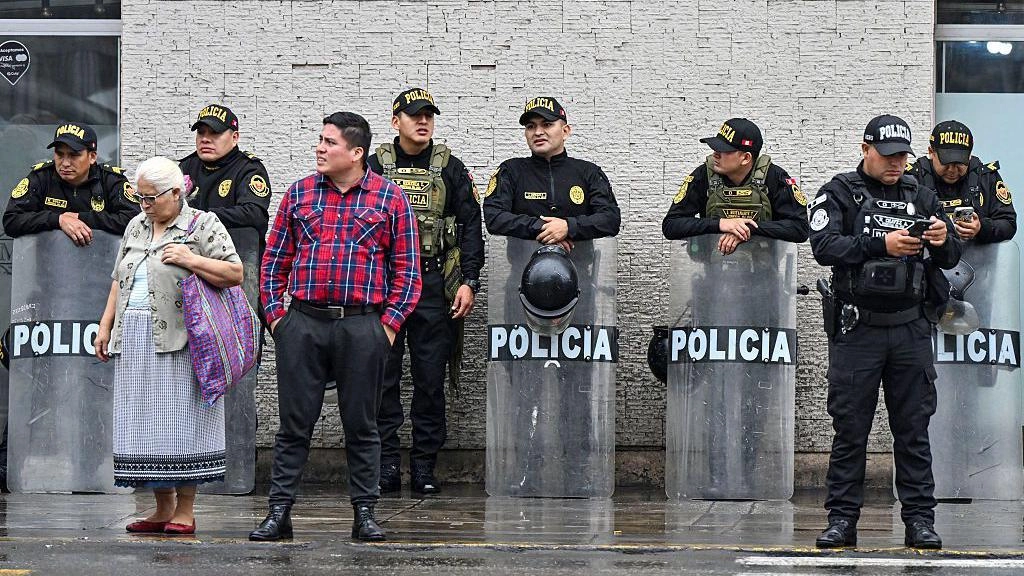
Armed police guard the entrance to the bus terminal where Toño works. According to them, this is the district of Lima most affected by extortion.
Toño, who now drives accompanied by armed plainclothes police for his protection, wants whoever the next president is to have a “tough hand against crime.”
According to an independent crime and violence observatory, 239 drivers were killed last year.
"I have never been so afraid to leave my young children. If I had money, I would leave the country," she says.
Eiffel Calla, head of security at the terminal, points out that five drivers from his company have been attacked: one died and another was left in a vegetative state.
Fear of insecurity has led other Latin American nations to lean to the right in recent elections, boosting leaders who promise tough law enforcement policies.
In his last campaign events, Fujimori declared “war” on extortionists and promised to deploy the army against organized crime, take control of prisons and collaborate with financial institutions to block money from extortion.
The weight of the past
Keiko has invoked the memory of her father, Alberto Fujimori – president between 1990 and 2000 – whose heavy-handed policy led to his imprisonment for human rights violations.
However, his supporters remember him for having established order in the country and stabilized the economy.
At a Fujimori rally, one of his supporters named Piero says that a tough policy against insecurity is greatly needed in current times and describes Peru as a country overwhelmed by crime.
Another supporter, Janeth, states: “For economic stability, we elected Keiko Fujimori.”
Despite having gone through eight presidents in the last decade, the Peruvian economy has remained relatively stable. The country is a major exporter of key minerals and metals, such as copper.
Fujimori's supporters contrast his free-market approach and his promise to attract more American investment with Sánchez's proposals: reviewing mining contracts, increasing certain corporate taxes, raising the minimum wage and giving the state greater control over natural resources; ideas that have disturbed the financial markets.
He argues that the wealth derived from Peru's natural resources does not reach ordinary people or the communities—often rural—where much of the mining activity is concentrated.
His followers, like María Elena Linares, disagree with the idea that his policies will cause economic instability.
"We are going to nationalize, but we will also accept foreign countries that want to contribute to our nation. Don't believe in this negative idea that communism scares away foreign investors; they are totally wrong!" she insists.
“Our raw materials, our gold and our copper go to other countries… we live in misery.”
More instability?
Raúl supports Sánchez's plans to expand the role of the State and hopes that this will attract more investment not only in health and education, but also in infrastructure outside the big cities.
Sánchez has also promised to free former left-wing president Pedro Castillo, who was jailed in 2022 after trying to dissolve Congress and govern by decree to avoid an impeachment process.
On Friday, a judge ruled that Sánchez could be tried for alleged undeclared campaign funds from regional elections held between 2018 and 2020. He denies the allegations and is expected to appeal the decision.
Fujimori was also under investigation for years for allegations related to campaign finance, charges that were dropped last year. However, he spent almost a year and a half in preventive detention between 2018 and 2020.
No party has a majority in the Peruvian Congress—which has led to frequent presidential impeachment proceedings—although Fujimori's party has the largest minority bloc.
Many Peruvians are exhausted by this instability.
Last year, protests broke out led by Generation Z, whose young people argued that the State was failing to combat crime, corruption and inequality.
Those under 30 represent about a quarter of the Peruvian electorate, and many of those who protested do not believe that either candidate can achieve real change.
Consuelo, 21, is vice president of the Student Federation of the Pontifical Catholic University of Peru and describes a “political exhaustion” with respect to the “political class.”
She feels that choosing between the final two options in Sunday's vote is tantamount to choosing the “lesser evil.”
However, he is concerned about Fujimori's promise to replicate some of his father's policies.
“Talking about Fujimorism is talking about authoritarianism, and that is something that for many students represents enormous fear.”
Another student, Cielo, 23, has participated in “anti-Keiko” protests, despite the fact that crime is one of her main concerns after her family suffered extortion in their small business.
The young vote
Álvaro, 22, comments that his preferred candidate did not make it to the final round, but that he would vote “judiciously” for Sánchez to prevent Fujimori from coming to power.
“I would like a more modern right,” he says, “with free market values, but represented by someone who is not so revanchist and who wants to work for Peru.”
What these students share with the most passionate supporters of both sides is the desire for instability to end so that policies against crime, corruption and inequality can truly be implemented.
However, in the absence of a majority party in Congress and with two candidates located at opposite ends of the political spectrum, many analysts consider that this scenario still seems distant.
José Luis Pérez Guadalupe, Minister of the Interior between 2015 and 2016 and professor at the Universidad del Pacífico, points out that the “great polarization” implies that, “whoever wins, it will be difficult for them to carry out their plans.”
"We have had eight presidents in ten years, twenty-four justice ministers and thirty-two interior ministers. It is a very high volatility."
It is not surprising, then, that many Peruvians share Consuelo's frustrated opinion: “Whether Fujimori wins or Sánchez wins, we know that there will most likely be a lot of instability.”